
 All Posts By Presser
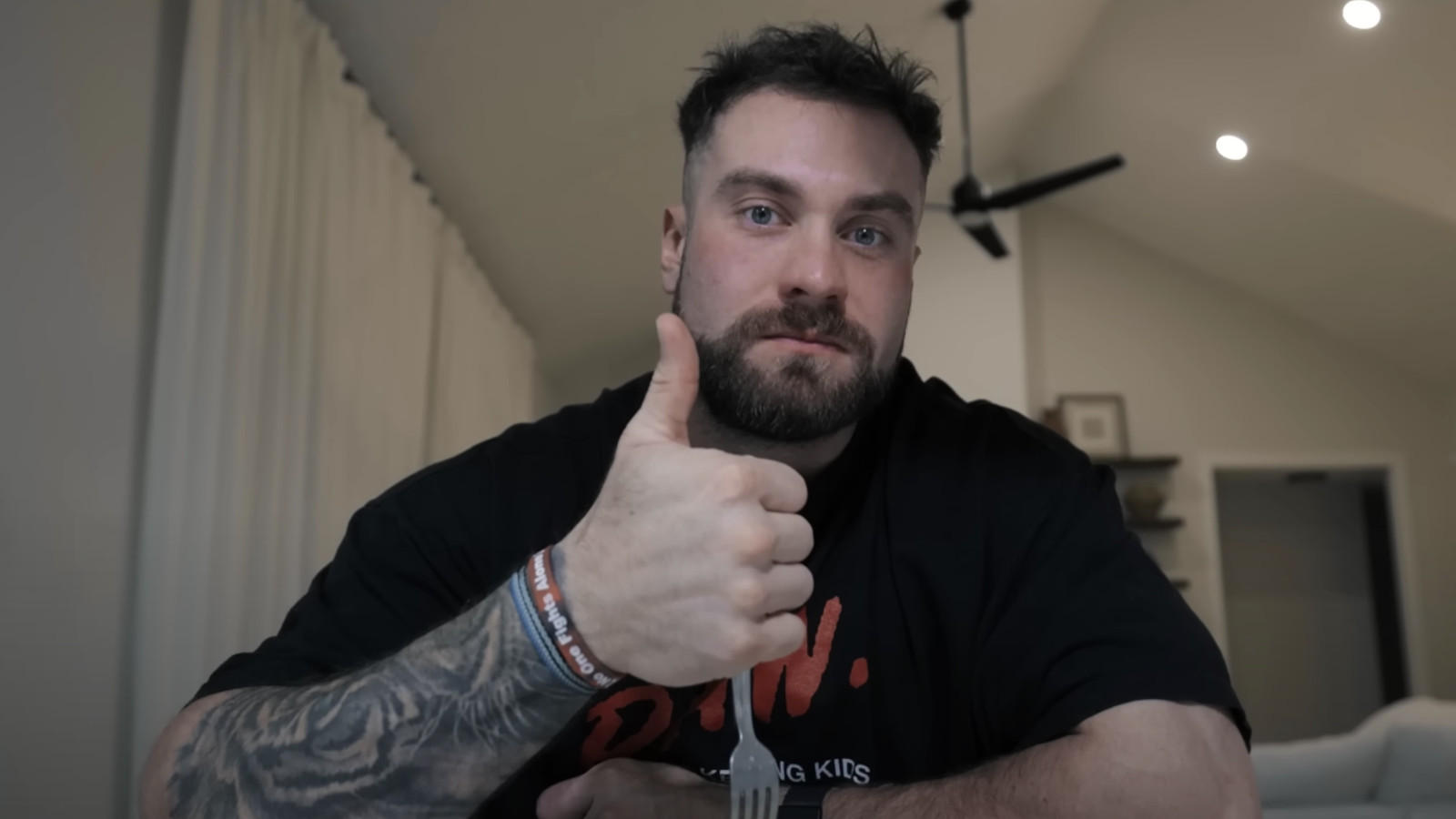
Bodybuilder Chris Bumstead Shares His Revamped Off-Season Diet for 2023
Reigning Classic Physique Olympia champ Chris Bumstead has won four consecutive titles from 2019 to 2022. Of course, besides the stellar posing this division requires, his diet has also played a massive part in garnering those victories.
In a full day of eating video uploaded to his YouTube channel, the champ shares how he’s changing his diet for the off-season in order to be better than ever for the 2023 Olympia. Check it out below:
[Read More: The Best Protein Intake Calculator for Muscle Gain and Fat Loss]
Chris Bumstead’s 2023 Off-Season Diet
Since this video was filmed at the beginning of Bumstead’s off-season, he’s currently eating a relatively low amount of calories — around 3,500 a day — compared to the later stages of the season. He says he weighs around 253 pounds consistently at the moment, so he plans to increase his daily calories by about 400 in a few weeks if his weight doesn’t change.
That being said, he intends to keep his calorie intake lower overall this off-season compared to previous years — he upped his calories to 5,000 in 2022 — to stay lean and avoid gaining fat.
Below is how a full day of eating for the four-time Olympia champ looks during the 2023 off-season:
Breakfast/Meal 1
Bumstead’s typical breakfast is a fruit smoothie during the weekdays, while weekends include waffles made by his fiance, Courtney King.
[Read More: The Best Supplements for Muscle Growth]
The weekday smoothies contain protein, fruits, fiber, and healthy fats. Here’s the full rundown:
Bumstead also has toast with butter and honey for breakfast. All in all, it includes:
Two slices of Ezekiel sprouted grain bread
Ghee butter
Honey
The total nutrition targets for the food above are:
Calories — 1,073
Protein — 59 grams
Fat — 47 grams
Carbs — 101 grams
Meal 2
His second meal combines complex carbohydrates, protein, and (of course) ketchup for flavoring:
Sweet potato — 250 grams
Ground turkey — 180 grams
Ketchup
In the champ’s opinion, ground turkey tastes better with sweet potatoes, and chicken goes better with rice. The total calories and protein for his second meal of the day are:
Protein — 40 grams
Calories — 481
Meal 3 — Pre-Workout Meal
Bumstead gets his third meal of the day from MegaFit Meals. This is a pre-workout meal designed to give him a boost before training. It contains:
Beef — 180 grams
Brown rice pasta
Marinara sauce
“It’s the easiest way to get in a bunch of calories,” Bustead says of the meal. “The perfect way to build in the off-season and a beautiful pre-workout meal.”
[Read More: Best Home Gyms for the Money]
The total calorie and macronutrients for Bumstead’s pre-workout meal are:
Protein — 40 grams
Carbs — 74 grams
Fat — 14 grams
Calories — 600
Meal 4 — Post-Workout Meal
Bumstead’s post-workout meal contains 706 calories, and it’s one that he enjoys because he says it reminds him of eating a burger without indulging in too much fat. Though Bumstead didn’t list the exact macros for this meal, here’s what it included:
Ground Bison Patties — 200 grams
White Rice — 250 grams
Ketchup
Meal 5
Bumstead notes that he used to have protein shakes before bed, but they caused too much bloating. So instead, his final meal of the day is a mix of protein, complex carbs, and healthy fats:
Chicken breast — 180 grams
White rice — 200 grams
Olive oil — 20 grams
Bumstead’s Total Calories
Here’s the macro breakdown of Bumstead’s entire day of eating:
Carbs — 369 grams
Fat — 121 grams
Protein — 240 grams
Calories — 3,559
Even though he’s still early into the off-season, Bumstead acknowledges that he’s eating these meals every day and rarely strays into junk food territory.
In closing, he left viewers with one simple piece of advice: “The moral of the story today is to eat healthy foods and give your body the fuel it needs to thrive.”
The Latest Bodybuilding Stories
Keep up with the latest bodybuilding stories from BarBend below:
Featured Image: Chris Bumstead on YouTube
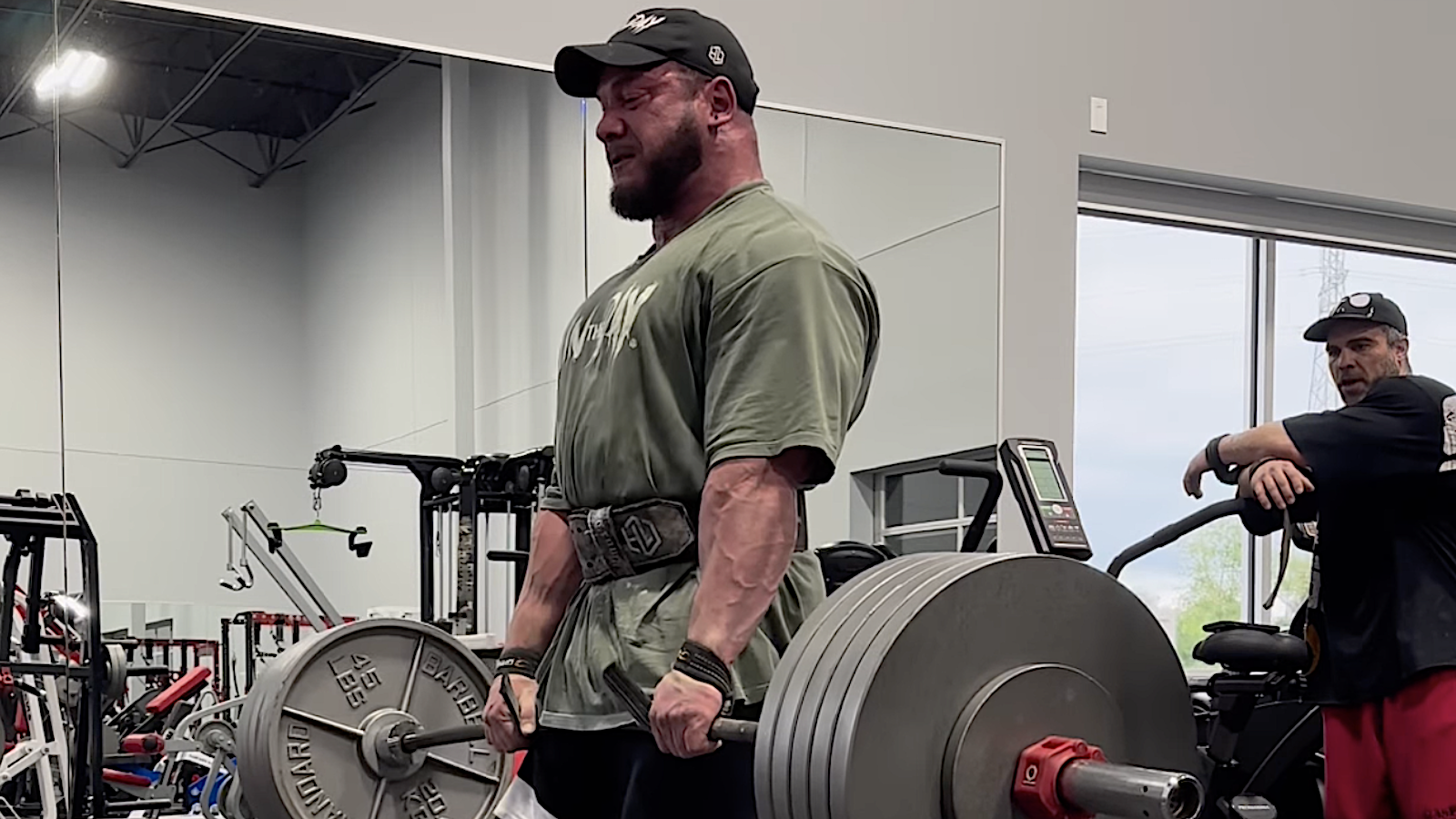
Hunter Labrada Breaks Down Techniques of His Pull Day
Men’s Open bodybuilder Hunter Labrada fell short of the top sixth at the 2022 Olympia. He’s working this off-season to climb the Olympia ladder to compete against the top in the division, such as Hadi Choopan, Derek Lunsford, and Nick Walker, again. To do so he will have to win a pro show during the 2023 season.
Labrada feels one way to improve his physique is by thickening his back musculature and deepening their separation. He uploaded a YouTube video to his channel on April 2, 2023, breaking down training cues for his back and hamstrings day. Check it out below:
[embedded content]
[Related: How 3-Time Bikini Olympia Champion Ashley Kaltwasser Eats on Show Day]
Hunter Labrada’s Pull Workout
Here’s a breakdown of the back and hamstring exercises Hunter Labrada performed:
Warm Up — Face Pulls
Before getting into the pull movements, Labrada warmed up his shoulders via face pulls. He used straps as the handles to enable external rotation to target the rear deltoids. The external rotation should happen at the shoulders, not from the core or by moving the rib cage up.
Unilateral Pulldown
Labrada thinks it’s best to target the lower lats unilaterally, hence unilateral pulldowns. This movement can be done on a cable pulldown or Nautilus machine.
Pull the elbows straight down to the hips (not back) to engage the lower lats. Exertion for this movement is high. Labrada recommends resting before switching sides.
Unilateral Machine Seated Row
This exercise was done on a PRIME machine, targeting Labrada’s lower lats. “Think about keeping shoulder depression the whole time,” Labrada advised. “When we’re rowing, doing pulldowns, or anything targeting the lower lats, create an arching motion with our humerus.”
Rack Chins
This exercise is performed on a Smith machine with legs straightened and propped up on an incline bench, mimicking a wide-grip pull-up. Labrada believes rack chins are more effective than pull-ups for targeting the upper back because the legs are stabilized on the weight bench to keep the body upright, preventing the involvement of the lats.
Labrada incorporated a mechanical drop set on the second set. To do this, his training partner lowered the incline of the bench to flat. Having Labrada pull his weight up on the Smith machine while his legs are resting on a flat bench allows Labrada to eke out a couple more reps.
Any upper back work, whether it be a pulldown or a row, all we’re after is full protraction and retraction.
Labrada aims to raise the shoulder girdle as high as possible for protraction to get the scapula and elbows retracted down and back. This allows the traps, teres, and other back muscles to fully spread and contract.
Seated Machine Row
Labrada moved to bilateral movements and performed the seated row on a Magnum machine. Labrada remarked:
When I say protract on this one, I don’t mean to let your spine flop over. Your spine is beyond rigid and braced the whole time.
Labrada added another intensity set to this exercise by combining a rest-pause and drop set. He took a small break between sets, lowered the weight, and did as many reps as possible.
Lying Hamstring Curls
Labrada added lying hamstring curls to his routine to prime his hamstrings for deadlifts since they activate during the eccentric. Labrada’s tip is to treat these like preacher curls.
We’re trying to keep our hips, knees, and ankles straight with the pit of our knees.
The elbow and knees are hinge joints — they only move one way; not meant to move laterally. So the legs should be narrower than shoulder-width, and the ankles should be dorsiflexed — raising the foot towards the shin. Once the feet flare inward or outward, the knees are out of alignment.
Labrada thinks about driving his hips down to the bench and keeps his quads in contact with the pad. The shoulders are down and back, the hands firmly grasp the handles, and the lats engage to pull oneself into the pad to prevent the opposing weight from jerking the lifter back.
Barbell Deadlifts and Hyperextensions
To conclude his pull-day workout, Labrada hit deadlifts and hyperextensions. On the hypers, getting the hamstrings and glutes involved more than the lower back is the goal. To do this, Labrada sets the pad on the machine low — below the hips — to keep them mobile. Think about keeping the hips forward and driving the knees into the padding.
Hunter Labrada used wrist straps throughout his workout to pull heavier weights without worrying about grip as a limiting factor. Labrada typically does two pull workouts weekly — one back and biceps and one back and hamstrings. We’ll see if his back improvements help him capture another pro win and qualification to the 2023 Olympia.
Featured image: @hunterlabrada on Instagram
The Best Ab Rollers For Beginners, Non-Slip, And More
Ab rollers can be key in targeting ab muscles, as well as lesser-used core muscles. At the most basic level, the ab roller motion requires you to roll out on the roller from a quadruped position into a knee plank, and then roll back using your core to power through it all. Some athletes love ab rollers because they provide an awesome workout and target multiple muscles all at once. But since they require practice and stability to use properly, many people shy away from them and opt for more basic sit-ups or planks instead. Once you overcome the intimidation factor though, these devices can help you work deep muscles you may not be able to reach with just your bodyweight.
The core is a lot more complex than what many give it credit for. For example, a lot of beginners think the core is just the rectus abdominis (abs), but it’s actually the whole musculature of the torso. Ab rollers force you to move through a range of motion that requires multiple core muscles to engage, promoting a strong, neutral torso. They may appear simple in design, but not every ab roller is created equal. We’ve tested and reviewed some of the best ab rollers on the market for multiple purposes, and put them right here on this list for you to use on your own personal hunt.
Best Ab Rollers
Best Ab Roller Overall
Sometimes all you need to make a solid ab roller is quality manufacturing. Simple but effective, this pick’s durability goes beyond what you would typically find in a basic sporting goods store ab roller.
Rogue Ab Wheel
The Rogue Ab Wheel has a nickel-plated steel shaft and durable rubber tire tread that aid with stability and grip on most surfaces. The wheel’s edges are slightly rounded, which challenges you to hold steady on rollouts and avoid turns to better engage your core. While more durable than basic plastic rollers, this pick is still compact, lightweight, and portable.
Rogue Ab Wheel
The Rogue Ab Wheel is compact, lightweight and portable, and has a nickel-plated steel shaft and rubber tire tread that provides solid stability and grip.
Its 1.25” diameter and rubber handles provide texture for a steady grip, allowing you to focus on working your core, hip flexors, back, shoulders, thighs, and more.
Who Should Buy The Rogue Ab Wheel
Athletes looking to level up from a more basic plastic ab roller.
Users who want a sturdy nickel-plated steel shaft and rubber wheel.
Anyone who wants a durable ab roller that can stand the test of time.
Who Shouldn’t Buy The Rogue Ab Wheel
Customers looking for a cost-effective ab roller — this one is more expensive than most.
Anyone looking for a large ab wheel may want to check out other options on this list.
While a little pricier than your average ab roller, the Rogue Ab Wheel is made of high-quality steel and rubber that is built to challenge your core and last throughout years of usage.
Best Ab Roller for Beginners
When you’re just starting out, you’re going to want a roller that’s simple, stable, and easy to use — and it wouldn’t hurt if it came with an instruction manual. This pick nails it with all of these aspects and also dishes out durability that doesn’t usually come with rollers in this price range.
Fitnessery Ab Roller
The Fitnessery Ab Roller is not only a high-quality roller at a low price point, but it also comes with an e-book of workouts you can do with your ab roller, so newbies aren’t left wondering how to use the device.
Fitnessery Ab Roller
This is a high-quality roller at a low price point, and also comes with an e-book of workouts you can do with your ab roller. It’s made of durable stainless steel and non-slip rubber and PVC, and comes with a lifetime money back guarantee.
It’s also space efficient with a maximal width of 11 inches, which is small in comparison to the average 15-inch rollers on the market — but its wheel is thicker than most, which is great for first-time users. It’s made of a durable stainless steel and non-slip rubber and PVC, and comes with a lifetime money back guarantee, which is a great fallback perk for those just starting out.
Who Should Buy The Fitnessery Ab Roller
Beginners who prefer an ab roller that comes with an exercise guide e-book.
Anyone who wants a roller with a steel shaft and textured wheel for stability and grip.
Those who want a compact wheel they can store easily when it’s not in use.
Folks who are looking for a reasonably priced ab roller.
Who Shouldn’t Buy The Fitnessery Ab Roller
Anyone looking for a seamless rollout — the rollout does not feel as smooth on this roller as it does on some other rollers.
Those who want more of a challenge will want to look for a thinner wheel for more side-to-side difficulty.
The Fitnessery Ab Roller is a solid choice for novices who need the extra guidance of an e-book, as well as anyone who just wants a solid roller at a low price point.
Best Ab Roller Pair
The benefit of using a pair of ab rollers is that having a roller in each hand allows your arms to be spread wider, which in turn, activates more of your core. This lightweight pick can help advance your core exercise routine.
Amazon Basics Exercise Fitness Ab Rollers
Though straightforward, this pair of Amazon Basic Exercise Fitness Ab Rollers can challenge your stability even more than a single ab roller can. Simply roll your arms wider as you roll out for more of a challenge, and once your strength improves even more, you can advance your rollouts further to just using one arm at a time.
Amazon Basics Exercise Fitness Ab Rollers
Amazon Basic Exercise Fitness Ab Rollers will challenge your stability more than a single ab roller — just roll your arms wider as you roll out for more of a boost.
Each roller measures 7.9” x 15.8” x 5.7” inches and weighs 2.6 pounds, so you can bring them with you in a gym bag or just throw them in an equipment closet in your home gym when your workout ends. This pair is fairly inexpensive, and its black and blue polypropylene and nitrile butadiene rubber build will look great and last for a long time to come.
Who Should Buy The Amazon Basics Exercise Fitness Ab Rollers
Athletes who want to progress their ab roller workouts to a more challenging level.
Anyone who wants to try working one arm at a time.
Users who are looking for a cost-effective roller option.
Who Shouldn’t Buy The Amazon Basics Exercise Fitness Ab Rollers
Beginners who just want to try their hand at using one ab roller without advancing to two just yet.
Anyone who wants an ab roller with treaded grip on the wheel will want to look at other options on this list.
While an ab roller pair may not be for everyone, it’s a great option for users who want to advance their routine or try using one arm at a time — plus, this particular pair looks sleek, too, with its bright blue and transparent rubber wheels.
Best Ab Roller Kit
While ab rollers are great for core work, they can also be used for other resistance training if you have the right tools. This particular ab roller pick comes with six different tools you can use with or without your ab roller.
EnterSports Ab Roller Wheel
The EnterSports Ab Roller Wheel is a great standalone tool you can use to work your core, but pair it with resistance bands or push-ups and you can get a full-body workout, as well. Luckily, this ab roller comes with two resistance bands, two push-up handlebars, and a knee pad to elevate your session.
EnterSports Ab Roller Wheel
This ab roller comes with two resistance bands, two push-up handlebars, and a knee pad that you can use with or without your ab roller to elevate any workout session.
While all of these tools can be used to advance the core work you are already doing with your roller, if you hook the resistance band under your feet and around the ab roller, and hold the roller by the handles, you can also work your upper body with curls or lower body with resistance band squats. This all comes at an extremely reasonable price for all six products — if you’re looking to build out your home gym with a bunch of equipment in one go, this is a great pick for you.
Who Should Buy The EnterSports Ab Roller Wheel
Anyone who is looking for more than just an ab roller to build out their home gym.
Athletes who want to advance their ab roller workouts with resistance bands or push-up handlebars.
Customers looking for a good bit of equipment at a reasonable price.
Who Shouldn’t Buy The EnterSports Ab Roller Wheel
Users who just want to buy a straightforward ab roller without any extra frills.
Anyone who already have resistance bands may not need the ones that come with this wheel
For a reasonable cost, you can get an ab roller, two resistance bands, push-up handlebars, and a knee pad all in one — if you’re working toward having a full set of gym equipment at home, this is a great way to check multiple boxes at once.
Best Non-Slip Ab Roller
If you’re the type who’s concerned about catching the tile the wrong way and slipping mid-rollout while you’re using your ab roller, this pick is for you. With a wider wheel and additional resistance and assistance during movement, this roller provides optimal stability while in motion.
Perfect Fitness Ab Carver Pro Roller
Unlike normal ab rollers, the Perfect Fitness Ab Carver Pro Roller has a couple of unique construction traits that help with stability. There’s an internal spring that provides additional resistance as you roll out, and assistance as you roll back, making slipping virtually impossible.
Perfect Fitness Ab Carver Pro Roller
This ab roller has an internal spring that provides additional resistance as you roll out, and assistance as you roll back, and it comes with a wide wheel for extra stability.
Additionally, the wheel is designed with ergonomic friendly handles and a wide wheel so you have more coverage on the ground as you roll, increasing stability. Plus, this pick comes with a knee pad and a downloadable 21-day workout plan for guidance.
Who Should Buy The Perfect Fitness Ab Carver Pro Roller
Anyone who wants a wider wheel for more stability on the ground.
Athletes who want an internal spring that provides more resistance and assistance during motion.
Those who want a roller that comes with a knee pad and/or workout plan.
Who Shouldn’t Buy The Perfect Fitness Ab Carver Pro Roller
Customers looking for a cost effective ab roller option.
Folks who want a compact roller they can bring on the go with them.
Though larger than some other ab rollers, the wide wheel on this roller allows for more stability, and the internal spring adds resistance on the rollout and assistance on the roll back for a thorough and safe workout.
Benefits of Ab Rollers
These deceptively simple but brutally effective pieces of equipment have fairly straightforward benefits. They’re used to enhance the strength and stability of abdominal muscles which is their main focus, but ab rollers may also help develop the upper body muscles of the chest, shoulder, triceps, and even back from stabilizing yourself throughout the range of motion.
Image via Shutterstock / Olena Yakobchuk
Improving your abdominal stability can possibly aid in athletic performance, heavy lifting, and everyday life making these very useful yet affordable pieces of equipment. Progressing the difficulty is rather easy with just a weight plate or weighted vest. You can also make the movement easier by using bands for assistance or rolling on your knees instead of planked.
How We Chose the Best Ab Rollers
Though there are many similar ab rollers on the market, there are small nuances that help differentiate between rollers. For this reason, we carefully curate our top picks by assessing two characteristics: construction and performance.
Construction
The first characteristic we assess with ab rollers is their overall construction. More specifically, we look at three components that all need to be high quality to ensure durability and functionality in a roller: the wheel, the handles, and the shaft.
The summation of these three construction components can separate a great ab roller from one that will break down quickly. For example, you want a shaft that is made of steel, and designed to withstand continual stress to ensure there’s no bending. Also, wheels should have a sturdy construction and outer texture for grip. All of these details factor into our construction assessment, and therefore, no roller on this list comes poorly constructed.
Performance
The performance assessment of the ab roller helps us decide which groups of athletes would benefit most from each pick. From a macro view, all ab rollers will perform similarly, but tiny details make them better for certain types of athletes. For example, resistance wheels are ideal for advanced fitness enthusiasts who need a little extra resistance to work their core. These athletes can also benefit from kits that come with more equipment to incorporate into their workouts.
Image via Shutterstock / George Rudy
Larger wheels are best for beginners who are learning the movement, and easing into the full range of motion. But textured wheels are great for pretty much anyone because there is less slippage, and you can use them on virtually any surface. These are only a few ways we assess the performance of every ab roller, but you’ll find a variety of these characteristics on this list to ensure we have something for each type of athlete.
How Much Do Ab Rollers Cost?
Ab rollers are rather inexpensive pieces of equipment that provide a great benefit for anyone looking to improve their abdominal stability and strength. Compared to ab machines and other larger or more expensive ab devices, ab rollers may seem simple. That helps to keep the price down compared to other ab training tools.
Best Ab Roller Overall
Rogue Ab Wheel
$75.00
Best Ab Roller for Beginners
Fitnessery Ab Roller
$30.99
Best Ab Roller Pair
Amazon Basics Exercise Fitness Ab Rollers
$29.99
Best Ab Roller Kit
Entersports Ab Roller Wheel
$39.99
Best Non-Slip Ab Roller
Perfect Fitness Ab Carver Pro Roller
$39.99
You can snag ab rollers for pretty cheap — as little as about $30 though they do go on sale sometimes so you may be able to pick one up for even less. Some other more expensive ab rollers have upgraded features like textured wheels for better grip, padded handles for comfort, and bearings for smoother rolling. They can cost up to around $75 though most are in the range of $40 to $50.
What to Consider Before Buying Ab Rollers
While ab rollers may seem fairly straightforward, you’ll still want to consider things like your personal workout routine and fitness level before deciding which ab roller to get. To understand what we mean, read on.
Workout Styles
Everyone’s fitness routine varies to some degree. Whether you love pilates and low impact work, or you are sprinting on the treadmill and hitting those heavier weights, incorporating an ab roller into your routine can be beneficial. However, if you’re using your roller daily or on rough surfaces, you’ll obviously want one that is more durable. On the other hand, if you are using your ab roller only on occasion and on smooth surfaces, you can get away with a less expensive option that’s a little less durable.
Image via Shutterstock / Beauty Stock
You should also consider if you want accessories to come with your ab roller or not. Many ab rollers come with a knee pad at the very least, and some even come with resistance training equipment. If your workout style will benefit from a kit, you’ll want to opt for that instead, as you will most definitely get more bang for your buck in that case.
Level
If you’re a beginner, you are going to want to hunt down a different ab roller than someone with more advanced technique. Beginners will want a larger wheel with good grip that helps with stabilization, while more advanced athletes may want something more narrow that challenges their core significantly. Before you just grab the best looking roller or the cheapest option, toss your fitness level into consideration and grab the roller that will help you progress the most.
Final Word
Ab rollers can be a great tool for building a strong and resilient core. From ab rollers that come in full kits, to ab roller pairs, there are plenty of functionalities to choose from on today’s market. What’s great about ab rollers is that truly every level athlete can find one that will work for them.
Like every piece of equipment though, it’s always wise to assess what you want and need most in your roller and compare from there. And overall, let this list be your guide as you get rolling.
FAQs
I’m a beginner, what type of ab roller should I buy?We’d advise looking for a roller with cushioned handles, a wheel with rubber tread, a wheel that is slightly larger, and maybe even an option that comes with an exercise guide to help learn the movements. All of these components can be useful to help ease you into using ab rollers more fluidly.
How much do ab rollers cost?Ab rollers are fairly inexpensive, especially for how effective and difficult they can be. You can pick a cost-effective roller up for around $30 though sometimes they’re even less than that. On the high end, ones with bearings, padded handles, or treaded wheels can cost anywhere from about $50 to $75.
Is an ab roller bad for the back?Every exercise when done incorrectly can come with inherent risk, and the ab roller is no different. We suggest performing rolls at your own pace, judging your range of motion on your personal strength abilities. If you cannot achieve a full roll out right away, then start small and work toward it.
Can an ab roller get me a six-pack?An ab roller, a balanced diet, and a consistent workout plan can all help you achieve more definition. Instead of thinking about one piece of equipment, think about the bigger picture and how a roller can be a tool to help you get there.
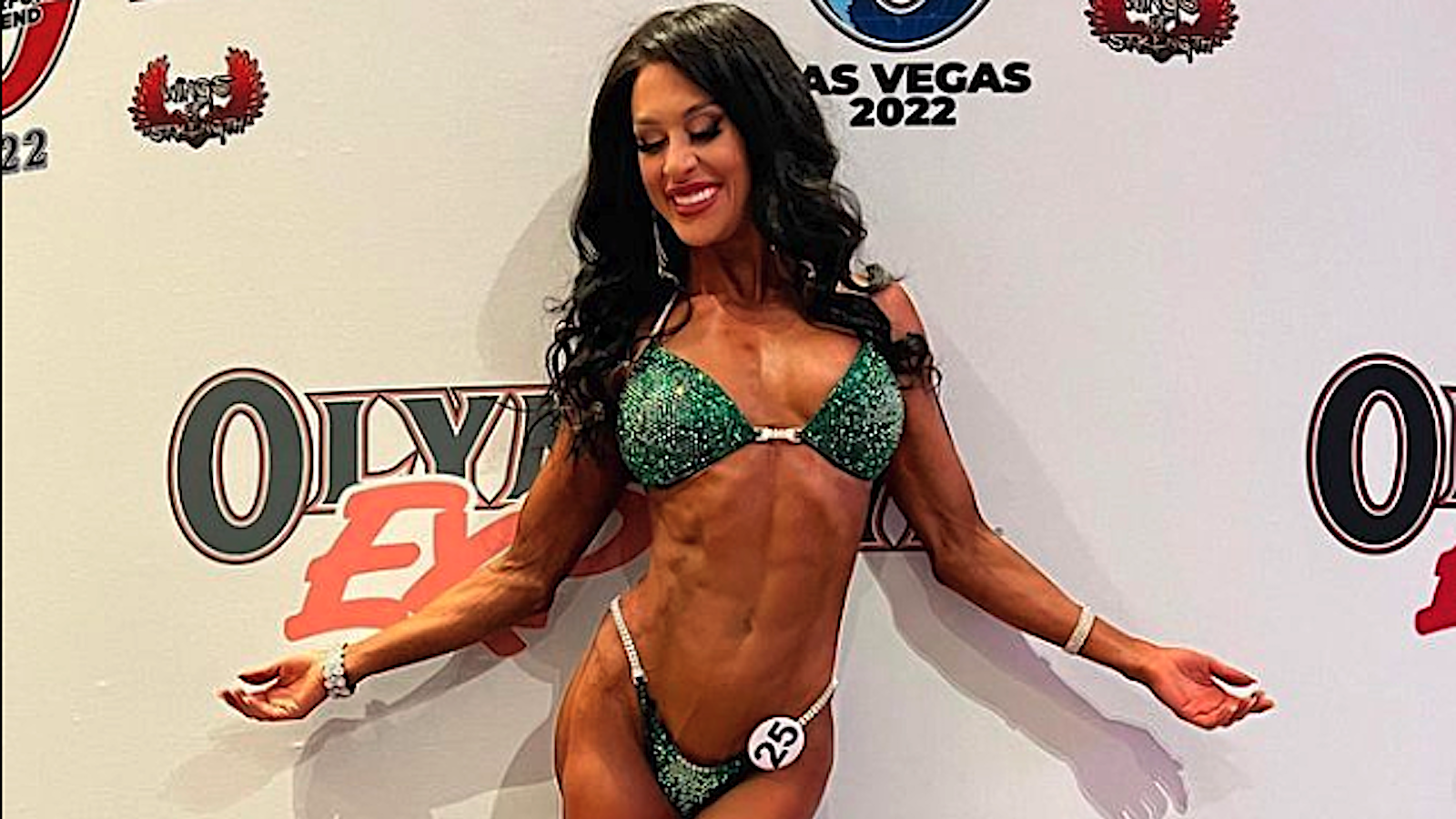
How 3-Time Bikini Olympia Champion Ashley Kaltwasser Eats on Show Day
An example breakfast for Kaltwasser on show day is cream of rice with coconut oil, cinnamon, and a sprinkle of sugar because “extra carbs on show day is great.” Throughout the day, she’ll snack on flavored rice cakes, sunflower seed butter, and sugar-coated nuts — all foods that don’t sit in her stomach when she needs to feel light walking on stage.Kaltwasser avoids carbonated beverages to avoid bloating but is conscious of staying hydrated and does drink coffee — she flashed a large Dunkin’ Donuts cup onscreen. Kaltwasser will pour electrolyte powders into her liquids to keep her muscles full and prevent cramping.Kaltwasser has only competed once in 2023 as of this article’s publication: a fourth-place finish at the 2023 Bikini International. As a former Bikini Olympia champion, she has a lifetime qualification for the Bikini Olympia.Since Kaltwasser doesn’t weigh the Olympia as heavily as competing consistently, we will likely see her on the competitive stage several times before the 2023 Olympia on Nov. 2-5, 2023, in Orlando, FL.

10 Facts on how bad COVID Was for the Fitness Industry
Key Statistics about COVID 19 Pandemic Nearly 60% of US gym membership holders are considering canceling. Post COVID-19, 59% of Americans have not renewed their gym memberships. 59% of lifetime gym membership holders will not renew their gym memberships. According to the NHFA, a whopping 22% of American gyms have closed down post COVID-19 pandemic,…
Best Dip Belts for Comfort, Value, and More
The dip, sometimes called the upper-body squat, is a favorite among lifters across many different disciplines — and for good reason. This ever-reliable exercise works your chest, shoulders, and triceps hard. For those who don’t know the exercise, it is usually done by holding yourself upright on dip bars, arms aligned with the body, and hands on the bars. The motion involves lowering until elbows just about break ninety degrees before pressing back up to the starting position; that’s one rep. Once body weight alone is easy to lift, you may be in the market for a dip belt.
Dip belts wrap around your lower torso, resting against your lower back, and have a chain or strap around the front that attaches to various weights like plates, dumbbells, kettlebells, or a willing partner. The array of dip belts available on the market is pretty expansive (with leather, nylon, neoprene, and other options), so let’s slowly lower ourselves into the best dip belts on the market and rise up with the right one for you.
Best Dip Belts
Editor’s note: The content on BarBend is meant to be informative in nature, but it should not be taken as medical advice. The opinions and articles on this site are not intended for use as diagnosis, prevention, and/or treatment of health problems. It’s always a good idea to talk to your doctor before beginning a new fitness, nutritional, and/or supplement routine. Individual needs for vitamins and minerals will vary.
Best Dip Belt Overall
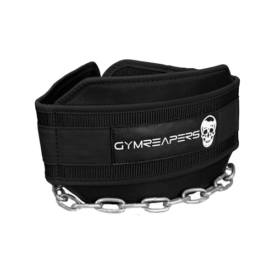
Dip belts are a great tool for adding extra resistance to — you guessed it — dips. They can be used for more than that with the right design, and some are definitely more functional and comfortable than others. This one hits all the right notes, making it our top overall pick. Meet the Gymreapers Dip Belt.
Gymreapers Dip Belt
Not only is this dip belt tough, but it’s comfortable to wear too. Instead of pinching leather that most dip belts are made from, this belt is made from contoured neoprene with padding in the back for extra support under heavy weights. To hold the weight, Gymreapers has an adjustable, heavy-duty, 30-inch steel chain with an enlarged carabiner for easy clipping.
Gymreapers Dip Belt
If you want both comfort and heavy-duty support in your dip belt, look no further than the Gymreapers Dip Belt. Available in three colors, Black, Red, and Ranger Green, this belt is made to last with contoured neoprene and back padding for comfort.
Pick out your favorite color — Black, Red, or Ranger Green — and elevate your dip, pull-up, and chin-up game for about $39.99 before tax with free Prime shipping.
Who Should Buy the Gymreapers Dip Belt
Those who want their dip belt to last a long time. A steel chain and high-quality neoprene ensure this belt can stand up to heavy use.
Athletes who want an adjustable dip belt to accommodate those of different heights.
People who are keeping their budgets tight. This dip belt is reasonably priced, especially for its high-quality build.
Who Shouldn’t Buy the Gymreapers Dip Belt
Those who prefer a leather dip belt will want to look elsewhere.
Anyone who doesn’t want the noise of a steel chain may want to opt for a fabric or leather-only option with no chain.
People who are very large or very small may not fit comfortably in this as it is a one-size-fits-most belt.
Reasonably priced and extra-padded for comfort, this dip belt features a heavy-duty chain for supporting max weight. Plus, it comes in an easily washable neoprene material. What’s not to like about this dip belt? If you’re in the market for one, we think it’s definitely worth your consideration.
Most Comfortable Dip Belt
Comfort is important when it comes to lifting gear, especially with dip belts. Nobody wants to feel their skin being scraped or pinched every set. This belt excels in comfort thanks to the placement of its dual carabiners and extra padding.
Hypeletics Weighted Dip Belt
On top of being a well-padded dip belt to achieve a level of comfort that could sway the decisions of athletes who intend to lift rather heavy, this dip belt is versatile. Hypeletics features two carabiners, one on either side of the hips, for added comfort and stability when weight is on the belt. This tough belt can hold up to 270 pounds of weight which is way more than most people will need. It has the capacity to double as a squat belt by using a carabiner to cinch the waist clips together.
Hypeletics Weighted Dip Belt
A reinforced high-grade neoprene belt with a 40-inch strap capable of supporting six Olympic sized plates. The soft padding is positioned intentionally to prevent the belt from digging into your sides.
In addition to being a comfortable piece of gear, it has quite the waist range it can fit. Anyone with a waist over approaching 38 inches is still within range of what this belt can safely accommodate. Pick up your favorite of six different color options with options like Pink Camo and Desert Digital for about $34.99 before tax with free Prime shipping.
Who Should Buy Hypeletics Weighted Dip Belt
Athletes with larger waists.
Those who want the versatility of a dip belt that can double as a squat belt.
Anyone who needs to emphasize comfort during their workouts.
Who Shouldn’t Buy Hypeletics Weighted Dip Belt
Athletes who have smaller waists and need a snug fit.
Those who want a leather dip belt.
Taller folks may want a dip belt with a shorter chain. This one is 40 inches long.
As is a pattern for a lot of the better dip belts on the market, this belt might struggle to comfortably sit on an athlete who has a smaller waist. If your waist is over 30 inches and you find a need to ease the pressure loaded from equipping weight plates to a dip belt, then this option should be in consideration for you.
[Related: Could Baking Soda Be The Best Workout Supplement You’ve Never Tried?]
Best Dip Belt With Chain
There’s something old-school and satisfying about the rattling of chains and clanging of plates in a gym that feels cool. With this dip belt, you’ll have exactly that with a solid 30-inch chain to support heavy dips and pull-ups.
Gymreapers Dip Belt
The chain on this dip belt is made from steel and is 30 inches long — though you can adjust it with the oversized carabiner to nearly any length that suits your needs. Doing belt squats? Maybe you need it shorter for a better range of motion. Dips or pull-ups? Longer might be better to stabilize the plate with your feet more easily.
Gymreapers Dip Belt
If you want both comfort and heavy-duty support in your dip belt, look no further than the Gymreapers Dip Belt. Available in three colors, Black, Red, and Ranger Green, this belt is made to last with contoured neoprene and back padding for comfort.
Gymreapers made their dip belt comfortable too with padded and contoured neoprene around the back, which can help when you start adding a lot of weight. Choose from your favorite of three colors — Black, Red, and Ranger Green — for around $39.99 before tax with free Prime shipping.
Who Should Buy the Gymreapers Dip Belt
Athletes who want an adjustable chain on their dip belt will like this pick.
Those who need to keep their fitness equipment on the more affordable side. This dip belt is priced well for its high quality.
People who are looking for different color options for their dip belt. You can pick from three here.
Who Shouldn’t Buy the Gymreapers Dip Belt
Athletes who are looking for a versatile dip belt. This one is decently versatile, but there are others with more versatility on the market.
Those who are on a strict budget may want to look for some more bargain options or see if their gym has one they can provide for free to use.
Anyone who wants a listed weight capacity. We suspect this belt can hold a solid amount of weight, but there isn’t a limit listed, so test at your own risk.
This dip belt combines the old-school feel of a steel chained dip belt with the modern comforts of contoured, neoprene padding for an all-around superior product. Add some extra intensity to your bodyweight movements with the Gymreapers Dip Belt.
Best Value Dip Belt
When it comes to accessory equipment for the gym, you don’t want to spend a ton of money on specialty pieces like a dip belt. Purchasing a solid one that fulfills its purpose is usually sufficient. Sometimes that same economic choice is also a top-tier piece of equipment, like in the case of the Gymreapers Dip Belt.
Gymreapers Dip Belt
This dip belt is a premium-quality product at budget-level pricing. Whether you’re new to weighted bodyweight movements or an experienced pro, this belt can accommodate your needs. The heavy-duty, adjustable steel chain is 30 inches long and makes for a top-notch product.
Gymreapers Dip Belt
If you want both comfort and heavy-duty support in your dip belt, look no further than the Gymreapers Dip Belt. Available in three colors, Black, Red, and Ranger Green, this belt is made to last with contoured neoprene and back padding for comfort.
To further improve upon the classic dip belt design, Gymreapers includes padding and a contoured design around the back and sides of the belt for added comfort — especially during higher-rep sets or when the weights get heavy. Pick up your favorite color (Black, Red, or Ranger Green) for around $39.99 before tax with free Prime shipping, and you can get to making those gains.
Who Should Buy the Gymreapers Dip Belt
Those who want to ball on a budget. This dip belt was seemingly made for it.
People who want premium features, but don’t want to pay a premium price. Padding, an adjustable chain, and a contoured fit are features we’d expect on belts double this price.
Those who are just beginning to dabble in weighted bodyweight exercises and want to start off with a relatively inexpensive dip belt.
Who Shouldn’t Buy the Gymreapers Dip Belt
Folks who might not yet be advanced or strong enough for adding extra resistance to bodyweight movements.
Anyone who is very tall may find the 30-inch chain to be too short for them to comfortably use.
Those who prefer to use leather or nylon dip belts.
The steel chain here is strong and thick, like most of our favorite lifters, and the belt itself is padded and ergonomically shaped for maximum comfort when pushing yourself with those heavy dips. For a belt that’s more on the budget side of the price spectrum, this dip belt has a ton of premium features.
[Related: The Lifter’s Guide To Magnesium: What This Nutrient Does For Strength]
Most Durable Dip Belt
When you buy a piece of equipment for the gym, you want it to last a while, so you can get your money’s worth out of it. No one wants to replace their dip belt every year, and this belt has the ability to stand the test of time. Enter the Rogue Dip Belt.
Rogue Dip Belt
You may have seen this dip belt in competition use before at the CrossFit Games. It features a 30-inch, steel chain-link system and D-shaped carabiners, which allow for a higher load capacity, easier adjustments on the fly, and a tougher overall makeup. The belt itself is made from heavy-duty and durable nylon that’s three inches in the front and four inches in the back for better load disbursement.
Rogue Dip Belt
The Hulk himself couldn’t break this dip belt with a massive 29,400-pound weight rating. That’s thanks to heavy-duty nylon and a 30-inch steel chain which attaches to two steel D-shaped carabiners.
The weight rating on this dip belt is comically high at 29,400 pounds (you read that right). So it’s safe to say it can hold your extra weight for dips or pull-ups. It comes in Black and Yellow, and is priced right around $55 before tax and shipping.
Who Should Buy the Rogue Dip Belt
Athletes who need help with weight distribution for better comfort and balance. The four-inch width across the back helps in this department.
Folks who want supreme confidence in their dip belt. Not only was this dip belt used in the CrossFit Games, but its weight capacity is off the charts.
Those who like to be seen. The high-vis yellow option ensures no one will miss you crushing your reps.
Who Shouldn’t Buy the Rogue Dip Belt
People who don’t like the rougher feel of nylon compared to neoprene.
Athletes who want color choices other than Batman and Construction Worker.
Those who are on a budget can find cheaper alternatives on this list.
This belt is built for one purpose — function — and it achieves that tremendously. It does this through high-quality and very durable materials, like nylon and steel, as well as expert construction. Anything from Rogue is expected to be of top-tier quality as that’s what the brand is known for. We don’t think you’ll find a more durable dip belt than this one from Rogue.
Benefits of Dip Belts
Dip belts can be a great addition to your training regimen. You can up the difficulty and resistance of many bodyweight exercises — not only dips, but pull-ups and any type of exercise you can creatively think up. The additional weight you’re able to afix to the belt and your body may aid in driving your strength and muscle growth further than you could with your bodyweight alone. Some people use dip belts for an entirely different purpose — decompressing their spine — by strapping the belt to their ankles or lower spine and hanging on a pull-up bar.
How We Chose the Best Dip Belts
The differences between dip belts and their attributes can influence their durability and comfort while lifting. Ultimately, the best dip belt should relieve any strain on your back while supporting the increase in weight. Here are some of the key features to look for when investing in your next dip belt.
Material
There are many different materials that can make a good dip belt. Neoprene is breathable, which can be more comfortable depending on what you workout in. Leather is likely not to tear and withstand the test of time, but doesn’t breathe. Nylon is durable and may be more flexible under pressure.
[Related: Leather Vs. Nylon Lifting Belts: What Are The Differences?]
Chains vs. Straps
Most dip belts will be sold with either a chain or a strap, although there are other options like rope, bungees, or bands. Both chains and straps are serviceable and can bear similarly large amounts of weight. The main differences between the two is how they feel while lifting, which comes down to personal taste, and their length in regard to the dip belts they accompany. The length is important for maintaining proper weight distribution during a lift to ensure you feel comfortable and can maintain proper form.
How Much Do Dip Belts Cost?
Dip belts aren’t as expensive as some other types of workout gear. Some people may not be able to justify the cost for a piece of equipment that is essentially single-use without some creativity on behalf of the user. If you want to push up your pull-up game then a dip belt is invaluable and you can easily rationalize the modest price.
Best Dip Belt Overall
Gymreapers Dip Belt
$39.99
Most Comfortable Dip Belt
Hypeletics Weighted Dip Belt
$39.97
Best Dip Belt with Chain
Gymreapers Dip Belt
$39.99
Best Value Dip Belt
Gymreapers Dip Belt
$39.99
Most Durable Dip Belt
Rogue Dip Belt
$55.00
People in the market for a top-notch dip belt can find one for as cheap as about $40 though the price can increase a bit from there. Generally reinforced and padded dip belts or those with very high weight capacities can range up to and over $60.
What To Consider Before Buying Dip Belts
While it may seem straightforward, there are actually quite a few considerations to make before choosing your dip belt, including your form and the amount of weight you will consistently be using.
How’s Your Form?
Ensure you are completing dips with proper form using supported weight or bodyweight before adding weight with a dip belt. If your form is failing without any additional weight, attaching plates to a dip belt and performing the movement could lead to injury. Make sure you are strong enough and are close to form-perfect before investing in a dip belt.
Get a Feel For It
Once you have your dip belt, don’t rush right into the weight you think you can move. Try out different lighter amounts of weight on your dip belt before you perform the exercise to get a feel for how each weight amount stresses the dip belt and the pressure it exerts on your back, which should not be painful. If you experience pain with the dip belt on, remove the weight immediately and reassess.
[Related: Intermittent Fasting 101: A Guide To Benefits, Muscle Gain, And More]
Be Mindful Of Weight Distribution
Dip belts are made to support additional weight, but the form of that weight is something you can change depending on the dip belt and your preferences. For example, if the weight distribution of a weight plate is less than desirable, you could try using a kettlebell or dumbbell instead. Just be sure that any weight is safely harnessed to the chain or strap before performing any exercises.
Final Word
Dip belts offer a way to overload exercises that would otherwise be limited by your bodyweight. They can be extremely useful, especially if you want to keep the intensity higher or the same as your body weight decreases when dieting. Adding some extra resistance can mimic dips at a heavier weight to keep the intensity high. They come in lots of different materials from leather to nylon and neoprene, but they all serve the same purpose. Some have better versatility than others with adjustable chains and multiple connection points. Think through some of the ways you envision using this piece of equipment before making a final decision — it may save you from having to buy again shortly.
At the end of the day, dips are an exceptional exercise for building the triceps, shoulders, and chest. They should be a mainstay of your upper body training if your shoulders are healthy enough for it. A dip belt can help you add more weight to your lifts to further your gains and continue your progression toward a stronger upper body.
FAQs
What is the best dip belt?There are a lot of options for dip belts on the market but they’re not all made equal. We’re big fans of the Gymreapers dip belt since it’s cost-effective despite being very high in quality. It features padding and reinforced stitching making it not only comfortable but sturdy for heavy weights and repeated use.
When should I use a dip belt?Dip belts are used to add increased resistance, and thus increased intensity, to your workouts. They should be included in the beginning of your working sets and generally for lower reps to focus more on strength and hypertrophy. Ditch the belt and focus on bodyweight only for more endurance-based training in the higher rep ranges.
How much do dip belts cost?Dip belts are relatively inexpensive compared to other gym equipment though some folks may not find them worth it. For people who are focused on improving their bodyweight training and kicking it up another notch then you can find dip belts for as little as about $40. Ones that are reinforced or padded may cost more — up to around $60 or more.
My gym already has a dip belt. Should I still buy my own?That’s up to you. We can tell you that there are a ton more advantages than disadvantages to owning your own. You’ll never have to wait for someone to finish using it or wonder if the person before you wiped it down. It’ll also be the right size for you since you can measure your waist before ordering one. The only real downside is having to transport it to and from the gym.
I’m not strong enough yet to use a dip belt. What can I do to get there?We have a guide to progressive overload, which can potentially help you make progress in pretty much any lift when done correctly. Bench dips are a great alternative to bodyweight dips until you can perform three to five repetitions with good form in a controlled manner. Just be sure to keep in mind that it takes time to progress and you’ll get there if you keep at it and work hard.
Looking Back at John Claassen’s 235-Pound Raw Deadlift at 92 Years Old
It’s no secret that resistance training has positive impacts on longevity. A 2019 meta-analysis in the European Journal of Preventive Cardiology found that “Resistance training is associated with lower mortality and appears to have an additive effect when combined with aerobic exercise.” (1) John Claassen is representative of these results.
The then 89-year-old Claassen found he moved less efficiently, and his posture was worsening with age; he sought to make a change. Now, the 96-year-old Claassen is a powerlifter training at Greysteel Strength and Conditioning in Farmington, MI. He celebrated his 90th birthday with a 100-pound deadlift and has only improved since.
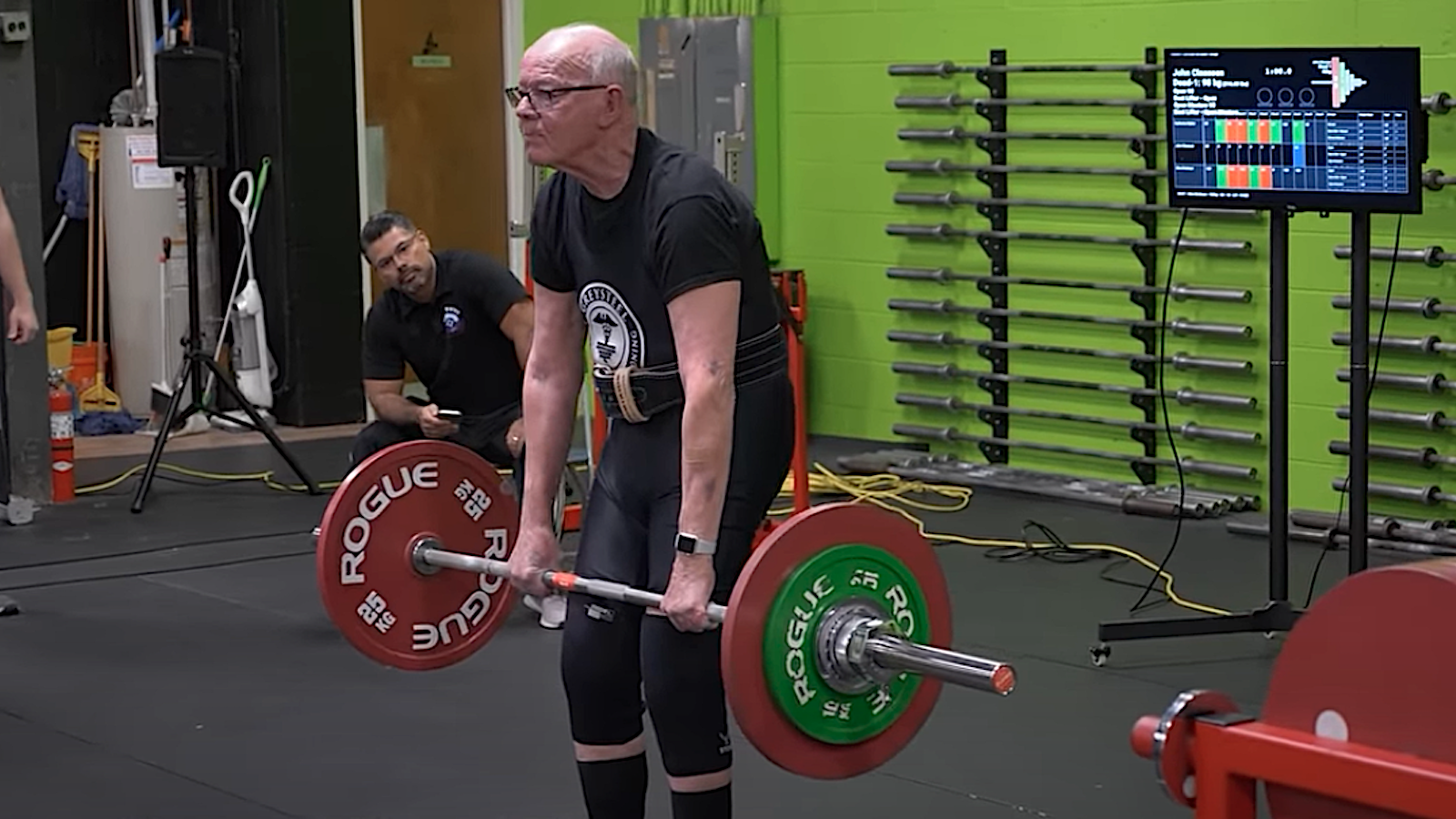
In the documentary-style video below, the then 92-year-old Claassen trains for a deadlift contest at CrossFit Illumine in Niles, IL, where he competed raw. He went three for three — 97.5 kilograms (215 pounds) on his first attempt, 102 kilograms (225 pounds) on his second attempt, and 106.5 kilograms (235 pounds) on his third attempt. Check it out below:
[Related: Eleuterio Montalvo (125KG) Lifts Third-Heaviest All-Time Raw Total of 868.5 Kilograms in the Teen 18-19 Division]
During his training for his deadlift competition, Claassen performed barbell curls, deadlifts, safety-bar squats, prowler pushes, and incline bench presses. On contest day, he was filmed warming up with 90, 135, and 180 pounds on the barbell. He wore knee sleeves and a lifting belt.
The only competition I have is with myself.
Training at an older age has a plethora of health benefits. According to PLoS One, “Older athletes are capable of rigorous training programs and top performances while adjusting to changes due to biological aging.” Additionally, Olympic weightlifting and powerlifting are less likely to lead to injury than participation in contact sports. (2)(3)
A 2021 meta-analysis in the European Review of Aging and Physical Activity found that after analyzing 561 healthy older adults aged 65.8 to 82.8 with sarcopenia (loss of muscle tissue due to aging), resistance training “improves body fat mass, muscle strength, and muscle performance.” (4) Specifically, they found positive effects on body fat mass, handgrip strength, knee extension strength, and gait speed.
Train for Life
Claassen didn’t begin his weight training journey until he was 89 years old. He decided to make a change because he noticed his physicality deteriorating as his posture worsened. The change involved walking into the gym, finding a coach in a supportive environment, and some weight plates on a barbell. He’s representative that it’s never too late for fitness.
More Training Content
References
Saeidifard, F., Medina-Inojosa, J. R., West, C. P., Olson, T. P., Somers, V. K., Bonikowske, A. R., Prokop, L. J., Vinciguerra, M., & Lopez-Jimenez, F. (2019). The association of resistance training with mortality: A systematic review and meta-analysis. European journal of preventive cardiology, 26(15), 1647–1665. https://doi.org/10.1177/2047487319850718
Huebner, M., Meltzer, D., Ma, W., & Arrow, H. (2020). The Masters athlete in Olympic weightlifting: Training, lifestyle, health challenges, and gender differences. PloS one, 15(12), e0243652. https://doi.org/10.1371/journal.pone.0243652
Aasa, Ulrika et al. “Injuries Among Weightlifters And Powerlifters: A Systematic Review”. British Journal Of Sports Medicine, vol 51, no. 4, 2016, pp. 211-219. BMJ, doi:10.1136/bjsports-2016-096037. Accessed 11 Apr 2023.
Chen, N., He, X., Feng, Y. et al. Effects of resistance training in healthy older people with sarcopenia: a systematic review and meta-analysis of randomized controlled trials. Eur Rev Aging Phys Act 18, 23 (2021). https://doi.org/10.1186/s11556-021-00277-7
Featured image courtesy of Greysteel: Fitness After Fifty’s YouTube channel.
How to Do the Barbell Bulgarian Split Squat — Technique Tips, Variations, & More
Single-leg training is the embodiment of the “no pain, no gain” philosophy. Not only do unilateral exercises help reinforce good posture and improve your balance, they’re also devilishly effective at building muscle and strength. None, perhaps, more so than the barbell Bulgarian split squat.
The Bulgarian split squat is among the most high-value movements you can do for your glutes, quads, and core — and that’s before you even think about adding any extra resistance into the mix.
Credit: Serhii Bobyk / Shutterstock
Throw a loaded (or unloaded, even) barbell onto your back and you’ve got an all-in-one leg builder. However, the Bulgarian-style barbell split squat isn’t for the faint of heart; nor is it easy to perform. Here’s what you need to know about this exercise and, if you can stand it, what you stand to gain.
How to Do the Barbell Bulgarian Split Squat
It’s no secret; if you want to do the barbell Bulgarian squat, you’ll need a barbell. Additional weight plates are optional but will extend the utility of the exercise as you get stronger.
An elevated surface on which to rest your non-working leg is mandatory as well. A weight bench or plyometric box both work, but any stable knee-height surface will do.
Step 1 — Set Yourself Up
Credit: Sports Rehab Consulting / Youtube
Your best bet is to perform barbell-based split squats in a squat rack. Begin by unracking the barbell from the hooks as if you were going to perform a standard back or front squat. Take a few steps back and then lift and plant your non-working leg onto an elevated surface behind you.
Find your footing and stabilize your body. Grip the barbell tightly and contract your core. That’s the starting position.
Coach’s Tip: Taking a wide grip on the barbell might improve your balance.
Step 2 — Drop Your Hips
Credit: Sports Rehab Consulting / Youtube
From your starting position, descend into the squat by sitting down and slightly back with your hips. Allow your knee to travel freely in front of your toes if necessary. Sit down until the crease of your hip is lower than your kneecap, and then push forcefully into the floor with your working leg to return to the starting position.
Coach’s Tip: Fix your gaze on a point several feet away from you, close to the floor, to help maintain your balance as you move.
Barbell Bulgarian Split Squat Sets and Reps
When it comes to programming single-leg exercises, you should always be cognizant of the balance requirement before jumping into a heavy or high-repetition set. If you’re training to improve your balance, great — but there are other ways to program this movement as well.
To Improve Balance: Go for 2 sets of 15 to 20 reps with a light weight and a slow tempo.
For Muscle Growth: Try 3 or 4 sets of 8 to 10 reps with a moderate weight.
To Gain Leg Strength: Keep it heavy and do 3 to 5 sets of 4 to 6 reps.
Common Barbell Bulgarian Split Squat Mistakes
There’s a lot that can go awry during any single-leg exercise, and the barbell Bulgarian split squat is no exception. To do a proper split squat with the barbell, you need to steer clear of these mistakes.
Too Much Weight on Your Back Leg
The biggest mistake you can make during any single-legged squat is relying too heavily on your non-working leg. In a proper Bulgarian squat (whether you use a barbell or not), your non-working leg should do nothing more than help you suspend yourself in space.
80 to 90 percent of your body weight should rest on your working leg. Think of your off leg as a kickstand. Once you’ve established your setup, shift the bulk of your weight onto your working leg and keep it there for the entire set.
The placement of your working leg during barbell Bulgarian split squats will affect how you perform the exercise and what muscles do the majority of the work.
Credit: Prostock-studio / Shutterstock
If you plant your foot directly under your hips, you’ll need exceptional ankle mobility to sit down into a deep squat. This will tax your quadriceps more than your glutes and also make the exercise more difficult to balance.
On the other hand, stretch your foot out too far in front of your body and you’ll limit quad engagement in favor of more glute and adductor activation instead. This position will also require you to lean forward and stretch your groin.
You should, at first, aim for a happy medium between these two extremes. Once you’re comfortable with the groove of the split squat, you can inch your foot forward or backward a bit to bias certain muscles over others.
Shifting Your Gaze
If you’re having trouble steadying yourself during an exercise like the split squat, one of the worst things you can do is shift your gaze around during your set. Instead, your best bet is to fix your eyes on a specific point from start to finish.
Ideally, you should look forward and down. This will help keep your head aligned with the angle of your torso. Also, your point of focus should be at least five feet in front of you, but what matters most is that your eyes don’t go wandering.
Barbell Bulgarian Split Squat Variations
It may not look like the most versatile movement out there at a glance, but there’s a lot you can do with the barbell Bulgarian split squat. If you’re bored of the standard movement or want to adjust the stimulus, you can try out these variations.
Safety Bar Bulgarian Split Squat
If you have access to a safety bar in your gym, you might want to give it a go during the split squat. The safety bar adjusts the resistance such that it falls closer to your midline, which should make it easier to maintain your balance.
Safety bars also come with two ergonomic handles to hold onto, which can be highly useful if you can’t grasp a bar on your back due to inflexibility or injury.
Front Rack Bulgarian Split Squat
If you’re a true masochist, you can double down on the difficulty of a barbell split squat by holding it in the front rack position instead of across your back.
The front rack barbell split squat takes almost every aspect of the exercise up a notch. It challenges your upper back to a greater degree since the anterior load will constantly attempt to collapse your torso. It’s also harder to balance and asks more of your core.
The only potential downside is that you can’t use as much weight, but the exercise is challenging enough that you won’t need to in most cases.
Barbell Bulgarian Split Squat Alternatives
Heavy single-leg squats have a lot to offer, but the barbell Bulgarian split squats aren’t everyone’s cup of tea. If you like them in theory but don’t gel with them in practice, there are other ways to reap many of the same benefits. Try out some of these alternatives instead.
Assisted Dumbbell Bulgarian Split Squat
Holding a heavy dumbbell (or two) during your split squats works wonders if you don’t have access to a barbell. However, dumbbell Bulgarian squats can be just as challenging to balance.
If you want to stimulate your legs unilaterally for muscle growth and aren’t concerned with the “acrobatics” of the exercise, you can support your balance by holding a dowel or PVC pipe in your free hand. This provides another point of contact with the ground and makes balance an afterthought, allowing you to focus harder on squeezing your legs.
Barbell Step-Up
Step-ups work just as well for building your legs as any split squat, particularly if you’re willing to load them up with heavy weights.
One unique benefit of the barbell step-up is that you can fine-tune your desired range of motion by adjusting the height of whatever you’re stepping up on to. This can help you ensure you don’t push into a range of motion you aren’t comfortable with or get stuck in the bottom of a split squat with no way out.
Single-Leg Leg Press
Single-leg training may sound alluring but you might only be after some targeted muscular stimulation. In the event that balance and hip mobility aren’t concerns of yours, you can still train your legs one at a time by hopping onto the leg press station.
Single-leg leg presses enable you to overload your quads and glutes with no fear of losing your balance. You also don’t have to devote nearly as much energy to maintaining core stability and posture. This frees you up to focus entirely on taking your muscles to, or beyond, failure.
Muscles Worked by the Barbell Bulgarian Split Squat
To make the most of any exercise you perform in (or out of) the weight room, you should have a working knowledge of the muscles that make each rep possible. Here’s a short overview of the major muscles that contribute to the barbell Bulgarian split squat.
Quadriceps
Your quadriceps, or “quads,” sit on the front of your thighs and control the bending and extending of your knee During the barbell Bulgarian split squat, your quad engages to help you stand up and complete each repetition.
Credit: DmitryStock / Shutterstock
You can also shift more or less load onto or away from your quads by adjusting the distance of your foot relative to your torso. The further away your foot is from your body, the less forward knee movement you’ll have, generally speaking. This limits how much your quads can contribute to each repetition, but you won’t be able to take them out of the equation entirely.
Glutes
Single-legged squatting is among the most effective things you can do in the gym to target your gluteal muscles. Not only do your glutes have to contract to push you out of the bottom of each rep of the split squat, but the gluteus medius and minimus have a stability-focused role.
This makes the barbell Bulgarian split squat a two-for-one glute builder. You can use it to build glute strength and power, while also developing robust hip stability at the same time.
Core
Any movement that requires you use one limb at a time will involve the muscles of your core to some degree. During a movement like the barbell Bulgarian split squat, your body weight isn’t evenly distributed across your base of support.
This requires you to contract your abdominals and obliques isometrically to help stabilize your trunk not only against gravity but the added resistance of the barbell as well.
Benefits of the Barbell Bulgarian Split Squat
Single-leg squatting is among the most valuable things you can do during your leg workouts. From forcing new muscle hypertrophy to shoring up weaknesses, here’s what you stand to gain by adding in the barbell Bulgarian split squat.
Targeted Muscle Growth
When you go to train your arms, you probably don’t perform exclusively bilateral, two-armed exercises. Unilateral training helps you devote all your might to one muscle at a time; the same principle applies to leg training as well.
During back or front squats, your focus can easily shift away from the muscles you’re trying to work and toward simply pushing as hard as you can. While there’s nothing wrong with that, some single-leg work during which you give all your attention to your legs individually can do wonders.
Develops Hip Mobility and Strength
Working on one leg is one of the best ways to bulletproof your hips. Not only do the muscles surrounding your hips have to stabilize the joint as you descend and ascend through the split squat, but those tissues also have to prevent any errant side-to-side shifting as well. That added pelvic stability should carry over to other two-legged exercises as well.
Great Stimulus Without Lifting Heavy
Loading up a heavy barbell is one of the best parts of hitting the weight room, but ultra-heavy training isn’t for everyone. You may be tired, nursing an injury, or simply not have access to enough plates for a heavy squat workout.
Whatever the reason, you can get a brutally-effective workout in by swapping to single-leg training with the barbell Bulgarian split squat. The barbell itself may be enough, and every extra pound you add will be equal parts challenging and rewarding.
Who Should Do the Barbell Bulgarian Split Squat
If you have the guts — and a barbell, of course — you can take on the barbell Bulgarian split squat and reap the rewards. Beyond that, there are a few select groups that stand to benefit from this exercise in particular.
Beginners
If you’re taking your first steps on your fitness journey, a few of those steps should probably happen while you’re setting up for some sort of split squat. Unilateral training is a great way to set you up for long-term success in the gym.
Credit: MDV Edwards / Shutterstock
An exercise like the barbell Bulgarian split squat will help you improve your proprioception, or your bodily awareness in space. This carries over to every other exercise you perform. You’ll also build muscle and strength in the process, of course.
Strength Athletes
Strength athletes who practice powerlifting, weightlifting, strongman, or even CrossFit should consider adding the barbell Bulgarian split squat to their accessory repertoire. Most strength sports involve plenty of bilateral squatting but little to no movement or training on one leg.
Attacking aspects of your athleticism that aren’t covered by your sport will keep your workouts fresh, fun, and diverse. Furthermore, you can use exercises like the split squat as a screener to identify any weaknesses in your joint stability or leg strength that may impact your sport-specific performance.
Those Recovering from Injury
Single-legged movements are among the most commonly prescribed rehabilitative tools for soft tissue injuries. This is partly due to the fact that bilateral exercises (movements like the back squat, where you stand on both legs) can mask discrepancies in strength or stability. Or, your stronger side may pick up too much of the load, robbing the damaged area of proper stimulation.
Alternatively, the setup and execution of the barbell Bulgarian split squat naturally limits the amount of knee flexion. You also simply cannot move as much weight as during a two-legged squat. These factors have led some researchers to recommend split squats as a replacement for bilateral squats for those suffering from knee ailments. (1)
Credit: Manu Padilla / Shutterstock
That said, if you’re injured in any way, you should always consult with your physician or physical therapist before using any form of resistance training as a rehabilitative treatment.
Stand Your Ground
If you want to test your mettle in the weight room and build a pair of beastly wheels in the process, you need to swallow your pride and start doing the barbell Bulgarian split squat. You’d be shocked at how heavy an empty barbell can feel, but the gains are more than worth it.
FAQs
Still wondering if the barbell Bulgarian split squat is right for you? Check out some of these common questions to find the answers you seek.
Are split squats safe with a barbell?Absolutely. The barbell Bulgarian split squat may require a more intricate setup than working with just your own body weight or using dumbbells, but that doesn’t mean the exercise is unsafe.
That said, it’s not as easy to dump the weight and exit the set if you reach failure on this exercise. You may want to recruit a spotter to assist you from time to time, especially if you decide to go heavy.
What leg should I start with during barbell Bulgarian split squats?Generally speaking, during most unilateral movements you should start the set by working your non-dominant limb first. That leg is already working at a small disadvantage of strength or coordination; you don’t want to also be tired from working your stronger leg right before. Work your weaknesses while you’re fresh.
References
Mackey, E. R., & Riemann, B. L. (2021). Biomechanical Differences Between the Bulgarian Split-Squat and Back Squat. International journal of exercise science, 14(1), 533–543.
Featured Image: Serhii Bobyk / Shutterstock
The Best CrossFit Workouts for Building Muscle to Break Through Plateaus
You probably didn’t come to CrossFit for the muscles. Instead, you probably showed up because you were looking to improve your cardiovascular health, get stronger, or just find a fitness community. But, if we’re honest, the muscles probably didn’t hurt.
If you’ve ever even glanced in the direction of the CrossFit Games, you’ll have noticed that CrossFitters tend to be absurdly ripped. For the uninitiated, this can be intimidating, to say the least. But you don’t have to take your shirt off during your WODs (workouts of the day) to be a real CrossFitter. You’ve just got to keep showing up — the muscles will likely show up, too.
Credit: Denis Kornilov / Shutterstock
But if you did come to CrossFit for all that sweet muscle mass, don’t worry. We’ve got the best CrossFit workouts for building muscle just for you. Because even though your average WOD will help you get jacked, these CrossFit-style workouts are designed to focus on hypertrophy — muscle growth — and take your boulder shoulders and teardrop quads to the next level.
Editor’s Note: The content on BarBend is meant to be informative in nature, but it should not be taken as medical advice. When starting a new training regimen and/or diet, it is always a good idea to consult with a trusted medical professional. We are not a medical resource. The opinions and articles on this site are not intended for use as diagnosis, prevention, and/or treatment of health problems. They are not substitutes for consulting a qualified medical professional.
Best CrossFit Workouts for Building Muscle
Best CrossFit Workout for Building Upper Body Muscles
CrossFitters use their upper bodies like nobody’s business. Even if a movement seems to be about their lower bodies, it’ll often be performed in a way that taxes the upper body. For example, lunges seem like they’re all about your lower body until you’re performing them front-racked or overhead.
But for this workout, you’re going to focus entirely on your upper body. The goal here is to really shore up the smaller muscles of your upper body that risk getting overshadowed by your back and chest. Your triceps and biceps are going to get a lot of play, so get ready to feel a pump.
The Workout
CrossFit workouts are about pushing your limits. Even when workouts look simple on paper, they’re designed to present extreme challenges in practice. Here, the rep scheme combined with working against the clock will get very taxing, very quickly.
12-minute AMRAP (as many rounds as possible)
Especially since you’ll be performing strict chin-ups instead of kipping pull-ups, you’ll have to be very strategic about how you’re splitting up your reps. Consider modifying the movements later in the workout even if you don’t have to right away.
Movement Modifications
This workout is deceptively simple, but the fatigue will build extremely quickly. Since there are only two moves — and they’re both upper-body focused — your exhaustion will have nowhere to hide.
You might not have to modify this workout right out of the gate. But to keep working up to the 12-minute mark, you might need to use variations of these exercises to get you to the finish line with sharp form.
Some modifications for the chin-ups follow:
Some alternatives for the bar dip follow:
Band-Assisted Dip
Bench Dip
Close-Grip Push-Up
Best CrossFit Workout for Building Lower Body Muscles
CrossFit will take a toll on your lower body, plain and simple. Anyone who’s ever suffered through a WOD can probably tell you that it’s like getting hit with multiple leg days at once when you try to hobble out of bed the next day.
But that’s no reason not to give your legs a little extra love. The more attention you give your legs — as long as you’re recovering well — the better equipped you’ll be to face down the rigors of your next WOD.
The Workout
This workout will go after all areas of your legs, including one place where it’s notoriously difficult to build muscle — your calves. Make sure that you’re giving your heels and ankles ample attention in your warm-up and recovery time.
Five rounds, for time:
For each lift, choose a weight that feels very manageable during the first round but will be challenging by round three. It should be quite difficult to get through unbroken by round five.
Movement Modifications
Unless otherwise specified, calling for back squats and front squats indicates using a barbell. If you need to modify, you can instead use dumbbells.
To get the stimulus of a back squat, stand with each foot on a bumper plate or a step riser, with a gap in between just wide enough to accommodate a dumbbell. Squat while holding a dumbbell between your hands with your arms long. Keep your torso tall.
This position will allow you to sink deep into the squat while using a significantly heavier weight than you might be able to goblet squat.
Speaking of goblet squats, this is an excellent option for modifying your barbell front squat. If you need unweighted versions, you can use a PVC pipe or even a broomstick to simulate the positions of a barbell in both types of squats. You can also, of course, simply perform air squats.
Instead of doing a barbell Romanian deadlift, you can also swap in dumbbells. You can also perform hip hinges with the same form as a Romanian deadlift, but with empty hands. Just focus on maintaining tension in your glutes and hamstrings. Move slowly and with control.
If you can’t pull off a single double-under, let alone 20, try for single-unders — regular jump rope skips. Without a jump rope, you can simply simulate jumping rope with small hops. If your feet, knees, or hips can’t abide jumping, you can opt instead for eccentric calf raises. Be sure to stretch your calves — maybe even treat yourself to a calf and heel massage — afterward.
Best CrossFit Workout for Building Core Muscles
You do not need a six-pack to be an incredible CrossFitter. You can, indeed, be incredibly strong and fit without your muscles showing through a low body fat percentage (which is how one acquires a visible six-pack).
But if you’re looking to build out your core muscles, you’ve come to the right place. This workout will have you taking advantage of some classic CrossFit moves to help you build an incredible amount of core strength and muscle mass.
The Workout
Here, you’ll be performing some of the most well-known CrossFit exercises in one of the most well-known CrossFit formats: the descending rep ladder of 21, 15, and nine reps. You’ll perform 21 reps of each exercise first. Then, do 15 of each exercise. Finish off your workout with nine of each movement.
21-15-9 reps, for time:
Movement Modifications
If need be, you can sub in a goblet squat or even an air squat to make the front squats more accessible. Try to use a weighted variation if you can, as the front-loading of the weight is what makes the front squat move particularly good for core strength.
Without access to a glute-ham developer (GHD), you can perform sit-ups on a decline bench. You can also simply perform regular sit-ups.
If you can’t do a full toes-to-bar, consider hanging leg raises or even hanging knee raises. No access to a pull-up bar? Try lying leg raises instead.
A modified workout might go like this:
21-15-9 reps, for time:
Goblet Squat
Sit-Up
Hanging Knee Raise
Best Beginner CrossFit Workout for Building Muscle
CrossFit beginners truly have their work cut out for them. Not only are they fighting an uphill battle of learning new skills, but they’re also developing strength and high-intensity endurance all at the same time.
To help ease the transition into CrossFit, beginners might find a muscle-building workout more their speed. It’s less traditional CrossFit and more introductory style to help athletes find their footing. You’ll be using a classic, sport-specific rep scheme — a descending ladder — but you’ll be doing it with an eye toward hypertrophy.
The Workout
These movements look simple on their own, but they get very intense, very quickly. If you’re less used to the descending ladder nature of many CrossFit workouts, think of this workout as one big drop set. But instead of dropping the weight, you’re dropping the number of reps you perform with each round.
Three to five rounds, for time:
Movement Modifications
While this workout is already designed for beginners, that doesn’t mean everyone’s beginner level looks the same.
For example, ring rows might be too unstable for you. In that case, try inverted rows in a Smith machine or with a barbell anchored in a power rack. You can also perform light barbell rows — the sheer volume of reps will add up.
Bulgarian split squats may not be accessible to you in terms of balance or your current level of hip mobility. In that case, try forward or reverse lunges. If you need to, hold onto the handles of a TRX suspension trainer or equivalent to help give you a counterbalance. Your upper body’s engagement can also give your legs a little bit more strength if need be.
The box step-ups can be replaced with a regular step instead of a full plyo box. Or, you can substitute high knee marches in place.
If you can’t lift overhead, consider swapping in bench presses. In situations where an empty barbell is too heavy for you, you can also simply use lighter dumbbells.
Best No-Equipment CrossFit Workout for Building Muscle
Just because a workout is bodyweight-only doesn’t make it equipment-free — especially in CrossFit. Bodyweight moves include everything from ring muscle-ups to box jumps, all of which require equipment.
But with this equipment-free CrossFit workout, you’ll be able to build muscle (and get your heart rate going) anytime, anywhere. You’ll need enough space on the ground for you to essentially be able to lie down. Otherwise, space won’t be an issue.
The Workout
Don’t mistake the lack of equipment for easiness. This workout is tricky — especially if you’re looking to perform each move to your maximum potential. With your overhead squats, keep your upper body just as engaged as you would if you were holding a loaded barbell.
Be just as disciplined with your form as you would be hefting a lot of weight. This diligence will pay off in spades when you start to notice all the muscle you’ve built.
21-15-9 reps, for time:
Movement Modifications
If any of these movements aren’t for you, that’s alright — they’re relatively simple to swap out.
For athletes who struggle with burpees, there are a few options. You can step back into a plank position instead of jumping back. If you’re pregnant or otherwise can’t get your belly on the ground, you can hike your hips up to help lower your chest. You don’t need to perform a jump at the top, and you can similarly eliminate the push-up from the bottom.
With the bodyweight overhead squat, simply keep your hands down or out in front of you instead of overhead if the reach is too intense for you. You might also sit down on a stable chair instead of going to full depth if need be.
Perform a regular push-up instead of a pike push-up if you have to. You can also do a wall push-up, an incline push-up, or a push-up from your knees.
Finally, eliminate the jumping part of the jump squat and simply squat, down to a steady chair if you need to. To maintain a similar explosive stimulus from jumping, sink into your squat slowly. When you’ve reached your full range of motion, explode upward quickly. No need for your feet to leave the floor for you to start generating power.
Benefits of Building Muscle for CrossFitters
But should CrossFitters focus specifically on building muscle? If you’re able to dedicate the recovery you’ll need to accommodate any extra training sessions, then the short answer is yes — you probably should.
Prevent or Break Through Plateaus
Make no mistake — even smaller muscle groups get a tremendous amount of work from the functional compound movements found in any CrossFit WOD. But by building those smaller muscles, you’ll likely be able to improve your lifts a tremendous amount. How?
Take kipping pull-ups, for example. Your entire body and core will be taken to town in an incredibly intense way. Your grip will be on fire by the end of your sets. And, yes, that will give a tremendous amount of strength and development — even size — to your forearms.
Credit: UfaBizPhoto / Shutterstock
But when the workload gets to be too much, your smaller muscles are likely to burn out before your bigger muscles. That creates a limiting factor in how many reps you can handle unbroken before taking a break to shake it off.
Pausing between reps costs valuable time and can hamper your gains. Relatively underdeveloped smaller muscle groups may even be the culprit behind your latest plateau.
Building up your smaller muscles (like your forearms, biceps, and triceps), you’ll be shoring up the bottom line of your bigger lifts. In doing so, you’ll be raising the bar on all of your lifts and WODs, helping you improve that much more before facing down your next plateau.
Combat Muscle Imbalances
Since so many CrossFit movements are bilateral — barbell work and deficit handstand push-ups, for example — it’s easy for your dominant side to take over. If you’re a lefty, the left side of your body might bear more of the brunt of weight distribution during bilateral work. This can create both strength and muscle imbalances.
Perfect symmetry might not matter all that much to you if you’re not a physique athlete. But it’ll likely matter to you in terms of injury prevention. Keeping your muscles as balanced as you can be able to help make your body more resilient against injury. And the longer you can go without injury, the more likely you are to tackle each WOD to the best of your ability.
Help Transition Into CrossFit
Coming over to the dark side from a different strength sport? Welcome in. You’re likely used to performing a set number of sets and reps to induce a certain adaptation — say, building more strength or stimulating hypertrophy.
In CrossFit, you’ll be counting reps alright. But you’ll be doing it staring down a ticking clock and burning lungs and muscles all over your body. Training for hypertrophy — giving a CrossFit flair to the types of workouts you’re already familiar with — can help CrossFit beginners feel confident about their new sport.
CrossFit Warm-Up for Hypertrophy
No matter what your specific session goal is, you always want to warm up before tackling your WOD. Warm-ups not only prepare your body for the rigors of your upcoming workout — but they also optimize your performance and help make you more resilient against potential injuries.
When you’re training for hypertrophy, you’ll want to pay close attention to smaller, often overlooked muscle groups. You’ll focus closely on these muscle groups — think, your rear delts, triceps, and biceps — during your hypertrophy training. So, you’ll also want to single them out during your warm-up.
Cater each warm-up to the specific movements you’ll be doing that day. For example, spend extra time on hip mobility if you’re going to be snatching, front squatting, or lunging. Take extra time with your shoulders and thoracic mobility if you’re going to be doing any kipping or overhead work.
But generally speaking, CrossFit workouts are going to involve your whole body in some way, shape, or form. Because of that, a good CrossFit warm-up should cover all your bases.
Air Bike: 3-5 minutes, low intensity
Band Pull-Apart: 15-20
Active Frog Stretch: 60 seconds
World’s Greatest Stretch: 6 per side
Lateral Lunge: 8 per side
Half-Kneeling T-Spine Rotation: 8 per side
Bear Crawl: 30 seconds forward, 30 seconds backward
Crab Reach: 8 per side
Session-Specific Strength Exercise: 2-5 ramp-up sets, 3-6 reps per set*
*For each main lift of the day, get a feel for the movement with your bodyweight only or an unloaded barbell. Gradually increase the intensity of the movement in separate sets until you approach the weight or intensity of the exercise as prescribed in your workout.
Don’t perform so many reps that you’ll tire yourself out, but aim to get your blood pumping and your muscles firing.
How to Program CrossFit Workouts for Building Muscle
In CrossFit, you’ll be challenging pretty much all your muscles in every session. It’s a big commitment to toss in an additional focus on intentionally building certain muscles. Here’s how to program intelligently to make sure that you’re maximizing your gains and minimizing your risks.
Focus on Recovery
There’s no getting around it — CrossFit is a whole lot of work. Adding more sessions to your regimen to build muscle can run the risk of interfering with your body’s ability to adequately recover from one session to the next.
Help your muscles recover by ensuring that you’re getting enough sleep and food to fuel your performance. Make sure you’re warming up and cooling down before and after each workout to help you stay more resilient against injury. Consider self-myofascial massage with foam rollers and filling out your stretching routine with resistance bands.
The more you focus on recovery, the more you’ll be giving your muscles the space and fuel they need to grow.
Program on Separate Days
This option may be especially appealing to strength athletes who are newer to CrossFit. If you’re currently doing one or two CrossFit WODs per week — on your weekends, perhaps — consider sprinkling these muscle-focused workouts into the rest of your week. That way, you won’t be taking away from your recovery.
You will also be giving your body a more familiar way to sink into CrossFit training. The sets and rep schemes typical of hypertrophy training in other sports like powerlifting, weightlifting, and bodybuilding can help you ease into the conditioning and mental rigors of CrossFit. You’ll be building muscle and getting better at CrossFit as you go.
Add Hypertrophy Finishers
For those who are more experienced with CrossFit, you might have trouble adding extra hypertrophy-based sessions to your program. You may already be doing two-a-day workouts or simply doing an intense WOD every day.
In those situations, it might eat into your recovery — or simply not work logistically — to add another standalone workout into your program. To solve this problem wisely and with an eye on your recovery, simply add a short hypertrophy-focused session to the end of your WOD.
Complete your WOD, grab some water, wipe off the sweat, and dive back in for a slightly less intense bout of muscle-building. Stack your hypertrophy sessions strategically. If you’re looking to drive muscle growth in your legs, choose that session after a legs-focused WOD. That way, your legs will get all the action in one day and you can consolidate your recovery period.
Program Around Your Weak Points
Be smart about which muscle-building workouts you want to focus on. Focus on what aspects of your performance are lagging during your WODs.
Having trouble with your shoulder-to-overheads? Focus on upper body hypertrophy, since your troubles may lie with weaker triceps for lockout strength. Having trouble with your deadlift lockout? Work on building those glutes and hamstrings with a lower-body hypertrophy workout instead.
Build Those Muscles
There’s no way around it — CrossFit pros are ripped. If you’re looking for your piece of the hypertrophy pie, you might not want to depend on WODs alone. While you can (and probably will) gain a lot of high-quality muscle mass with just your regular training, you can pack more muscle onto your frame with hypertrophy-specific CrossFit workouts.
Integrate these CrossFit workouts for building muscle into your training program after your typical sessions or on their days entirely. Make sure your recovery is dialed in, then proceed to build up your weakest links with hypertrophy sessions. Your WODs will thank you — and so will the size of your muscles.
If you’re ready to find out more about everything CrossFit training, here are some articles to sink your teeth into next.
Featured Image: Denis Kornilov / Shutterstock
Jay Cutler vs. Nick Walker: A Fantasy Bodybuilding Showdown
If you want to determine the most successful bodybuilder of a certain era, then you simply look at the number of championships they won during their careers. Determining the most popular competitors is a little different. Social media can help provide some information, but it isn’t all about followers online. Crowd support at shows, lines at expos, and merchandise sales could tell more of the story.
Regardless of what metrics you use, Jay Cutler and Nick Walker hold their own in both onstage success and fan support.
Cutler, a four-time Mr. Olympia, competed as a pro from 1998 to 2013, and he’s still one of the most admired athletes in the sport 10 years after his retirement.
Meanwhile, Walker was one of Cutler’s fans growing up, but he’s now forging his own legacy and building his own fanbase — and trophy case — that could potentially rival Cutler’s someday.
Could Walker actually match Culter’s accomplishments? We’ll have to wait a while before we get an answer. But in the meantime, we here at BarBend are breaking down their physiques and accomplishments to see how both men stack up.
Credit: @JayCutler on Instagram (Cutler) // T.J. Darr (Walker)
[Related: Arnold Schwarzenegger vs. Chris Bumstead: Breaking Down a Fantasy Bodybuilding Matchup]
Bodybuilding Accomplishments
Comparing the duo’s accomplishments in 2023 wouldn’t exactly be fair to Walker. He’s only in his third full season as a pro, while Cutler had a career that lasted well over a decade. Even though we will mention all of Cutler’s major career highlights, we’ll emphasize his success up to the age of 28, which is Walker’s age as of March 2023. In a striking coincidence, the two even share a birthday — August 3 — meaning Cutler is exactly 21 years older than Walker.
Jay Cutler’s Accomplishments
Cutler won 15 pro shows during his career, including four Mr. Olympia titles and three Arnold Classics. However, he didn’t score any of those Olympias before the age of 33. If we were to keep his career analysis to the age of 28, then that leads up to his 2002 season.
According to Muscle Memory, Cutler turned pro in 1996 by winning the NPC Nationals heavyweight title. His first pro show was the 1998 Night of Champions, where he placed 12th. He then qualified for the 1999 Mr. Olympia by placing in the top three at that year’s Iron Man Invitational, but he finished 15th out of 16 competitors at the O itself.
[embedded content]
[Related: 9 Bodybuilders Under 200 Pounds Who Were Absolute Giant Killers]
Cutler’s first pro win came at the 2000 Night of Champions, which became the New York Pro years later. He then finished eighth at that year’s Mr. Olympia. He really hit his stride after placing second to champion Ronnie Coleman at the 2001 Mr. Olympia. Many feel Cutler was actually the better competitor that night, and it’s a decision that is still considered one of the most controversial in the show’s history.
The 2002 season kicked off with 28-year-old Cutler winning his first Arnold Classic title. He then opted to skip the Olympia that year, making his career highlights up to age 28 as follows:
1996 NPC Nationals Heavyweight Winner
2000 Night of Champions Winner
2001 Mr. Olympia, 2nd Place
2002 Arnold Classic Champion
Nick Walker’s Accomplishments
Walker turned pro at the 2020 North American Championships, and he immediately made his pro debut at the Chicago Pro that same season, finishing in fourth.
He already had a following going into the 2021 season, but his popularity skyrocketed after winning the New York Pro. In another coincidence, Walker’s first pro win came at the same contest as Cutler’s, albeit with a different name.
The 2021 Arnold Classic came after the New York Pro due to scheduling changes around the COVID-19 pandemic. Walker shocked the world and won that contest as well, marking his first major title in only his third pro show.
[embedded content]
[Related: Ronnie Coleman vs. Mamdouh “Big Ramy” Elssbiay: A Fantasy Battle Between Bodybuilding Heavyweights]
His Olympia debut came two weeks later with a fifth-place finish — 10 spots higher than Cutler’s first Mr. O outing. Walker returned to the Olympia in 2022 and placed third behind champion Hadi Choopan and runner-up Derek Lunsford. He then kicked off the 2023 season by returning to the Arnold Classic, where he finished second behind champion Samson Dauda.
Walker isn’t expected to compete again until the 2023 Olympia Weekend on Nov. 2-5 in Orlando, FL, and he be turn 29 by that point. Here are his career highlights as of March 2023:
2020 North Americans Champion
2021 New York Pro Winner
2021 Arnold Classic Champion
2022 Mr. Olympia, 3rd Place
Training Style
Both men are known for their freakish muscle mass — but how did they build it? Cutler is reported to be 5’9” while Walker stands 5’7”, and both weighed around 250 pounds on stage. With Walker being such a fan of Cutler growing up, you can imagine that he took some training cues from the four-time Mr. Olympia over the years.
Jay Cutler’s Training Style
Cutler credits foundational free weight movements such as the bench press, squat, and deadlift for building his mass.
“While machines are still beneficial — when you get to a certain point, you can’t get to that [Mr. Olympia] level without doing free weight movements,” Cutler said on his YouTube channel in September 2021. He did (and still does), however, work more with machines and dumbbells to refine his physique as his career progressed.
[embedded content]
[Related: 10 Memorable Performances From the Arnold Classic Bodybuilding Contest]
During his prime, Cutler implemented a high-volume training approach and rarely used supersets or other intensity-boosting methods. He hit upwards of 20 to 25 sets per body part, with sets being in the eight to 12 rep range. He still follows this approach as he nears his 50th birthday.
In November 2022, Cutler shared an 11-exercise shoulders and triceps workout that is similar to how he trained during his days of dominating the stage. He didn’t detail the reps and sets, but these are the moves he performed:
Seated Dumbbell Shoulder Press
Chest-Supported Seated Lateral Raise Machine
Rear Delt Cable Crossover Flye
Incline Fixed Barbell Front Raise
Incline Dumbbell Rear Delt Flye
Seated Triceps Extension Machine
Cable Triceps Pushdown
Kneeling Rope Pushdown
Seated Cable Triceps Extension
Machine Calf Raise
Leg Press Calf Raise
Nick Walker’s Training Style
Though Walker performs many of the same movements as Cutler, he’s far more notable for his freakish displays of strength on social media. During his 2022 Mr. Olympia prep, Walker posted a video of himself hitting incline bench press reps with 180-pound dumbbells and deadlifts with five 45-pound weight plates on each side (which totals 495 pounds, assuming Walker was lifting with a standard 45-pound barbell).
Like Cutler, Walker has since started incorporating more machine movements into his programming because they allow him to isolate muscle groups and refine his mass.
[embedded content]
[Related: The Story Behind the Chaotic Drug-Tested 1990 Mr. Olympia]
That said, he still uses free-weight exercises regularly and keeps his rep ranges around 12 to 15. One example of Walker’s shoulder training is this session he completed with 2019 Mr. Olympia Brandon Curry in the summer of 2022.
Popularity
It’s always difficult to compare the popularity of bodybuilders from different eras because of the lack of social media during Cutler’s career and the different ways of promotion between then and now. There are significantly fewer magazines around now, and merchandise sales have changed as well. Nonetheless, you can see why these two men are where they are in the bodybuilding world.
Jay Cutler’s Popularity
Cutler’s popularity during the 2000s was matched only by eight-time Mr. Olympia Ronnie Coleman. That’s because, throughout their careers, they were usually the last two men standing on the Olympia stage, and their physiques helped define the “mass monster” era. They were the most high-profile athletes in the sport, with each selling workout DVDs and appearing in magazines. If anything, their rivalry helped both men achieve even greater heights in terms of popularity.
[Related: How Strong Was Arnold Schwarzenegger? We Look Back at the Oak’s Short-Lived Powerlifting Career]
Cutler was — and still is — savvy when it comes to the business of bodybuilding. He was the top athlete for the supplement company MuscleTech for most of his career, started his own merch line, and was a fixture at trade shows. His pursuit of Coleman, combined with his commitment to support his fans, made him a legend long before he won an Olympia title.
Since his retirement, Cutler stays relevant with newer fans thanks to his podcast, social media pages, and his YouTube channel. On Instagram alone, he has more than 4.8 million followers as of March 2023, ranking alongside current competitors like Big Ramy.
Nick Walker’s Popularity
Walker’s fanbase can be seen in part on both his Instagram (1.3 million followers) and YouTube channels (231,000 subscribers). Outside of social media, he has his own clothing line and is sponsored by supplement brand HD Muscle. Like Cutler, Walker also makes appearances at trade shows, gyms, and nutrition stores.
[Related: How Strong Was Arnold Schwarzenegger? We Look Back at the Oak’s Short-Lived Powerlifting Career]
The attention of bodybuilding fans is now more spread thanks to the addition of other divisions such as Classic Physique and Men’s Physique, but Walker remains a popular figure in the industry and could remain so for several years to come.
Coaching
Both Walker and Cutler employed some of the most respected trainers and coaches in the industry to help them build their championship physiques. Here’s who helped them get to the top:
Jay Cutler — Chris Aceto and Hany Rambod
Cutler began his career with “The Technician” Chris Aceto and stayed with him throughout most of his career. Aceto helped Cutler win all of his pro shows up until the 2008 Olympia when he lost to Dexter Jackson.
[embedded content]
[Related: Kings, Chemists, and Oaks: The 10 Best Bodybuilding Nicknames of All Time]
Cutler then changed over to Hany Rambod, who guided him to his final two Olympia victories in 2009 and 2010. After initially agreeing to work with Chad Nicholls for his 2013 return to the stage, Cutler eventually reunited with Aceto and finished his final Mr. Olympia contest in sixth place.
Nick Walker — Matt Jansen
Walker has mainly used one coach throughout his competition preps so far: Matt Jansen. The duo worked together from Walker’s amateur days until the 2021 Olympia, where he finished in fifth.
[embedded content]
[Related: 12 of the Most Underrated Bodybuilders of All Time]
After a brief falling out, Walker switched to working with Dominick Mutascio in early 2022. However, Walker and Jansen reunited later that year and returned to the 2022 Olympia as a duo. Walker finished that contest in third place, and they followed that up with a second-place finish at the 2023 Arnold Classic.
Conclusion
From birthdays to first victories and major titles, the comparisons between Cutler and Walker appear to be valid to this point. They also happen to be among the most popular bodybuilders of the respective generations. In the end, though, it all comes down to Olympia hardware. “The Mutant” certainly has the potential to rival Cutler when it comes to Sandow trophies, but only time will tell if he gets it done.
Featured Images: @jaycutler on Instagram (Cutler), T.J. Darr (Walker)