
 All Posts By Muscle Insider
Board Certified PHD
2023 Mr Big Evolution Pro Portugal Scorecards
/* custom css */
.tdi_86{
color: #eaeaea;
}IFBB PROFESSIONAL LEAGUE®, IFBB PRO LEAGUE®, IFBB PRO® and the IFBB Professional League logo are registered trademarks owned by the IFBB Professional League.The IFBB Professional League logo cannot be altered in any way, shape or form without the expressed written approval of the IFBB Professional League. Where such approval is granted, the IFBB Professional League will provide the altered logo.© 2022 IFBB Pro, All Rights Reserved.

2023 Mr. Big Evolution Pro Portugal Results and Scorecards (Live Results)
The 2023 Mr. Big Evolution Pro Portugal took place in Estoril, Portugal on July 9. This event featured a total of nine divisions including Men’s 212 Bodybuilding, Classic Physique, Men’s Open, Men’s Physique, Bikini, Women’s Bodybuilding, Figure, Women’s Physique, and Wellness.
As of this year, there are fewer months to earn an invite to the next Mr. Olympia contest. Currently, athletes have until Oct 9. The 2023 Mr. Olympia competition is scheduled for Nov. 2-5 inside the Orange County Convention Center. Outside the Men’s Open, the top three finishers from last year’s Olympia (2022) are automatically invited back to this year’s contest.
2023 Mr. Big Evolution Pro Portugal Winners
Men’s Open: Andrea Presti
Men’s 212 Bodybuilding: Roman Lushchenko
Classic Physique: Antoine Loth
Men’s Physique: Coming Soon!
Bikini: Coming Soon!
Women’s Bodybuilding: Coming Soon!
Figure: Coming Soon!
Women’s Physique: Coming Soon!
Wellness: Coming Soon
2023 Mr. Big Evolution Pro Portugal Results
Men’s Open
Roman Fritz and defending champ Andrea Presti were both in the running for first during prejudging and finals. They put on a great contest and kept fans quite intrigued. Judges favored the conditioning, separation, and x-frame of Andrea Presti.
He last competed at the Empro Classic Pro where he narrowly took runner-up to Michal Krizo. Meanwhile, Roman Fritz took fifth at the same Empro Classic Pro contest. Ultimately, Andrea Presti won the show and is now a three-time Mr. Big Evolution Pro champion.
Winner — Andrea Presti
Second Place — Roman Fritz
Third Place — Emir Omeragic
Fourth Place — Krystian Wolski
Fifth Place — Petar Klancir
Sixth Place — Vladyslav Sukhoruchko
Seventh Place — Laszlo Szmereka
Eighth Place — Alessandro Orri
Ninth Place — Lionel Beyeke
Men’s 212 Bodybuilding
During prejudging, Marco Sarcone stood out with exceptional conditioning. His last contest came in dominant fashion at the 2022 Worldwide Amateur Olympia in first place. He battled against Roman Lushchenko today. Lushchenko’s last show came in first at the Amateur Olympia Spain in 2019. They put on a good contest but Roman Lushchenko got his hand raised and secured first place.
Winner — Roman Lushchenko
Second Place — Marco Sarcone
Third Place — Nasser Sayed
Fourth Place — Lucas Coelho
Fifth Place — Daniel Sticco
Sixth Place — Miguel Angel Angustia Fontenla
Seventh Place — Ayat Najd Bagheri
Eighth Place — Gabor Berek
Ninth Place — xx
Tenth Place — Jorge Zamorano Avila
Classic Physique
During prejudging and finals, it was a battle between Stephane Matala, who is known for great conditioning and striations, and Antoine Loth. Loth last competed at the 2023 Poland Pro where he took fifth. In the end, the conditioning and experience of Antoine Loth helped him secure the Classic Physique title in Portugal.
Winner — Antoine Loth
Second Place — Stephane Matala
Third Place — Miguel Malimo
Fourth Place — David Martinez Campos
Fifth Place — Adam Bomert
Sixth Place — Emanuele Ricotti
Seventh Place — Lucas Guido
Eighth Place — Florian Hartlage
Ninth Place — Pedro Ferreira
Tenth Place — Luca Corrado
.
Men’s Physique
Coming Soon!
Bikini
Coming Soon!
Women’s Bodybuilding
Coming Soon!
Figure
Coming Soon!
Women’s Physique
Coming Soon!
Wellness
Coming Soon!
2023 Mr. Big Evolution Pro Portugal Scorecards
Coming Soon!
FitnessVolt congratulates the winners! We look forward to seeing you all compete on the Olympia stage this November!
Published: 9 July, 2023 | 5:09 PM EDT

Dorian Yates Shares ‘Opposite Approach’ to Diet that Keeps Him Ripped at 61
Legendary bodybuilder Dorian Yates set a new bar for the Men’s Open division with his insane physique. Although he hasn’t competed in decades, he maintains a high level of personal fitness. In a recent post made on Instagram, Yates reveals his unique “opposite approach” to dieting that has helped him maintain a ripped physique at the age of 61.
Dorian Yates made a name for himself with his impressive muscle mass, size, and definition and boasted one of the best back developments of all time in the Men’s Open division. He pioneered the sport in the UK and emerged as the biggest bodybuilding superstar out of the region. He won his maiden Sandow trophy at the 1992 Mr. Olympia and went on a dominant run to become a six-time champion.
Yates used the high-intensity training techniques of Mike Mentzer and Arthur Jones to craft his physique. He would go near failure in every training session instead of following a fixed number of sets and reps traditionally adopted by bodybuilders.
The 61-year-old carried his passion for fitness into his later years. He left the fans stunned with a jacked physique update where he performed a workout on a beach in Brazil earlier this year. Then, he listed barbell rows with an underhand grip as the exercise of his choice to build a barn door back months later.
Yates opened up on his training frequency in the prime of his career two months ago. He revealed he’d workout four days a week for Joe Weider’s Olympia Weekend and the made case against squats being an essential part of every training program for muscle growth.
Having pushed his body to the limit, Yates picked up several injuries over the years. He started using stem cell therapy two months ago and reported his inflammation went down and his shoulders got better after 30 days of being on the treatment plan. As for the progress in his elbow and knee, he indicated it would take a few more weeks before he feels a significant change.
Dorian Yates gave fans a look into the two-exercise ab routine he utilized to win six Mr. Olympia titles last month. He would time the workout after shoulders and triceps and go to failure in two sets of bodyweight crunches and reverse crunches each. He followed up by laying out the chest workout regimen that helped him build a full chest.
Yates showed off his shredded abs in a physique progression snap two weeks ago. He compared photos of himself at age 22 and now, boasting clear abs throughout nearly 40 years.
Dorian Yates Credits Shredded Physique to Intermittent Fasting at 61
In a recent Instagram post, Dorian Yates shared the diet he follows to stay ripped at the age of 61.
“Intermittent fasting, quite the polar opposite approach to eating than I was used to 30 years ago when I’d be eating every two hours!” said Yates. “
But for the past few years, I’ve been practicing intermittent fasting.
I’ve experienced numerous benefits, and have researched pretty much every approach to dieting.
“Intermittent fasting works extremely well for myself.
I’m now pursuing my health goals and optimising for longevity as opposed to bodybuilding.
Read my latest blog where I go into why I adopted intermittent fasting, the benefits, how you can potentially use it when trying to build muscle and more.
But the best diet for health goals may not be the same as the best for trying to build maximum muscle.”
Intermittent fasting, a popular and scientifically supported diet approach, involves periods of extended fasting where individuals refrain from consuming food. This trendy method has gained recognition for its potential benefits, including weight loss, muscle gain, blood sugar regulation, and activation of anti-aging genes.
Dorian Yates stressed the importance of using extracurricular training in addition to lifting weights for boosting recovery and offered some of the exercises he’s utilizing to enhance longevity earlier this month.
Yates revealed the approach he used for his diet to get ready for competition days ago. While he would go down to 3,500-4,000 calories in prep, he once cut down to 2,500 calories for his debut.
His latest update will inspire many fans to give intermittent fasting a chance for improving their fitness game.
Published: 9 July, 2023 | 2:59 PM EDT
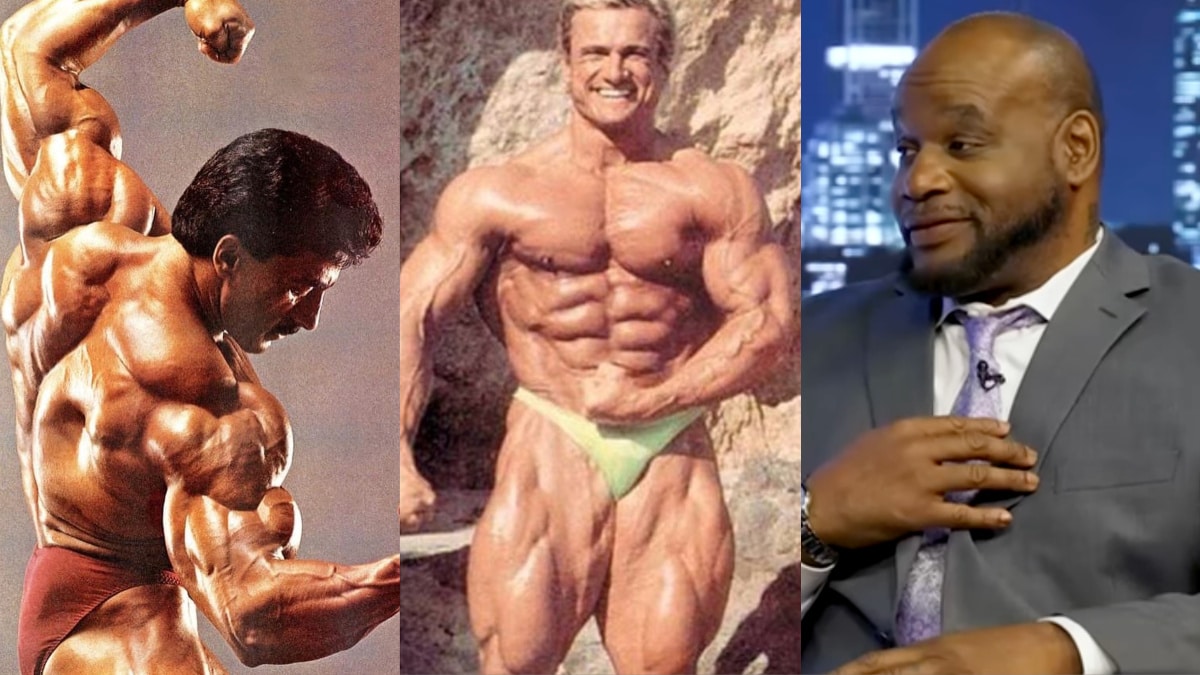
Chris Cormier & Olympia Judge List Best Backs & Legs in Bodybuilding History
Bodybuilding veteran Chris Cormier has found a place as a respected analyst since moving on from professional competition. He amassed a wealth of knowledge and experience stemming from his decades of work in the sport. In a recent episode of Prime Time Muscle, Cormier and Olympia judge Terrick El Guindy listed the best backs and legs in bodybuilding history.
Chris Cormier first gained attention for his massive muscle mass, size, and conditioning in the Men’s Open division in the 90s. He placed fourth at the 1994 Arnold Classic and turned in a strong performance to get a sixth-place finish in his Mr. Olympia debut in 1994. While he did not win the contest, Cormier was a consistent top-eight finisher and scored two bronze medals. He hung up his posing trunks after a final outing at the 2007 Montreal Pro Classic.
Earlier this year, Cormier heaped praises on 2022 Mr. Olympia Hadi Choopan for his insane consistency in the last five years. He believes Choopan is one of the hardest-working athletes and could defend the title successfully with his refined conditioning and posing abilities.
El Guindy and Cormier made the case against the need to get glute implants and injections in bodybuilding as it could create imbalances, which would result in docked points. The pair broke down the immensely successful careers of the two winningest athletes in bodybuilding, Dexter Jackson and Ashley Kaltwasser three months ago. Cormier ranked Jackson’s resume at the top due to the fierce competition he went up against in fewer shows than available today.
Cormier extended his support for budding Open contender Michal Krizo to become a major force in the near future two months ago. Based on Krizo’s raw look, Cormier is convinced he could be a title contender if he continued to improve at a decent rate.
Last month, Cormier lauded reigning four-time Classic Physique Olympia champion Chris Bumstead for his immense success and analyzed his chances in the Open class. He argued Bumstead could battle it out in some poses and warranted a special invite to compete in the Open Olympia.
Chris Cormier picked the arms of Robby Robinson as the greatest ever along with his crazy biceps peak while El Guindy favored the arms of seven-time Mr. Olympia Phil Heath last month.
Chris Cormier & Olympia Judge List Best Backs in Bodybuilding History
In a recent YouTube video, Chris Cormier and Terrick El Guindy shared their thoughts on the competitors who had the best back muscle development of all time. The duo agreed on former Mr. Olympia Samir Bannout having the best back, ahead of legendary bodybuilders like Ronnie Coleman, Dorian Yates, and Phil Heath.
“If you’re going to go with the best backs, I’d say the ‘Lion of Lebanon.’ When I started competing, he was the Mr. Olympia at the time,” said Cormier. “It was 1983, he won the Olympia and I didn’t think it was real because being a teenager. You’re looking at all the striations, the Christmas tree so deep all across the lats.
“Ali Malla was another one who had an awesome back from back in the day, the back double bicep along with that, every shot from the back looked like it was pasted on, like Plato actually pasted on. I didn’t think those triceps were real because I didn’t know that you can get those little lines.”
“Then you gotta go with Lee Haney. He also had a magnificent back, him and Dorian Yates. Robby Robinson had the back double not so much the last bit but the back double. Flex Wheeler had a crazy back double bicep. Then, there was also Ronnie Coleman. You can not ever speak about this without Ronnie Coleman.”
El Guindy said, “Ronnie Coleman 1999 back double biceps and back lat spread, Dorian Yates 1993 back double biceps and back lat spread, Mohammed Benaziza 1991 Night of Champions, black lat spread and very thick on the back double bicep. Let’s mention guys that didn’t win shows, didn’t become legends, such as Joel Stubbs, he had an incredible back double bicep. In terms of quality, it’s hard to beat Samir Bannout.
“Let’s not forget about one of the guys that people don’t appreciate, stop right now and start appreciating Phil Heath. Phil Heath 2013 back double biceps might be one of the prettiest things you’ve ever seen.”
Cormier & El Guindy on Best Legs Ever
‘The Real Deal’ and El Guindy gave their takes on the competitors who brought the best legs in the history of bodybuilding. They agreed on ‘The Quadfather’ leading the list with Cormier in the mix as well.
El Guindy said, “With back you can go many directions but with legs only one; big, shredded, massive, dense, and it hasn’t gotten better. It’s the only guy in the world with those legs, Tom Platz. Paul De Mayo possibly second, Chris Cormier, and then you got Branch Warren had legs for days.
“2013 Big Ramy’s legs with all that separation, incredible. 2022 Big Ramy without the separation not incredible,” he continued. “Tom Platz is number one for me. Maybe Chris tied with Paul De Mayo and Branch Warren but they were different styles of legs.”
El Guindy added Coleman but Cormier did not agree. They believe there is no clear contender with massive legs in contemporary bodybuilding.
“I’m also going to say Ronnie Coleman and Phil Heath. One time I saw Phil Heath guest posing in Los Angeles and his legs looked massive.”
“Renel Janvier had the glutes, quads, fibers all over,” said Cormier. “You didn’t have to say Ronnie Coleman because he started out with some of the smallest legs in the sport and ended with some of the biggest legs in the sport. Dorian had big legs in certain poses, not all around. He had the calves obviously., It wasn’t just the quads, it was overall density of the leg and his whole body, the back, the whole shot was just crazy.”
El Guindy added, “I’d like to see more legs from Nick Walker. That’s one of the things. Nick Walker is known for his muscularity on top. He needs more flaring quads to minimize the waist. At this point in this generation, we don’t have anybody specific that we go has wow huge legs.”
Two weeks ago, Chris Cormier and El Guindy backed rising Open sensation Andrew Jacked’s chances at dominating the sport for the next few years. They identified 2023 Arnold Classic winner Samson Dauda as the biggest threat standing on Jacked’s way to glory.
You can watch the full video below.
Published: 9 July, 2023 | 12:09 PM EDT
2023 Musclecontest Patriots Challenge Pro Results and Scorecards
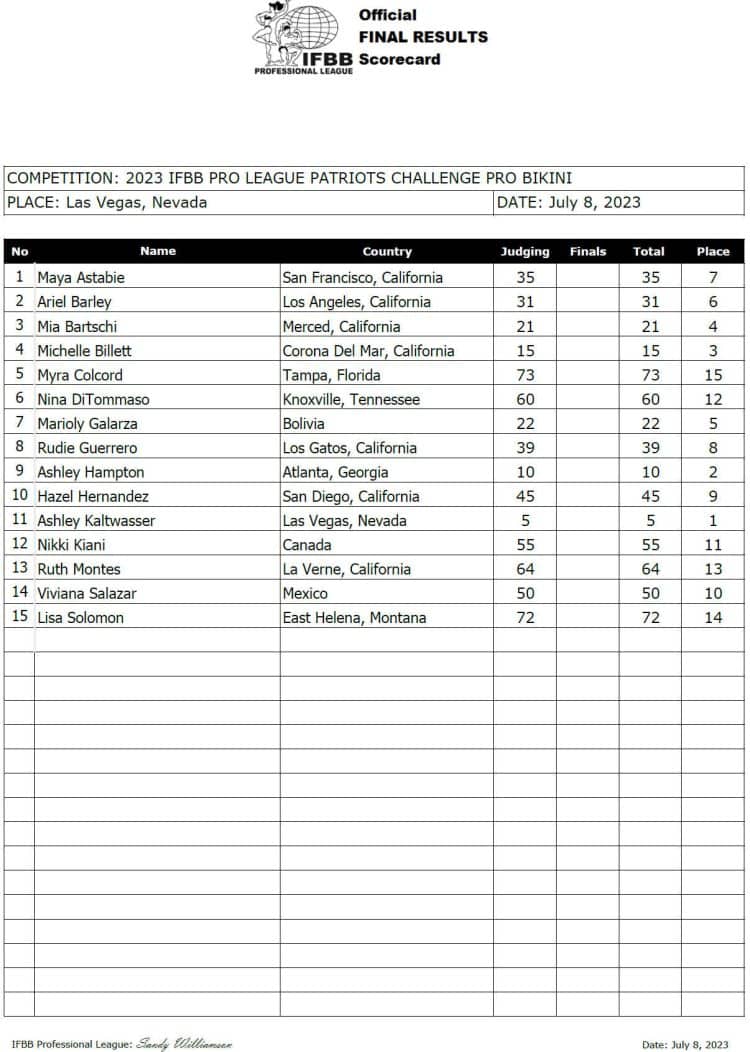
On Saturday, July 8, in Las Vegas, Nevada, nearly 20 Bikini talents stormed the stage at the 2023 Musclecontest Patriots Challenge Pro looking to earn gold, a cash check, and bragging rights. This show served as a qualifier for the upcoming Olympia contest.
As it stands, competitors have until Oct 9 to guarantee passage to this year’s Olympia show. Among those competing is three-time Bikini Olympia queen Ashley Kaltwasser. While she has already earned her ticket to Olympia, she’s here to block others from attending. In addition, if Kaltwasser proves successful this weekend, she will make history by becoming the only bodybuilder to ever win a total of 40 IFBB Pro League shows.
Aside from Kaltwasser, Ruth Montes is after gold. She already competed at four shows this year. In her last outing, Montes took eighth place at the 2023 Mile High Pro. Ashley Hampton is another viable threat eager to do some damage on stage. She last made a statement at the Charlotte Pro back in April where she finished fourth.
2023 Patriots Challenge Pro Results
Bikini
Winner — Ashley Kaltwasser
Second Place — Ashley Hampton
Third Place — Michelle Billett
Fourth Place — Mia Bartschi
Fifth Place — Marioly Galarza
Sixth Place — Ariel Barley
Seventh Place — Maya Astabie
Eighth Place — Rudie Guerrero
Ninth Place — Hazel Hernandez
Tenth Place — Viviana Salazar
2023 Patriots Challenge Pro Scorecard
FitnessVolt congratulates the winner!
Published: 9 July, 2023 | 3:15 AM EDT
2023 Republic of Texas Pro Results and Scorecards
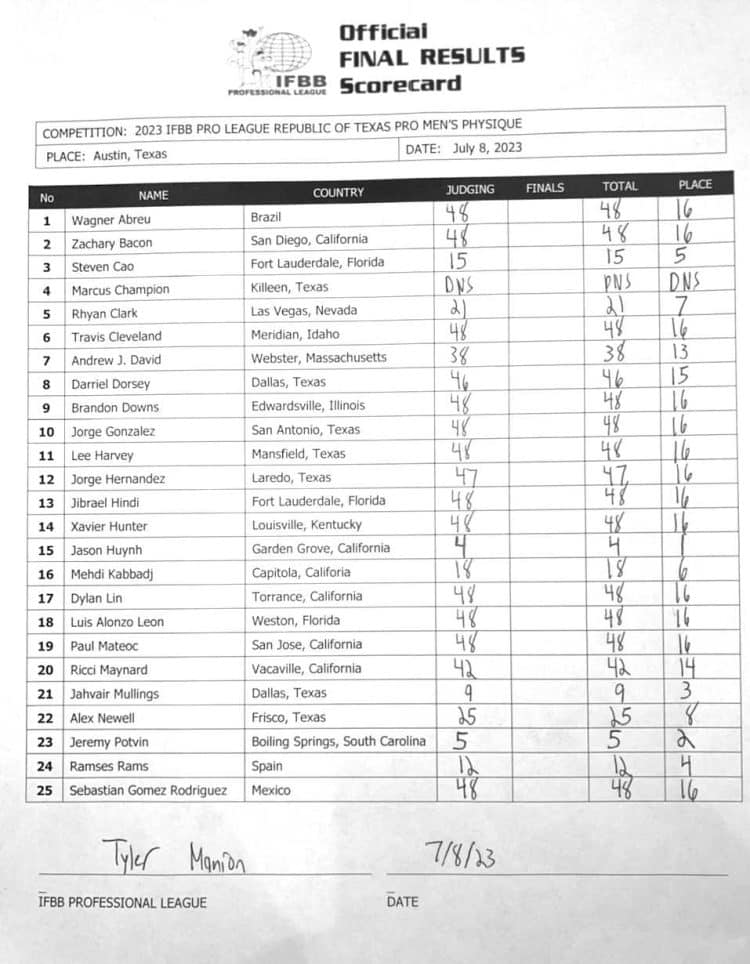
On Saturday, July 8, Austin, Texas will host the 2023 Republic of Texas Pro show. This event is set to feature competitors from the Men’s Physique, Bikini, and Wellness categories. The champions of these contests will qualify for the upcoming Mr. Olympia competition. This year’s 2023 Mr. Olympia takes place from Nov. 2-5 in Orlando Florida, inside the Orange County Convention Center. Athletes have until October 9 to earn their respective invites.
Heading into this weekend, fans have highlighted a few names in the Men’s Physique division. Jeremy Potvin is among them. He demonstrates a great display of balance and brings a full chest to the stage in each outing. His last appearance came in second at the 2022 Chicago Pro.
Steven Cao is another top name competing this weekend. Cao’s last show saw him also take silver in a close battle at the DC Pro. Lastly, Ramses Rams will be in attendance, who has put forth a very busy schedule this year. His last competition saw him take second at the 2023 Mile High Pro. Whoever emerges with the win, will have a shot at facing reigning Men’s Physique Olympia Erin Banks later this year.
As far as Bikini talent is concerned. Fans expect a big performance from Jordan Fisher who is riding high off a commanding victory at the 2023 Dallas Pro. She will face India Paulino who last stepped on the Olympia stage in 2022 but wasn’t able to place. Meanwhile, Lexus Redmond is a tenacious competitor and will aim to capture gold after her runner-up show at the Dallas Pro.
2023 Republic of Texas Pro Winners
Men’s Physique: Jason Huynh
Bikini: Lexus Redmond
Wellness: Frida Paulsen Stern
2023 Republic of Texas Pro Results
Men’s Physique
Winner — Jason Huynh
Second Place — Jeremy Potvin
Third Place — Jahvair Mullings
Fourth Place — Ramses Rams
Fifth Place — Steven Cao
Sixth Place — Mehdi Kabbadj
Seventh Place — Rhyan Clark
Eighth Place — Alex Newell
Ninth Place — Mario Stewart
Tenth Place — Karim Hawash
Bikini
Winner — Lexus Redmond
Second Place — India Paulino
Third Place — Adair Libbrecht
Fourth Place — Jordan Brannon
Fifth Place — Tara Grier
Sixth Place — Jordan Fisher
Seventh Place — Maria Acosta
Eighth Place — Rachel M. Linares
Ninth Place — Alexandra Vatthauer
Tenth Place — Sabra Young
Wellness
Winner — Frida Paulsen Stern
Second Place — Renee Jewett
Third Place — Tracy Williams
Fourth Place — Carrie Goforth
Fifth Place — Debora Paula de Oliveira
Sixth Place — Mia Samuels-Menjivar
Seventh Place — Michelle Ibata
Eighth Place — Victoria Puentes
Ninth Place — Gabriela Cadena
Tenth Place — Nuannaree Sriwaralak
2023 Republic of Texas Pro Scorecards
FitnessVolt congratulates the winners. We look forward to seeing you all shine on the 2023 Mr. Olympia stage!
Published: 9 July, 2023 | 3:03 AM EDT
Cable Close Grip Seated Row Guide: Muscles Worked, How-To, Benefits, and Alternatives
When it comes to back training, bodybuilders have a saying: If you want to grow, you gotta row! While vertical lat pulldowns and pull-ups are undeniably effective, it’s horizontal rows that pack on the greatest back mass.
However, there are many different rowing exercises to choose from. Your options include bent-over barbell rows, Pendlay rows, T-bar rows, single-arm dumbbell rows, Kroc rows, seal rows, and machine rows.
In this guide, we lift the lid on another popular rowing exercise – the cable close grip seated row. It’s one of our favorites, and it should be one of yours too. However, given how badly this exercise is often performed, it’s evident that some technique revision is required!
Cable Close Grip Seated Row – Muscles Worked
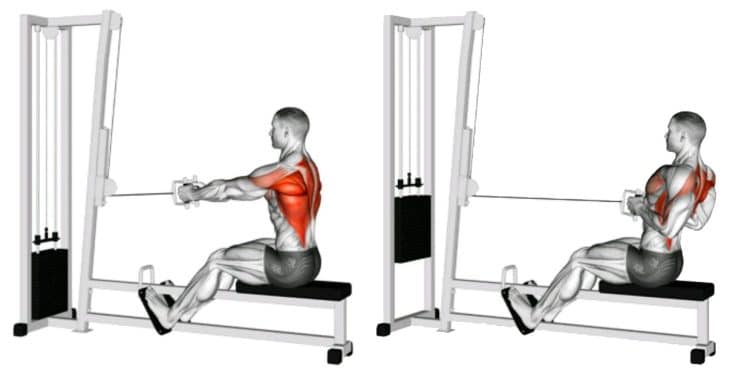
Cable close grip seated rows as a compound pulling exercise. That means they involve multiple muscles and joints working together. The main muscles trained by cable close grip seated rows are:
Latissimus Dorsi
The latissimus dorsi, or lats for short, are located on the sides of your upper back. When well developed, the lats look like wide, muscular wings. The functions of the lats are shoulder joint adduction and extension, the latter of which is part and parcel of cable close grip seated rows.
Trapezius
The trapezius is a large kite-shaped muscle that covers much of your upper back. Known as the traps for short, there are three groups of fibers that make up this muscle – upper, middle, and lower.
While all three sets of fibers are involved in cable close grip seated rows, the middle fibers, located across the shoulder blades, are the most active. These fibers pull your shoulder blades back and together in a movement called retraction.
Rhomboids
The rhomboids are located between your shoulder blades. They work with your mid traps to pull your shoulders back and together, which is called retraction.
Deltoids
The deltoids are your most significant shoulder muscles. Like the traps, there are three groups of fibers, called heads – anterior (front), medial (middle), and posterior (rear). All three deltoid heads are involved in cable close grip seated rows, but the posterior fibers are the most active.
Biceps
While cable close grip seated rows are undoubtedly an upper-back exercise, you’ll probably feel it in your biceps, too. Cable close grip seated rows involve a lot of elbow flexion, which is a function of the biceps. In fact, your biceps may fail before your bigger, stronger back muscles.
Forearms
Any exercise that involves your grip also trains your forearms, and cable close grip seated rows are no exception. Depending on your hand and grip strength, you may benefit from using gym chalk or lifting straps during this exercise so your hands don’t fail before your back muscles.
Core
Cable close grip seated rows are performed without support. As such, you’ll need to use your core muscles to stabilize your spine. Core is the collective term for the muscles of your midsection, including the rectus abdominis, obliques, transverse abdominis, and erector spinae. Bracing or tensing these muscles will ensure your spine remains rigid and stable during cable close grip seated rows.
How to Do Cable Close Grip Seated Row
Get more from cable close grip seated rows while keeping your risk of injury to a minimum by following these guidelines:
Attach a narrow parallel grip handle to a seated row machine or low pulley.
Sit on the bench and place your feet on the footrests. Grab the handle in both hands.
Sit up tall and straight with your arms extended in front of you and knees slightly bent.
Brace your core, and pull your shoulders down and back. Look straight ahead.
Lean forward slightly from your hips and allow your shoulder blades to slide forward. Do not round your lower back.
Shrug your shoulders back, sit up straight, bend your arms, and pull the handle into your abdomen.
Extend your arms and repeat.
Pro Tips:
Use gym chalk or lifting straps to reinforce your grip if required.
Keep your upper body stationary and vertical if you prefer.
Keep your upper arms close to your sides to fully engage all your back muscles.
Lead with your elbows to maximize muscle engagement.
Keep your wrists straight throughout.
Inhale as you bring the handle toward you, and exhale as you extend your arms.
Benefits and Drawbacks
Not sure if cable close grip seated rows deserve a place in your next back workout? Consider these benefits and then decide!
Reduced lower back stress
Exercises like bent-over and T-bar rows put a lot of stress on your lower back. In fact, some fitness coaches and trainers call these movements contraindicated, suggesting they should be avoided. While this is a little over-cautious, there is no denying that unsupported forward flexion can cause injuries, especially if you allow your lumbar spine to round.
However, cable close grip seated rows are much more lower back-friendly. You don’t have to waste energy supporting your upper body weight, so there is less stress on your back. Whether you suffer from back pain or just want to avoid it in the future, cable close grip seated rows are a sensible option.
A time-efficient exercise
Some rowing exercises are unilateral, meaning they train one side of your body at a time. While this is a useful way to identify and fix left-to-right strength imbalances, it can also make your workouts longer.
Bilateral cable close grip seated rows are more time efficient as you train both sides of your back simultaneously. This is a small but welcome advantage for exercisers with limited training time.
A complete upper back workout
While lat pulldowns and pull-ups are both popular and effective, they only tend to work your lats and have much less impact on the trapezius and rhomboids. As such, they can help you develop a wider back but won’t do as much for back thickness.
In contrast, cable close grip seated rows hit the lats AND the traps and rhomboids, making it a more self-contained back workout. Using cable close grip seated rows, you should be able to develop a back that’s both thick and broad.
Easy to adjust the weight
Cable close grip seated rows are usually performed on a machine with a selectorized weight stack. As such, you can quickly and easily change the weight. This makes cable close grip seated rows ideal for muscle-building drop sets. To perform a drop set, rep out to failure, reduce the weight by 10-15%, and immediately rep out again. Do 2-3 weight drops to fully exhaust the target muscles.
While cable close grip seated rows are a mostly beneficial exercise, there are also a couple drawbacks to consider:
Good postural awareness is a must
While cable close grip seated rows are relatively lower back-friendly, that depends on your form and posture. In other words, you need to sit up tall and straight to minimize lower back stress. This requires good postural awareness, and you’ll need to adopt the correct position by relying on your position sense and proprioception.
If you aren’t sure you are in good posture, video your cable close grip seated row workout and make adjustments accordingly.
Equipment requirements
Most commercial gyms have at least one cable seated row machine. But, because they’re usually quite large, heavy, and expensive, home exercisers may not have the space or the budget to put one in their garage or spare room gym.
The good news is there are several similar exercises you can do instead of cable close grip seated rows, which you’ll find described in the following section.
7 Cable Close Grip Seated Row Variations and Alternatives
Cable close grip seated rows are a highly effective upper back exercise, but that doesn’t mean you need to do them all the time. Here are several variations and alternatives you can use to keep your workouts productive and interesting:
1. Single-arm cable seated row
While training both sides of your back and arms at the same time can be an advantage for some, it isn’t for others. Bilateral training can lead to left-to-right strength and developmental imbalances. If you’ve got one side stronger than the other, single-arm cable seated rows could be the answer.
Steps:
Attach a D-shaped handle to a seated row machine or low pulley.
Sit on the bench and place your feet on the footrests. Grab the handle with one hand.
Sit up tall and straight with your arm extended in front of you and knees slightly bent.
Brace your core, and pull your shoulders down and back. Look straight ahead.
Lean forward slightly from your hips and allow your shoulder blades to slide forward. Do not round your lower back.
Shrug your shoulders back, sit up straight, bend your arm, and pull the handle into the side of your abdomen.
Extend your arm and repeat.
Rest a moment, switch sides, and do the same number of reps with the other arm.
Muscles targeted:
Primary: Latissimus dorsi, middle trapezius, rhomboids, posterior deltoids.
Secondary: Biceps, forearms, core.
Benefits:
Identify and fix left-to-right strength imbalances.
Less lower back stress than the bilateral version.
A useful anti-rotation core exercise.
Tips:
Keep your torso upright and shoulders squared throughout.
Use a thick handle to work on your grip strength.
You can also do this exercise with a rope handle.
2. Cable wide grip seated cable row
Regular cable close grip seated rows hit your lats and mid-upper back pretty equally. However, when you switch to a wide grip, your mid-traps, rhomboids, and posterior deltoids get more of a workout, and your lats must take a back seat. This is an excellent variation for developing upper back thickness and improving posture.
Steps:
Attach a long bar to a cable seated row machine.
Sit on the machine with your legs slightly bent and torso upright.
Hold the bar with a slightly wider than shoulder-width overhand grip.
Starting with your arms straight, bend your arms and pull the bar into your sternum.
Extend your arms and repeat.
Muscles targeted:
Primary: Middle trapezius, rhomboids, posterior deltoids, latissimus dorsi.
Secondary: Biceps, forearms, core.
Benefits:
An excellent way to emphasize the mid-upper back.
A good exercise for better posture.
A very effective movement for developing the posterior deltoids.
Tips:
Keep your elbows high throughout.
Pull your shoulders back and down while keeping your chest up.
Do not bend your wrists to pull the bar closer to your chest. Pull your elbows back instead.
3. Supinated grip seated cable row
Using a supinated or palms-up grip puts your biceps in a stronger position. As such, with this variation, you should be able to either lift more weight or do more reps. However, if you’ve got tight arms, you may find it hard, if not impossible, to fully extend your elbows. Try it and see how you get on; this exercise is not for everyone.
Steps:
Attach a straight bar to a cable seated row machine.
Sit on the machine with your legs slightly bent and torso upright.
Hold the bar with a shoulder-width supinated or underhand grip.
Starting with your arms straight, bend your arms and pull the bar into your abdomen.
Extend your arms and repeat.
Muscles targeted:
Primary: Latissimus dorsi, middle trapezius, rhomboids, posterior deltoids.
Secondary: Biceps, forearms, core.
Benefits:
A stronger position for the biceps.
A useful addition to close and wide grip seated cable rows.
A good back AND biceps builder.
Tips:
Lead with your elbows, and keep your upper arms close to your sides.
Adopt and maintain good posture throughout.
Try a narrow and medium-width grip to see which you prefer.
4. Resistance band seated row
No seated row machine? No problem! You can replicate this popular back exercise with a simple resistance band. All you need is a strong anchor and a suitable band. The type with handles at each is ideal. This is an excellent option for home workouts.
Steps:
Attach the middle of your band to a strong, low anchor.
Sit on the floor with your legs extended, knees slightly bent. Sit up straight, brace your core, and pull your shoulders back and down.
With one end of the band in each hand, pull the handles into your lower ribs.
Extend your arms and repeat.
Muscles targeted:
Primary: Latissimus dorsi, middle trapezius, rhomboids, posterior deltoids.
Secondary: Biceps, forearms, core.
Benefits:
An ideal exercise for home workouts.
Do this exercise almost anywhere and anytime, even while traveling.
A very joint-friendly back exercise.
Tips:
Sit on a low chair for comfort if necessary.
You can also do this exercise by looping your band around your feet.
Pull the handles into your chest to hit your upper back more than your lats.
5. Cable close grip standing row
While cable close grip seated rows are an excellent bodybuilding and strength training exercise, they’re not exactly functional. After all, other than at the gym, when was the last time you pulled a heavy weight toward you while sitting in a chair?
This standing variation is a little more functional and should carry over better to sports and activities outside of the gym.
Steps:
Attach a narrow parallel grip handle to an adjustable cable machine set to around mid-chest height.
Hold the handle with both hands and step back to tension the cable. Stand with your feet about shoulder width apart, knees slightly bent for stability.
Pull your shoulders back and down, brace your core, and look straight ahead.
Bend your arms and pull the handle into your abdomen.
Extend your arms and repeat.
Muscles targeted:
Primary: Latissimus dorsi, middle trapezius, rhomboids, posterior deltoids.
Secondary: Biceps, forearms, core.
Benefits:
More functional than seated cable rows.
Burns more calories than the seated variation, as you have to use your legs for support.
Less lower back stress and a reduced chance of rounding your lumbar spine.
Tips:
You can also do this exercise in a split stance.
Use a D-shaped handle and work one arm at a time if preferred.
Keep your upper arms close to your sides to maximize back engagement.
6. Inverted row
You don’t need a cable machine to train your upper back. In fact, all you really need is your body weight and a suitable bar. This exercise is ideal for home workouts and is also more functional than seated cable rows, as you have to stabilize your entire body to perform it correctly.
Steps:
Adjust the bar in a Smith machine or put a barbell in a squat rack at around hip height. Lock it in place so it won’t move.
Sit on the floor below the bar and hold it using an overhand, slightly wider than shoulder-width grip.
Extend your legs and lift your hips so your body is straight.
Starting with straight arms, bend your elbows and pull your chest up to the bar.
Extend your arms and repeat.
Muscles targeted:
Primary: Latissimus dorsi, middle trapezius, rhomboids, posterior deltoids.
Secondary: Biceps, forearms, core.
Benefits:
A very functional upper-back exercise.
An ideal exercise for home workouts.
Good for developing better posture.
Tips:
Make this exercise easier by bending your legs or raising the height of the bar.
Make it more challenging by putting your feet on a bench or wearing a weighted vest.
You can also do this exercise with gymnastic rings or a suspension trainer, e.g., a TRX.
7. Cable chest supported seated row
While cable close grip seated rows are already pretty lower back-friendly, there is still some stress on the muscles surrounding your lumbar spine. People with a history of lower back pain may find even this low amount of tension problematic. This rowing variation eliminates almost all lower back stress.
Steps:
Place an exercise bench in front of a low pulley machine so the backrest is upright and facing away from the weight stack.
Sit on the machine with your chest against the backrest, your feet flat on the floor, and the handles/bar in your hands.
Pull your shoulders down and back, and brace your core.
Bend your arms and pull your hands into your abdomen.
Extend your arms and repeat.
Muscles targeted:
Primary: Latissimus dorsi, middle trapezius, rhomboids, posterior deltoids.
Secondary: Biceps, forearms, core.
Benefits:
A very lower back-friendly rowing exercise.
An accessible exercise as most gyms have the necessary machine and benches.
An excellent exercise for beginners and older people.
Tips:
You can do this exercise using a dual pulley machine or a single cable.
Use a rope handle to increase your range of motion.
Keep your upper arms close to your sides to maximize upper back engagement.
Cable Close Grip Seated Row FAQs
Do you have a question about cable close grip seated rows or back training in general? No problem, because we’ve got the answers!
1. Which is better – Cable close grip seated rows or lat pulldowns?
Cable close grip seated rows and lat pulldowns involve many of the same muscles. However, where cable close grip seated rows are a horizontal pulling movement, lat pulldowns are vertical. This means cable close grip seated rows involve the mid traps and rhomboids more than lat pulldowns.
Does this make cable close grip seated rows better than pulldowns? That depends on what you want from your exercises. If you want to emphasize your lats, lat pulldowns are probably the way to go.
But, if you want to work your mid-traps and rhomboids more, cable close grip seated rows could be the best choice.
That said, these exercises complement one another, so if you can find space in your workouts for both of these movements, then you probably should.
2. Are cable close grip seated rows safe?
While no exercise is 100% safe, cable close grip seated rows are pretty low risk, especially if you avoid using too much weight and do them with the correct technique. They’re certainly safer than some other rowing exercises, such as bent-over and T-bar rows.
3. Cable close grip seated rows hurt my lower back – what gives?
If cable close grip seated rows hurt your lower back, you are probably rounding your lumbar spine or not sitting in good posture. Get someone to video you or give you feedback so you can determine what you are doing wrong.
Tight hamstrings and a weak core can make it harder to sit up straight, so address these problems if they affect you.
You may also feel your lower back if you are using too much weight.
Switch to the single-arm or chest-supported variations to hit the same muscles but with less pressure on your lower back.
4. How many sets and reps of cable close grip seated rows should I do?
Two to four sets of cable close grip seated rows should be sufficient for most people. If you feel like you need to do more than four sets, you are probably resting too long between efforts or not taking your sets close enough to failure.
Regarding reps per set, anywhere from around eight to 30 will work, providing you push your set to within a couple of reps of failure. However, lower reps, i.e., 8-15, are generally more time-efficient.
5. How often should I train my back?
While you could just train your back once per week, as some bodybuilders do, you’ll probably get better results from two back workouts. However, don’t just repeat the same session twice, as that will soon become boring. Instead, create two workouts with different exercises in each. This will help prevent boredom and overuse injuries. Do these workouts 2-3 days apart to allow time for recovery and growth.
For example:
Workout 1
Workout 2
Exercise
Sets x Reps
Exercise
Sets x Reps
1
Lat pulldowns
4 x 10-12
Pull-ups
4 x AMRAP*
2
Cable seated rows
3 x 12-15
Barbell rows
3 x 6-8
3
Single-arm rows
3 x 12-15
Seal rows
3 x 10-12
4
Dumbbell pullovers
2 x 15-20
Straight-arm pulldowns
2 x 12-15
*AMRAP = As Many Reps as Possible
Cable Close Grip Seated Row – Wrapping Up
Rows are one of the best ways to build a broad, muscular upper back. Horizontal pulling exercises like bent-over, T-bar, single-arm, and Pendlay rows are critical if you want strong, powerful lats, trapezius, and rhomboids.
That said, those exercises can also be hard on your lower back, and the risks may outweigh the benefits for some people. Cable close grip seated rows are more lower-back friendly than some other rowing exercises, and the easy-to-adjust weight stack mean they’re perfect for drop sets.
Combine horizontal rows with vertical pulldowns and pull-ups to hit back your muscles from all angles and build a physique you can be proud of!
2023 Republic of Texas Pro Scorecards
/* custom css */
.tdi_86{
color: #eaeaea;
}IFBB PROFESSIONAL LEAGUE®, IFBB PRO LEAGUE®, IFBB PRO® and the IFBB Professional League logo are registered trademarks owned by the IFBB Professional League.The IFBB Professional League logo cannot be altered in any way, shape or form without the expressed written approval of the IFBB Professional League. Where such approval is granted, the IFBB Professional League will provide the altered logo.© 2022 IFBB Pro, All Rights Reserved.
2023 Sheru Classic Pro India Scorecards
/* custom css */
.tdi_86{
color: #eaeaea;
}IFBB PROFESSIONAL LEAGUE®, IFBB PRO LEAGUE®, IFBB PRO® and the IFBB Professional League logo are registered trademarks owned by the IFBB Professional League.The IFBB Professional League logo cannot be altered in any way, shape or form without the expressed written approval of the IFBB Professional League. Where such approval is granted, the IFBB Professional League will provide the altered logo.© 2022 IFBB Pro, All Rights Reserved.
2023 Patriots Challenge Pro Scorecard
/* custom css */
.tdi_86{
color: #eaeaea;
}IFBB PROFESSIONAL LEAGUE®, IFBB PRO LEAGUE®, IFBB PRO® and the IFBB Professional League logo are registered trademarks owned by the IFBB Professional League.The IFBB Professional League logo cannot be altered in any way, shape or form without the expressed written approval of the IFBB Professional League. Where such approval is granted, the IFBB Professional League will provide the altered logo.© 2022 IFBB Pro, All Rights Reserved.