
 All Posts By Muscle Insider
Board Certified PHD
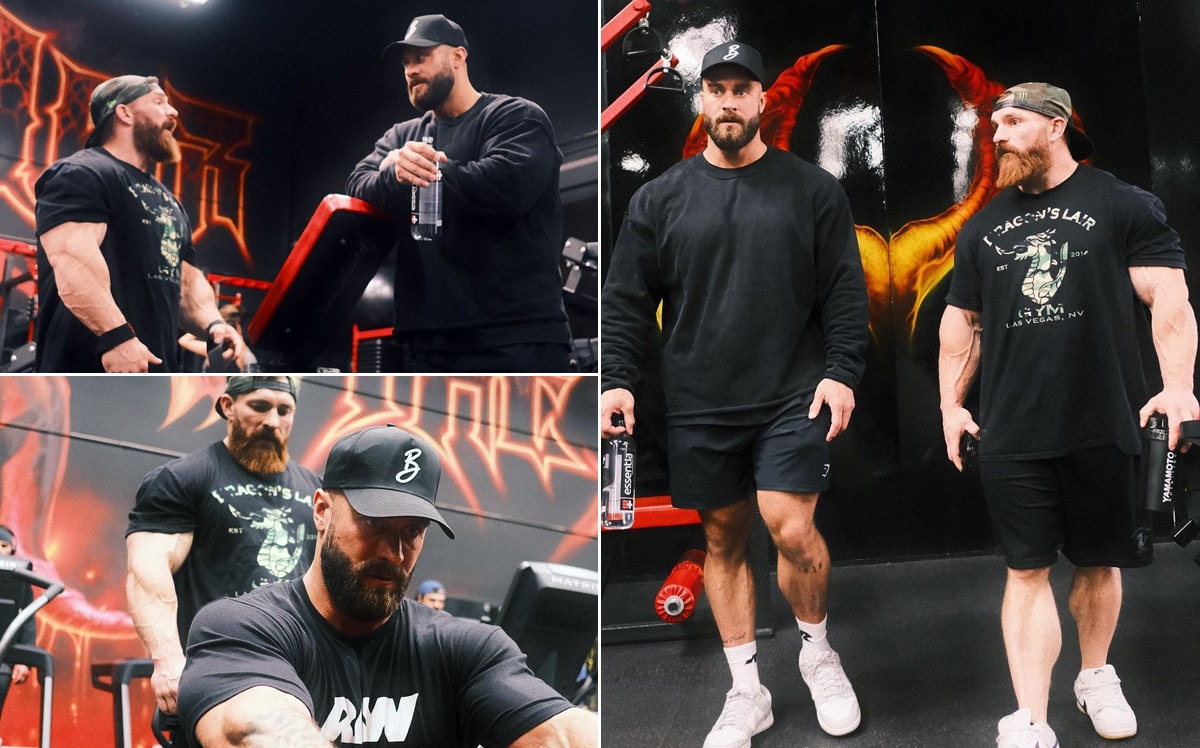
Chris Bumstead And Flex Lewis Decimate A Back Workout
Chris Bumstead continues to push himself by working with the finest individuals in the bodybuilding industry. Recently, CBum partnered with legendary bodybuilder Flex Lewis for an intense back workout to get one more step closer to the fifth Classic Physique Olympia title.
Canada’s finest Chris Bumstead is one of the most popular active bodybuilders on the planet. He has achieved the distinction by proving his worth in the competition. Since winning the Classic Physique Olympia title at the 2019 Olympia, the 28-year-old phenom has defended it with an iron will at the 2020, 2021, and 2022 Olympia.
Bumstead’s time in competitive bodybuilding is nearing the end as he intends to defend the Olympia title a few times before calling it a career. He entered the 2022 Olympia competition with a torn bicep and spent the first couple of months recovering from the injury.
As a part of his off-season effort, the Classic Physique kingpin joined veteran bodybuilder Flex Lewis for a back workout. Lewis is best known for his dominant title reign in the 212 division that saw him secure the 212 Olympia crown seven consecutive times from 2012 to 2018.
Lewis briefly considered a move up to the Men’s Open division but it never came to fruition. He announced retirement from the sport in May 2022 and has significantly downsized since. Successful business ventures like the famous Dragon’s Lair gym have kept Lewis busy and he is often seen helping active bodybuilders achieve their competitive goals as well.
Lewis and Bumstead went through the training session at the Dragon’s Lair gym. The video of this session was posted on CBum’s personal YouTube channel. So let’s check out how the bodybuilding greats worked towards building their backs.
Chris Bumstead and Flex Lewis go through a back workout
The back workout consisted of a total of four exercises – one vertical pull and three horizontal pull (rows). Vertical pulls like lat pulldowns primarily target latissimus dorsi (lats) – the large fan shaped muscle in the back. These movements are primarily responsible for building a wide back by developing the lats.
Horizontal pulls or rows are essential for giving thickness to the back. As a result, a training routine that emphasizes both types of movements is the key to complete back development.
Chest Supported Rows
CBum and Lewis kicked off the session with chest-supported seated rows on a plate-loaded machine. This compound movement engages many different muscles in the upper body which makes it efficient for building upper body strength and muscle mass.
Bumstead and Lewis started out light and slowly added more weight to the subsequent sets after sufficiently warming up the muscles. Following some solid sets of the exercise, they took to the second exercise of the day.
Chest Supported T-bar Rows
The bodybuilding community commonly accepts that rows are the best compound movement for building a 3D back. However, there are endless variations to choose from and they all deserve a place in your back routine. But if you could choose only one, our team at Fitness Volt would recommend T-bar rows.
T-bar rows work many different muscles like latissimus dorsi, trapezius, rhomboids, posterior deltoids, biceps brachii and erector spinae. These factors make it a classic back builder. Bumstead and Lewis cranked out a few sets of this exercise on the chest supported T-bar rows machine and jumped into the next exercise of the session.
Arsenal Strength Iso Lat Pulldown
Following the two major rowing movements, CBum and Lewis took to the first and the only pulldown movement of this training session. They got some heavy sets of Lat pulldown under the belt using Arsenal strength lat pulldown machine. Both weight arms of this machine attach to separate weight stacks independently. This helps create balance in both sides of the body as the person cannot pull the weight by using the favored side of the body.
The bodybuilder duo destroyed the sets of lat pulldown with incrementally heavier weights and took to the finisher of the day.
Seated Cable Rows
The back workout concluded with this rowing movement. The training partners called it a day in the gym after doing a few sets with slow and controlled motion.
Overall, the workout included:
Chris Bumstead has openly admitted that being a dominant champion comes with immense pressure. He is not untouched by the fear of losing his top spot. However, if he surrounds himself with the right people and keeps company with people like Flex Lewis who have been there, and done that, CBum can maintain the correct mindset to realize the dream of retiring on top.
You can watch the full workout video here, courtesy of Chris Bumstead’s personal YouTube channel:
Published: 19 May, 2023 | 9:01 AM EDT
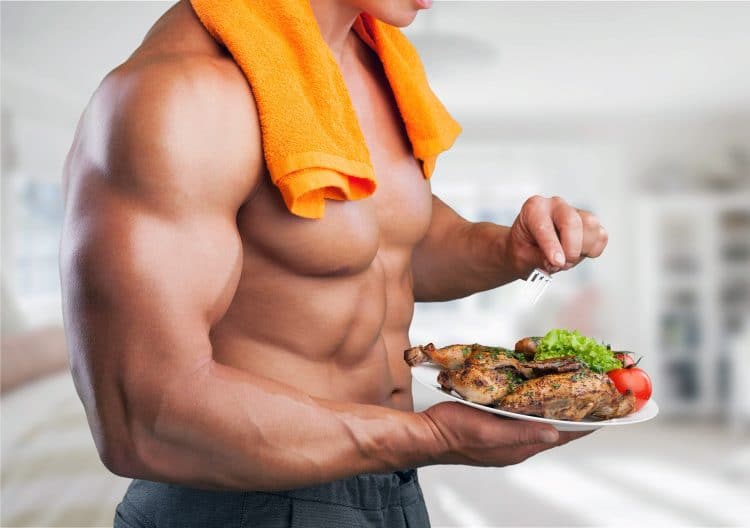
High-Calorie Foods For Bulking: 14 Best Food Ideas To Unleash Your Gains
Tell your trainer you want to build size and strength, and he’ll put you on a bulking program. The quality of your bulk depends on the foods you eat. Furthermore, since a bulking program involves eating more than usual, you must consider the taste of your food to ensure you don’t fall off the gaining regimen before meeting your transformation objective.
In this article, we take you through the best 14 high-calorie foods for bulking that will help you build muscle mass and strength while satisfying your taste buds. Plus, we shed light on the basics of bulking, its types, and a few tips to supercharge your physique transformation.
What is Bulking?
Bulking is one of the three phases of bodybuilding, with the other two being shredding and maintenance. Whether you are a fitness enthusiast or a pro bodybuilder, you will spend a considerable amount of time switching between the three phases to ensure you are on top of your game.
In a bulking phase, an individual aims to put on muscle mass and size while maintaining his body proportions. You must enter a calorie surplus to achieve your bulking goals, meaning you must eat more calories daily than you expend. A calorie surplus leads to raised glycogen stores in your body, increasing your body weight. [1]
During a bulking phase, you must ensure that you do not compromise your body composition and gain excess fat. Follow a balanced bulking diet regimen that contains nutrient-dense foods and a customized exercise regimen to meet your muscle mass and strength goals.
Difference Between Clean Bulking vs. Dirty Bulking
After months of hard labor on a shredding program, most newbie fitness enthusiasts are ecstatic to hear that their trainer is putting them on a bulking routine. Their imaginary bulking program breakfast consists of their favorite sugar-laden cereal and fruit juice, lunch involves burgers and fries, and they wrap up their mythical diet with a dinner of fried chicken and a tub of Ben & Jerry’s. If this is your idea of a bulking diet, you have got it all wrong. This unhealthy gaining diet is also known as dirty bulking.
In a dirty bulking program, the focus is on consuming a large number of calories while disregarding the calorie sources, quality, and nutritional value. On the flip side, a clean bulking program involves meeting your daily caloric needs through nutrient-dense whole foods while maintaining an appropriate macronutrient and micronutrient balance.
The dirty bulking diet is favored by people who like an unrestricted diet. However, this diet can lead to chronic health issues like type 2 diabetes and hypertension as it involves eating high-calorie, often unhealthy, and processed foods.
Although following a dirty bulking diet is much easier than abiding by a clean bulking regimen, the unbalanced high-calorie foods in this diet can result in excess body fat gain, further leading to body composition deterioration.
Dirty bulking can lead to faster weight gain; however, it results in more excess body fat gain than clean bulking. Furthermore, you must not overlook the health issues related to eating junk food for an extended period.
In this article, we will stick to 14 high-calorie food for bulking that will deliver a healthy amount of carbs, protein, and fats and don’t come with trade-offs, including excess visceral fat gain or a higher risk of contracting chronic health conditions.
Related: Dirty Bulk vs. Clean Bulk – What’s the Difference, and Which is Best?
14 Best High-Calorie Foods for Bulking
Contrary to what most people think, you don’t need to go out of your way on a bulking program to add more size and strength. Eating bigger servings of healthy foods is incredibly effective in a bulking regime.
Here are the 14 best high-calorie foods for bulking that should be a part of your diet regimen:
Nuts and Nut Butter
Nuts and nut butter should be a staple in your bulking regimen, as they are calorie-dense, packed with macro and micronutrients, and incredibly versatile and convenient.
You could grab a handful of nuts at any point during the day as a snack or have them with one of your meals. Nuts and nut butter are rich in healthy monounsaturated and polyunsaturated fats, including omega-3 fatty acids, which are essential for overall health, hormone production, and supporting muscle growth. They also contain a decent amount of fiber, vitamins (such as vitamin E), and minerals (such as magnesium and zinc).
Besides being a good source of healthy fats, nuts also contain a healthy dose of carbs and proteins. You can switch between peanuts, almonds, walnuts, cashews, and hazelnuts to keep your diet interesting. Plus, each nut has a unique nutrient content, which can help ensure you never run into nutrient deficiencies.
While choosing a nut butter, favor organic products that do not have added sugar or flavorings. You must also read the nutritional information before buying a nut butter, as its nutrient content can change depending on the brand.
Peanuts (100g)
Calories
567kcal
Carbohydrates
16g
Protein
26g
Fats
49g
Peanut Butter (100g)
Calories
588kcal
Carbohydrates
20g
Protein
25g
Fats
50g
Mass Gainer Shakes
Mass gainer shakes are an incredibly useful food source for folks who have difficulty meeting their daily calorie and macronutrient goals through whole foods. You could also use a mass gainer shake as a post-workout recovery drink or a meal replacement. Plus, mass gainer shakes come in delicious flavors, making consuming a high-calorie content easier.
The table below details the nutrient content of the Transparent Labs Mass Gainer, which is one of the best mass gainers on the market. The nutrient content of each supplement can vary depending on its ingredients.
Mass Gainer Shakes (190g serving)
Calories
760kcal
Carbohydrates
109g
Protein
53g
Fats
13g
Lean Beef
Lean beef is a high-quality protein. A 100g serving of lean beef contains 26g of protein, 15g of fats, and no carbs. Many lifters overlook the importance of protein in a bulking regimen. A high-protein bulking diet improves your muscle density, which helps retain muscle mass during the shredding phase.
Plus, lean beef is packed with vitamins such as B-complex vitamins (including vitamin B12) and minerals like iron, zinc, selenium, and phosphorus, which can help with red blood cell production, energy metabolism, and immune system function. Lean beef is also a natural source of creatine, which can help build muscle mass and strength.
Lean Beef (100g)
Calories
250kcal
Carbohydrates
0g
Protein
26g
Fats
15g
Related: Protein Calculator: Find Your Daily Protein Intake
Olive Oil
Olive oil should be your cooking oil of choice during your bulking phase. One tablespoon of olive oil contains 119 calories and 14g of monosaturated fats, which can support hormone production, aid in nutrient absorption, and provide a concentrated source of energy.
The calorie-dense healthy fat source enhances the absorption of fat-soluble vitamins, such as vitamins A, D, E, and K. Furthermore, olive oil has anti-inflammatory properties that can help soothe pains during an intense bulking strength training program. The versatile cooking oil can also improve your heart health. [2]
Olive Oil (100g)
Calories
884kcal
Carbohydrates
0g
Protein
0g
Fats
100g
Fatty Fish
Fatty fish are among the best high-calorie foods for bulking. Fish, such as salmon, contain omega-3 fatty acids and vitamins such as D and B2 (riboflavin). They are also rich in calcium and phosphorus and are a great source of minerals, such as iron, zinc, iodine, magnesium, and potassium.
Most people tend to meet their carbohydrate goals on a bulking regimen but tend to miss their protein and fat targets. Adding seafood to your diet can help fix the discrepancies. Since fish is a fast-absorbing protein source, eating salmon post-workout can kickstart your recovery process.
Salmon (100g)
Calories
208kcal
Carbohydrates
0g
Protein
20g
Fats
13g
Avocado
This fruit is one of the best sources of healthy fats. Besides being a healthy fat source, avocados contain a decent amount of fiber, which can help control your cholesterol and blood sugar levels.
Avocados also contain vitamins C, E, K and B-complex vitamins and minerals such as potassium, magnesium, and copper. Its rich, creamy flavor and anti-inflammatory properties make it a must-have in your bulking phase. You could have avocado in your salad with your meals or as a guacamole dip.
Avocado (1 Medium)
Calories
240kcal
Carbohydrates
13g
Protein
3g
Fats
22g
Whole Grains
Whole grains such as barley, cracked wheat, millet, quinoa, and black rice are complex carbohydrates that dissolve slowly into your bloodstream. It helps provide a steady energy supply, which can help power your intense training sessions.
Whole grains contain a healthy amount of fiber, which improves digestion, promotes satiety, and helps regulate blood sugar levels. They are also packed with essential vitamins and minerals. These nutrient-dense foods are incredibly versatile and can be consumed in different forms at any time during the day.
Multi-Grain Bread (1 regular slice)
Calories
69kcal
Carbohydrates
11g
Protein
3.5g
Fats
1.1g
Legumes
Legumes such as chickpeas, black beans, green peas, lima beans, kidney beans, and black-eyed peas are rich in carbs and protein. They also contain a healthy dose of fiber, B vitamins, iron, folate, calcium, potassium, phosphorus, and zinc.
Legumes are also complex carbohydrates that deliver a steady energy release, helping sustain intense and long workouts. Plus, legumes are economical and versatile ingredients that can be incorporated into various meals and recipes.
A 100g serving of legumes like chickpeas contains 364 calories, making them one of the best high-calorie foods for bulking.
Chickpeas (100g)
Calories
364kcal
Carbohydrates
61g
Protein
19g
Fats
6g
Eggs
Eggs are the darling of the fitness community. Folks on a bulking regimen should include a few whole eggs in their diet regimen as they are packed with protein and fats. One large whole egg delivers 78 calories, which is an excellent figure for a food source of its size.
Eggs are incredibly versatile. You could eat eggs at any time throughout the day. Many people prefer scrambled eggs over boiled eggs as they are easier to digest. Furthermore, the high-quality protein source contains essential nutrients, including vitamins A, B2, B6, B12, D, E, and minerals such as iron, zinc, and selenium, which can help improve your overall health.
Finally, the affordable protein source has high bioavailability, meaning it is easily absorbed and utilized by the body.
Whole Eggs (1 large boiled)
Calories
78kcal
Carbohydrates
0.6g
Protein
6g
Fats
5g
Chicken Breast
Chicken breast is one of the best protein sources, which can help balance your macronutrient split in a high-calorie diet. It contains all the essential amino acids required for muscle protein synthesis, making it perfect for people trying to build muscle mass in their bulking phase.
Chicken breast is also rich in essential nutrients, including vitamins B6 and B12, niacin, phosphorus, and selenium, which can boost energy production, metabolism, immune function, and overall health.
Chicken Breast (100g)
Calories
165kcal
Carbohydrates
0g
Protein
31g
Fats
3.6g
Sweet Potato
Sweet potato is one of the most delicious vegetables in an otherwise bland bodybuilding bulking diet. The complex carbohydrate is packed with calories and carbs, which will help add size to your frame.
Plus, sweet potato is rich in dietary fiber, both soluble and insoluble, which can aid digestion, promote satiety, and supports a healthy gut. It also contains a healthy dose of essential vitamins and minerals, including vitamins A, C, potassium, manganese, and B6.
Sweet potato’s antioxidating properties protect against cellular damage and inflammation caused by intense workouts during a bulking training program. Although a complex carb, sweet potato has a low GI score, meaning it has a low impact on your blood sugar levels. It allows you to meet your carb goals for your bulking phase without significantly spiking your blood sugar levels.
Sweet Potato (1 5-inch long)
Calories
112kcal
Carbohydrates
26g
Protein
2g
Fats
0.1g
Whole Milk
Milk is one of the most convenient high-calorie food sources to consume during a bulking phase. Folks undergoing a serious bulk find chugging a jar of milk easier than chewing countless amounts of chicken breast or legumes.
Besides a decent macronutrient split, whole milk is rich in essential vitamins and minerals, including calcium, vitamin D, B12, and phosphorus. It is also one of the most convenient and readily-available food sources around the world.
Whole Milk (1 cup)
Calories
149kcal
Carbohydrates
12g
Protein
8g
Fats
7.9g
Greek Yogurt
Greek yogurt is a high-quality protein source you could have with one of your meals or as a snack. The fast-absorbing properties of Greek yogurt ignite muscle recovery after intense workouts.
Greek yogurt often contains live and active cultures, contributing to a healthy gut microbiome. Your gut health is essential during a bulking phase for optimal nutrient utilization and immune function, as you’ll be eating significantly more calories than usual. Like milk, Greek yogurt is an excellent calcium source, essential for bone health and muscle function. It can help reduce your risk of injury and support bone strength.
Greek Yogurt (100g)
Calories
59kcal
Carbohydrates
3.6g
Protein
10g
Fats
0.4g
Cottage Cheese
This is a slow-digesting form of protein, which provides a sustained release of amino acids into the bloodstream. Cottage cheese contains casein protein which promotes muscle growth and prevents muscle breakdown during periods of fasting, such as overnight.
Ensuring your muscles have a constant supply of protein throughout the night will prevent muscle breakdown, which can be incredibly helpful during your bulking phase. Furthermore, the healthy fat source is packed with essential nutrients such as calcium, phosphorus, selenium, vitamin B12, and riboflavin. It also contains probiotics that promote a healthy gut.
Cottage Cheese (100g)
Calories
98kcal
Carbohydrates
3.4g
Protein
11g
Fats
4.3g
Tips For Eating High-Calorie Foods For Bulking
Here are a few tips to get the best bang for your buck from your bulking journey:
Find an Appropriate Caloric Surplus and Macronutrient Split
You must determine your daily calorie and macronutrient targets based on your lifestyle, current physique, and bulking objective. According to the Centers for Disease Control and Prevention (CDC), adding 500-1,000 to your daily calorie intake can result in gaining 1-2 pounds weekly. [3]
After arriving at a suitable daily calorie intake goal, you must break it into an appropriate macronutrient (carbs, protein, and fats) split. Following an unbalanced macro split with high carb and fat intake can lead to excess body fat gain.
Eat Nutrient-Dense Foods
You shouldn’t mistake a bulking diet for a junk food diet. Relying on processed and refined foods to meet your daily calorie needs can hamper your overall health and well-being. You must stick to high-calorie whole foods to ramp up your bulking progress and keep your fat gain under check.
Related: Calorie Density Calculator
Follow a Personalized Training Regimen
Since the objective of a bulking program is to build muscle mass and strength, you must back up your high-calorie diet with a customized strength training regimen. Use progressive overload to ensure you are constantly challenging your muscles. Using the same training intensity, volume, and exercises for an extended period will lead to a muscle and strength plateau.
Furthermore, you must limit cardio and HIIT workouts during your bulking regimen as they lead to greater calorie burning, which can compromise your calorie surplus. Calorie-tracking apps can help ensure you are in a calorie surplus and meeting your macro goals.
Monitor Your Progress and Make Adjustments
Tracking your progress helps ensure that you are on the right path. Body weight, circumference, and body fat are reliable metrics for monitoring your bulking progress. You could also use photos to track your progress. These tracking methods will also keep you accountable.
Tracking your progress weekly will allow you to make quick adjustments if you feel your progress is unsatisfactory.
Follow The Bulking Phase With Cutting and Maintenance
You must always start a bulking program with a goal in mind. Starting your bulking journey without a set objective can lead to gaining excess body fat. The length of your bulking phase will depend on your starting physique and goals.
After achieving your bulking objective, you must follow the bulking phase with a cutting phase. Furthermore, you must switch to the maintenance phase after you reach your cutting goal. Most bodybuilders and fitness enthusiasts cycle between the three phases throughout the year.
Plan Your Meals in Advance
One of the reasons why so many people prefer dirty bulking is that it doesn’t require planning. You eat whatever you can get your hands on when you are starving. On the other hand, you must plan your meals during a clean bulk to ensure you are meeting your macronutrient goals.
Reserve one day of the week, preferably a Sunday, for prepping your meals. Use unprocessed foods that are nutrient-dense, easy and quick to cook, and have a long shelf life.
Frequently Asked Questions
How often should you consume cheat meals on a bulking program?
There is no hard rule about eating cheat meals on a bulking program. You don’t necessarily need cheat meals if you can meet your daily calorie goals with nutrient-dense whole foods. However, sticking to a strict diet regimen can lead to cravings, which opens room for a weekly cheat meal during a bulking regimen.
You must restrict yourself to one weekly cheat meal, as high amounts of processed food can skew your body composition and make you more vulnerable to contracting health conditions such as type 2 diabetes and high blood pressure.
How many calories should a bulking meal contain?
The ideal number of calories in a bulking meal depends on your personal preferences, current physique, daily calorie goal, and the number of meals you eat in a day, including snacks. Some people like to have a heavier breakfast and lunch and a light dinner, whereas others like to eat more balanced meals. If you eat three meals daily, you could consume 35% of your calories in your breakfast and lunch and the remaining 30% in your dinner.
Do I have to eat junk food during a bulking regimen to gain strength and muscle mass?
No! You must favor clean bulking over dirty bulking. Nutrient-dense foods like lean meats, whole grains, and healthy fats provide your body with the building blocks to build muscle mass and support overall health and well-being. On the flip side, relying mainly on junk foods significantly increases your risk of contracting chronic health conditions.
What are the best supplements for bulking?
The sports nutrition market is packed with supplements that can help you in your bulking journey. Some of the best bulking supplements include a mass gainer, whey protein, creatine, dextrose, and BCAAs. However, you must ensure you are not overly reliant on supplements to gain muscle mass and strength. Getting the bulk of your calories from nutrient-dense whole foods provides faster results and improves longevity.
What is the ideal macronutrient split during a bulking program?
The ideal macro split will vary depending on an individual’s current and goal physique. Nonetheless, your macronutrient split during a bulking phase should be in the following brackets:
Carbohydrates: 45% to 60%
Protein: 30% to 35%
Fats: 15% to 30%
Notably, it’s easier to meet these macronutrient split with a clean bulk. Relying on refined and processed foods for your daily caloric goal can significantly increase your carb and fat intake while marginalizing your protein intake.
Note: The content on Fitness Volt is for informative purposes only and should not be taken as medical advice to diagnose, prevent, or treat health problems. If you’re suffering from a health issue, are pregnant, or are under 18 years old, you should consult your physician before starting any new supplement, nutrition, or fitness routine.
Wrapping Up
Bulking is easier said than done. You must enter a calorie surplus while eating balanced high-calorie macronutrient sources to ensure you don’t gain excess body fat or compromise your body composition.
Following a personalized bulking diet and exercise regimen, according to your overall health, goals, and preferences, can help speed up your transformation progress. The 14 high-calorie foods for bulking listed in this article will help you achieve your gaining goals while satisfying your taste buds. Cycle these nutrient-dense food sources in your daily diet plan to achieve your strength and muscle goals while keeping your meals interesting. Best of luck!
References
Leaf A, Antonio J. The Effects of Overfeeding on Body Composition: The Role of Macronutrient Composition – A Narrative Review. Int J Exerc Sci. 2017 Dec 1;10(8):1275-1296. PMID: 29399253; PMCID: PMC5786199.
Nocella C, Cammisotto V, Fianchini L, D’Amico A, Novo M, Castellani V, Stefanini L, Violi F, Carnevale R. Extra Virgin Olive Oil and Cardiovascular Diseases: Benefits for Human Health. Endocr Metab Immune Disord Drug Targets. 2018;18(1):4-13. doi: 10.2174/1871530317666171114121533. PMID: 29141571.
Centers for Disease Control and Prevention. (2021). Losing Weight. Retrieved from https://www.cdc.gov/healthyweight/losing_weight/index.html
Three Leg Day Workouts for Women
A lot of guys, especially younger lifters, tend to skip leg day. Instead, they focus all their energy on training their pecs, lats, delts, and arms. This creates a very unbalanced physique, which is why many men are happy to be seen shirtless but keep their legs covered with long pants.
In contrast, many women are overly focused on training their lower bodies, especially their glutes. Some even train their legs every day, combining their lower body workouts with hours of leg-centric cardio.
So, why are so many women unhappy with the shape and condition of their legs?
In many cases, the reason is quantity over quality. In other words, some women’s leg workouts are high in volume and frequency but low in effective exercises. So instead of using a targeted approach, it’s more of a kitchen sink affair, with workouts containing so many exercises that many of them are actually redundant.
While such enthusiasm and dedication are to be applauded, there are better ways to use your training time and energy. These are valuable commodities that should be invested wisely and not wasted on unproductive or unnecessarily long workouts.
Get better results from your training time with these three tried and tested leg day workouts!
Leg Anatomy Basics
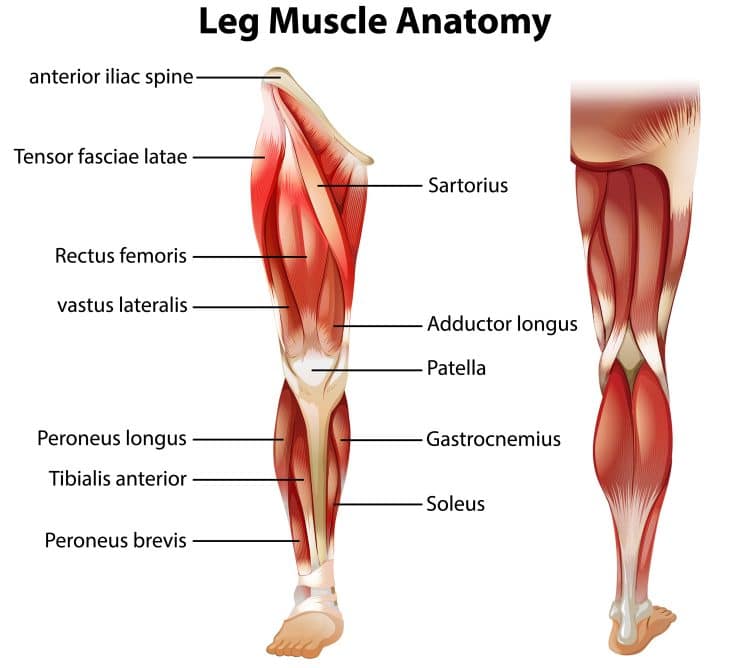
Before we get into the nitty-gritty of effective lower body training, let’s take a moment to look at the muscles you’ll be working. That way, you’ll be able to name the parts of your body you can feel during each workout.
The main muscles that make up your lower body are:
Gluteus maximus
Located on the back of your hips, the gluteus maximus (glutes for short) is the largest muscle in the human body and potentially the most powerful. The main role of the glutes is hip extension, but it’s also involved in external rotation and abduction of the hip.
Hamstrings
The hamstrings are a biaxial muscle that crosses the back of your knees and hips. As such, it has two main functions – knee flexion and hip extension. There are three hamstring muscles: biceps femoris, semimembranosus, and semitendinosus. You can develop the hamstrings by performing leg curls and hip hinging exercises.
Quadriceps
The quadriceps extend your knee and flex your hips. There are four quadriceps muscles: the rectus femoris, vastus lateralis, vastus medialis, and vastus intermedius. Known as the quads for short, these muscles are located on the fronts of your thighs.
Hip abductors
The hip abductors are located on the sides of your hips and thighs. They are responsible for lifting your legs out and away from the midline of your body. The hip abductors are the gluteus maximus and medius and tensor fascia latae.
Hip adductors
Located on the inside of your thighs, the hip adductors are responsible for drawing your legs in toward the midline of your body. The three hip adductor muscles are longus, brevis, and magnus, meaning longest, shortest, and biggest.
Triceps surae
Triceps surae is the collective name for the muscles of your calves – the gastrocnemius and soleus. These muscles work together to point your foot in a movement called plantar flexion. In addition, gastrocnemius, the uppermost calf muscle, also works with the hamstrings to flex your knees.
Six Benefits of Leg Training for Women
Most women don’t have to be told to train their lower bodies. After all, sculpted, toned legs are a common training goal. That said, in case you are unsure about the benefits of leg training for women, here is a list of six reasons why you should work your lower body hard and often!
Increased functional strength
Almost all strenuous activities involve your legs. A stronger lower body will make these activities easier and less tiring. For example, walking upstairs, running, and lifting heavy items off the floor are less demanding when you’ve got strong legs.
More shapely legs
While lower body-centric cardio can help increase muscle tone and endurance, if you want your legs to look their best, you need to include direct leg training in your workouts. You can use strength training to target each muscle with laser-like precision, sculpting your legs to create the lower body of your dreams.
Stronger bones and healthier joints
Lower body strength training is not just good for your muscles but also for your bones and joints. Like your muscles, your bones get stronger with training. Load-bearing exercises trigger the release of bone-building cells called osteoblasts. Increasing bone strength and density can help ward off age-related bone loss (osteopenia) and may prevent osteoporosis.
Strength training is also good for your joints, namely the hips and knees. Lifting weights makes your joints more mobile and stable and can help prevent or reduce knee and hip pain.
Increased calorie and fat burning
Your lower body contains about 40% of your total body muscle – possibly more, depending on your build and genetics. Powering these muscles through a workout requires a lot of energy, which is measured in calories. Leg workouts use far more energy than most upper-body workouts. Training your legs can help increase your weekly caloric expenditure, leading to fat and weight loss.
Better balance and coordination
Balance is your ability to keep your center of mass over your base of support. In contrast, coordination is your ability to move your limbs in a controlled, harmonious way. Freeweight and bodyweight leg exercises enhance both of these fitness qualities. Better balance and coordination mean that you won’t just look more athletic but will feel it, too.
Improved posture
Long periods of sitting can cause havoc with your posture and leave you with weak legs. Poor glute muscle tone, for example, can affect your lower back, leading to pain and poor posture.
Leg training, especially when you do standing exercises, can improve your posture so you can sit and stand more upright. Good posture makes you look slimmer and younger and takes pressure off your muscles and joints.
Leg Day Workouts for Women
Here are your three leg day workouts for women. But, before doing any of them, you must prepare your joints and muscles for what you’re about to do by warming up. Start with 5-10 minutes of easy cardio, e.g., air bike, rower, jogging, or jumping rope, followed by dynamic mobility and flexibility exercises for your lower body.
A ten-minute warm-up can save you months of lost training caused by an otherwise avoidable injury, so don’t skip it.
Ready? Then let’s get to work!
Home Leg Day Workout for Women
No gym? No problem! You can get a GREAT leg workout almost anywhere. All you need is a little space and an exercise mat. Do this workout at home, in your hotel room, at the park – anywhere you want!
#
Exercise
Sets
Reps
Recovery
1
Glute bridge
2-4
12-20
60-90 seconds
2
Plie squat
2-4
12-20
60-90 seconds
3
Side leg raises
2-4
12-20 per leg
60-90 seconds
4
Alternating lunges
2-4
12-20 per leg
60-90 seconds
5
Standing calf raise
2-4
12-20
60-90 seconds
1. Glute bridge
Target muscles: Gluteus maximus, hamstrings.
Steps:
Lie on your back with your legs bent and feet flat. Brace your core and press your lower back into the floor.
Drive your feet into the deck and lift your hips up so your body forms a straight line.
Pause for 1-2 seconds.
Lower your butt to the floor and repeat.
Make this exercise harder by using one leg at a time.
2. Plie squat
Target muscles: Adductors, quadriceps, hamstrings, gluteus maximus.
Steps:
Stand with your feet about 1.5 shoulder-widths apart. Turn your toes outward. Brace your core and pull your shoulders down and back.
Bend your legs, push your knees outward, and descend until your thighs are roughly parallel to the floor.
Stand back up and repeat.
3. Side leg raises
Target muscles: Hip abductors.
Steps:
Lie on your side so your body is straight. Rest your head on your outstretched arm.
Lift your uppermost leg up to about 45 degrees. Turn your hip slightly inward to maximize glute and adductor engagement.
Lower your leg and repeat.
On completion, roll over and do the same number of reps on the other side.
Make this exercise more challenging by putting a booty band around your knees.
4. Alternating lunges
Target muscles: Quadriceps, hamstrings, gluteus maximus.
Steps:
Stand with your feet together and your arms by your sides.
Take a large step forward, bend your legs, and lower your rearmost knee down to within an inch of the floor.
Push off your front leg and return to the starting position.
Do your next rep leading with the opposite leg.
Alternate legs for the duration of your set.
5. Standing calf raise
Target muscles: Calves
Steps:
Stand on the edge of a step, using your hands for balance.
Point your toes and rise up onto your tiptoes.
Lower your heels down and get a stretch in your calves.
Alternate between these two positions for the required number of reps.
Make this exercise harder by using one leg at a time.
Dumbbell Leg Workout for Women
Dumbbells are the perfect training tool for home exercisers, and gyms have them too. Use dumbbells to overload your muscles and build more strength. Choose weights that fatigue your muscles within the prescribed rep range.
#
Exercise
Sets
Reps
Recovery
1
Dumbbell Romanian deadlift
2-4
12-20
60-90 seconds
2
Dumbbell goblet squat
2-4
12-20
60-90 seconds
3
Dumbbell leg curl
2-4
12-20
60-90 seconds
4
Dumbbell lateral lunge
2-4
12-20 per leg
60-90 seconds
5
Dumbbell swing
2-4
12-20
60-90 seconds
6
Seated dumbbell calf raise
2-4
12-20
60-90 seconds
1. Dumbbell Romanian deadlift
Target muscles: Gluteus maximus, hamstrings.
Steps:
Stand with your feet together and a dumbbell in each hand, arms by your sides. Bend your knees slightly, brace your core, and pull your shoulders down and back.
Hinging from your hips, lean forward and lower the weights down toward the floor. Do not round your lower back.
Stand back up and repeat.
2. Dumbbell goblet squat
Target muscles: Quadriceps, hamstrings, gluteus maximus.
Hold a dumbbell in front of your chest, just below your chin. Stand with your feet shoulder-width apart, core braced, and shoulders back and down.
Bend your knees and squat down until your thighs are roughly parallel to the floor. Take care not to round your lower back.
Stand back up and repeat.
3. Dumbbell leg curl
Target muscles: Hamstrings.
Steps:
Lie on an exercise bench so your knees are on the edge. Clamp and hold a dumbbell between your feet. Secure it using a yoga strap or resistance band if necessary.
Bend your legs and curl the weight up until your knees are bent to 90 degrees.
Extend your legs and repeat.
You can also do this exercise lying prone on the floor.
Dumbbell lateral lunge
Target muscles: Quadriceps, hamstrings, gluteus maximus, abductors, adductors.
Steps:
Stand with your feet together and a dumbbell in each hand, arms by your sides. Brace your core and set your shoulders back and down.
Take a large step to your left, bend your left knee, and descend until your left thigh is close to parallel to the floor. Keep your right leg straight.
Push off your left leg and return to the starting position.
Repeat this movement to your right side.
Alternate sides for the specified number of reps.
5. Dumbbell swing
Target muscles: Gluteus maximus, hamstrings.
Steps:
Hold a single dumbbell in both hands and stand with your feet shoulder-width apart. Brace your core, pull your shoulders back and down, and bend your knees slightly.
Hinge forward from your hips and lower the weight down between your knees. Do not round your lower back.
Drive your hips forward and use this momentum to swing the weight forward and up to shoulder height.
Lower the weight and repeat.
6. Seated dumbbell calf raise
Target muscles: Calves
Steps:
Sit on an exercise bench or sturdy chair, so your knees are bent to 90 degrees and your shins are vertical. Rest the balls of your feet on a low step, e.g., a thick book, wooden block, or weight plates.
Rest and hold a dumbbell on each knee.
Extend your ankles and rise up onto your tiptoes.
Lower your heels down, get a stretch in your calves, and repeat.
Gym Leg Workout for Women
Access to a well-equipped gym means you’ve got everything you need to easily target your leg muscles. However, don’t get distracted and try to do every exercise you see. Instead, pick the best movements for each lower body muscle group. Remember – quality is always better than quantity!
#
Exercise
Sets
Reps
Recovery
1
Smith machine donkey kick
2-4
12-20 per leg
60-90 seconds
2
Leg press
2-4
12-20
60-90 seconds
3
Cable hip abduction
2-4
12-20 per leg
60-90 seconds
4
Cable hip adduction
2-4
12-20 per leg
60-90 seconds
5
Barbell hip thrust
2-4
12-20
60-90 seconds
6
Tiptoe farmer’s walk
2-4
40-60 seconds
60-90 seconds
1. Smith machine donkey kick
Target muscles: Gluteus maximus, hamstrings.
Set the bar on a Smith machine to around waist height.
Kneel on the floor beneath the bar and place the sole of one foot against it.
Extend your hip and drive the bar upward, taking care not to hyperextend your lower back.
Lower the bar and repeat.
Do the same number of reps on both sides.
2. Leg press
Target muscles: Quadriceps, gluteus maximus, hamstrings.
Sit on the leg press machine and place your feet on the footplate so they’re roughly shoulder-width apart. Release the weight catchers.
Bend your legs and lower the weight down until your knees are bent to at least 90 degrees. Do not round your lower back.
Extend your legs and repeat.
Reengage the weight catchers and then rest.
3. Cable hip abduction
Target muscles: Hip abductors.
Put an ankle strap around your lower leg and then attach it to a low pulley machine.
Stand sideways onto the machine, your working leg furthest from the weight stack. Hold the machine for balance.
Keeping your leg straight, raise your foot out and away from the midline of your body.
Lower your leg and repeat.
Do the same number of reps on both legs.
4. Cable hip adduction
Target muscles: Hip adductors.
Put an ankle cuff around your lower leg and then attach it to a low pulley machine.
Stand sideways onto the machine, your working leg closest to the weight stack. Hold the machine for balance.
Keeping your leg straight, cross your foot in front of you.
Return to the starting position and repeat.
Do the same number of reps on both legs.
5. Barbell hip thrust
Target muscles: Gluteus maximus, hamstrings.
Sit on the floor with your upper back resting against a sturdy bench. Rest a barbell across your hips. Bend your legs and put your feet flat on the floor.
Drive your feet into the floor and lift your hips to form a straight line with your knees and shoulders.
Lower your butt back to the floor, and then repeat.
6. Tiptoe farmer’s walk
Target muscles: Calves.
Stand with a dumbbell in each hand and your feet together. Brace your core and pull your shoulders down and back.
Rise up onto your tiptoes and then start walking around your training area.
Continue for the designated distance or until you are unable to keep your heels off the floor.
Leg Day for Women – FAQs
Do you have a question about these workouts or leg training for women in general? No problem, because we’ve got the answers!
1. How often should I train my legs?
It’s generally accepted that it takes 48-72 hours for a muscle to recover from training. This means you can work your legs every 2-3 days or 2-3 times per week. More workouts could lead to overtraining, while just one workout per week may not produce the results you want.
So, hit your legs 2-3 times per week, e.g., Monday and Thursday or Monday, Wednesday, and Friday. This will create a good balance between work and rest.
2. Can I change the exercises in these workouts?
While you are free to make changes to these programs, avoid using exercises that are too different. For example, while doing machine leg curls instead of dumbbell leg curls is fine, doing leg extensions instead of leg curls is not, as the replacement movement uses an entirely different muscle group.
So, make changes if you wish, but make sure you switch “like for like” and don’t use completely different movements. However, avoid changing the exercise order, as doing so can unbalance your entire workout.
3. Do I have to stick to the 12-20 rep range?
Unless you are training for pure strength, it really doesn’t matter all that much how many reps you do per set. Studies suggest that you can perform 5 to 35 reps per set and still make progress (1). Almost any rep count will work if you take your set close to momentary muscular failure.
However, if you want to build strength, you need to use heavy weights and do lower reps, typically 1-5. However, this is a very specialist type of training and not something many women (or men) need to do.
So, if you want to do eight, ten, twenty, or thirty reps per set, you are free to do so.
4. How do I make my thighs thinner?
Reducing the circumference of your thighs is usually more about your diet than your workout program. Invariably, big thighs are the result of excess fat storage rather than muscle mass. So if your thighs are bigger than you want and you’re not a weightlifter or bodybuilder, you probably need to adjust your diet and shed the excess fat.
However, it’s worth noting that no amount of dieting guarantees you’ll develop a “thigh gap” or achieve any other Instagram body standard, as your shape is primarily determined by your genetics.
So, don’t compare how you look to anyone else; just be the best you can be.
5. What is the best diet to use with these workouts?
Healthy eating and regular exercise go hand in hand – or they should! Eating right will make your workouts more productive, while an unhealthy diet could undermine your progress. However, there is no single perfect diet that’s right for everyone, and what you eat will depend on your fitness goals, likes and dislikes, cooking skills, and grocery budget.
So, rather than follow a cookie-cutter diet, why not take a shot at creating your own healthy eating plan? It’s actually easier than you think!
Check out this guide to overhauling your diet in six weeks. It could be the last diet you ever need.
Closing Thoughts
Friends don’t let friends skip leg day, or so the popular meme goes. That’s true for men AND women. Leg workouts offer a lot of benefits, including increased functional strength, better endurance, greater bone density, and enhanced fat burning.
In fact, leg training is so good for you it’s hard to think of many reasons not to do it.
Sure, leg training is demanding and can leave you tired and sore. But you’ll soon learn to love it when you see and feel how good it is for you.
So, give one of these leg day workouts for women a try. You’ll soon be on the way to leaner, shapelier, stronger legs.
References:
1 – Lasevicius T, Ugrinowitsch C, Schoenfeld BJ, Roschel H, Tavares LD, De Souza EO, Laurentino G, Tricoli V. Effects of different intensities of resistance training with equated volume load on muscle strength and hypertrophy. Eur J Sport Sci. 2018 Jul;18(6):772-780. doi: 10.1080/17461391.2018.1450898. Epub 2018 Mar 22. PMID: 29564973. https://pubmed.ncbi.nlm.nih.gov/29564973/
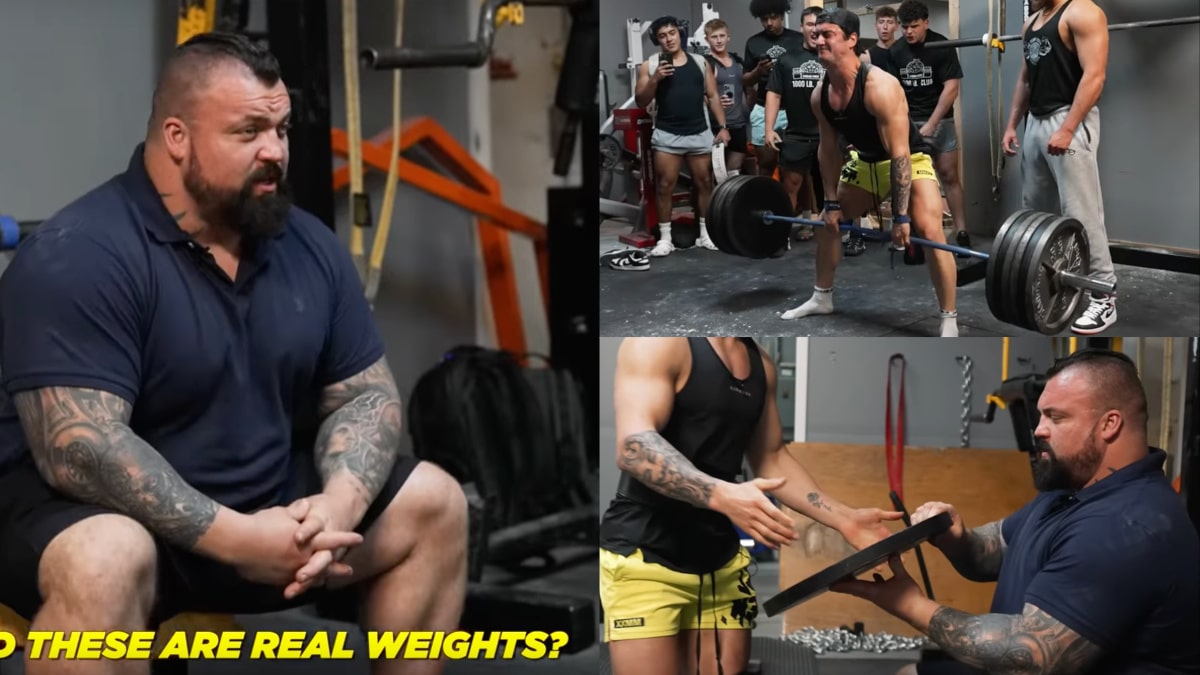
Jesse James West Pranks Eddie Hall With 675-lb Deadlift Using Fake Weights
English Strongman icon Eddie Hall first made a name for himself with his crazy feats of strength in competition. Although he stepped away from competing years ago, he continued to expand his footprint in the fitness world. In a recent video uploaded on YouTube, Jesse James West pranked Hall by recording some massive lifts using fake weights.
Eddie Hall kicked off his professional Strongman career in 2010 with a dominant win at England’s Strongest Man contest. He worked his way up the ranks and qualified for the World’s Strongest Man competition for the first time in 2012. He was at the height of his powers for the 2016/17 season when he set a new World Record on the deadlift of 500-kg (1,102-lb) and secured the coveted WSM title.
Hall took on fellow Strongman legend Hafthor Bjornsson inside the boxing ring in a bout billed ‘The Heaviest Boxing Match in History’ in March 2022. He dropped weight preparing for the contest and presented a leaner look. However, he failed to get the nod on the judges’ scorecards.
Earlier this year, Eddie Hall took inspiration from former two-time Mr. Olympia Mamdouh ‘Big Ramy’ Elssbiay and reigning four-time Classic Physique champion Chris Bumstead’s performances at the 2022 Mr. Olympia and announced his switch to competitive bodybuilding. He plans to make his debut in late 2024 at a weight of around 320 pounds (145.1-kg).
Eddie Hall teamed up with IFBB Pro bodybuilder Jamie Christian-Johal for an intense back workout to get ready for the move four months ago. The duo collaborated again for a laborious chest training session weeks later. Then, Hall performed a brutal back workout to improve his physique.
The 35-year-old opened up on the challenges of competing at the highest level in Strongman three months ago. He revealed he’d consume about 15,000 calories a day and even wolfed down 20,000 calories in a single day once. He stressed the importance of proper recovery for optimal performance.
Eddie Hall joined forces with legendary bodybuilder Jay Cutler for a grueling upper body workout two months ago. The four-time Mr. Olympia praised Hall’s work ethic after mentoring him through the session. Hall later partnered with powerlifting sensation Larry Wheels, who’s preparing for his Classic Physique debut; they took part in a taxing shoulder workout.
Internet sensation Jesse James West amassed a huge following on social media with his entertaining content centered around fitness. Besides playing pranks, he tries out different workout plans, gyms, and diets. He put the nine tenets of ancestral living to the test by trying to live like Liver King for over two days under the guidance of the man himself last August.
Jesse James West Pranks Eddie Hall with Fake Weights
In a recent YouTube video, Eddie Hall got tricked by Jesse James West into believing the latter recorded some insane lifts when he was actually using fake weights.
Jesse started with Squats using weights as follows:
1. Fake Weight: 0 lbs, real weight: 45lbs2. Fake Weight: 0 lbs, real weight: 135lbs3. Fake Weight: 0 lbs, real weight: 225lbs4. Fake Weight: 0 lbs, real weight: 315lbs5. Fake Weight: 405 lbs, real weight: 315lbs (Prank begins)6. Fake Weight: 455 lbs, real weight: 365lbs7. Fake Weight: 495 lbs, real weight: 315lbs
Bench Press using weights as follows:
1. Fake Weight: 0 lbs, real weight: 135lbs2. Fake Weight: 0 lbs, real weight: 225lbs3. Fake Weight: 315 lbs, real weight: 225lbs (Prank begins)4. Fake Weight: 365 lbs, real weight: 275lbs5. Fake Weight: 405 lbs, real weight: 225lbs
Deadlift using weights as follows:
1. Fake Weight: 0 lbs, real weight: 135lbs2. Fake Weight: 225 lbs, real weight: 135lbs (Prank begins)3. Fake Weight: 315 lbs, real weight: 225lbs4. Fake Weight: 405 lbs, real weight: 315lbs5. Fake Weight: 495 lbs, real weight: 315lbs6. Fake Weight: 585 lbs, real weight: 405lbs7. Fake Weight: 675 lbs, real weight: 405lbs
West played a similar prank on bodybuilding legend Ronnie Coleman earlier this year. He misled the eight-time Mr. Olympia into thinking he lifted 700 pounds on the squat before revealing he used fake weights for the stunt. He also collaborated with top strongman contenders Luke and Tom Stoltman for a Strongman-style training session three months ago.
Although Hall was aware of the possibility fake weights could be involved, West’s acting skills convinced him otherwise.
RELATED: Eddie Hall Explains How Exercise Helped Him Manage His ADHD: ‘I Was Definitely a Victim of That’
You can watch the full video below.
Published: 18 May, 2023 | 7:42 PM EDT
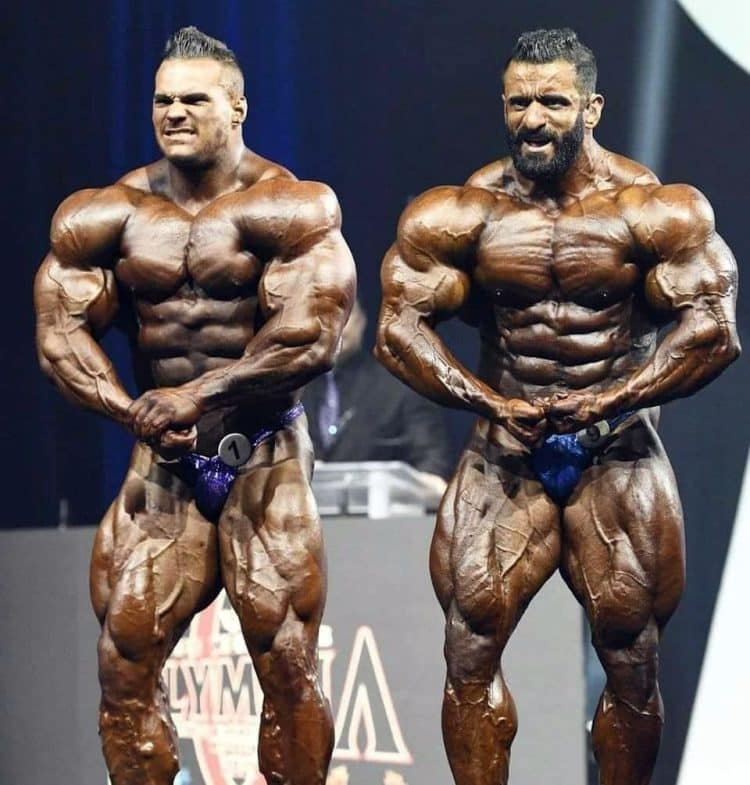
Lee Priest Predicts ‘Beef Stu’ and Tonio Burton Will Battle for 1st at 2023 New York Pro This Weekend
The bodybuilding season marches on as competitors prepare for another busy weekend. In a recent Rx Muscle interview, Lee Priest predicted which bodybuilders are most likely to walk away with gold at the 2023 New York Pro.
Over the last six months, the Men’s Open division has changed dramatically. At the 2022 Mr. Olympia contest, mass monster Mamdouh ‘Big Ramy’ Elssbiay failed to repeat as champion. Instead, Iranian-born Hadi Choopan claimed the title after outlasting contenders Derek Lunsford and Nick Walker in the finals.
Nick Walker and Hadi Choopan at The Mr. Olympia 2021
With a new Mr. Olympia champion looking over the category, fans’ attention turned to Columbus, Ohio for the 35th annual Arnold Classic. Once again, Walker was in the running to win but was narrowly defeated by Samson Dauda.
Considering Choopan, a former 212 bodybuilder, was able to win the Open title at Mr. Olympia, some in the sport believe the division is shifting to favor shape and conditioning over freak factor. And while the season has remained somewhat quiet since Dauda’s victory, that is about to change at the sport’s third most prestigious contest this weekend.
Lee Priest Names Tonio Burton & ‘Beef’ Stu Sutherland As 2023 New York Pro Favorites
Having assessed Tonio Burton‘s physique, Lee Priest shared that he was impressed with the athlete’s shape, muscularity, and conditioning, adding that he could ‘definitely win it.’
“Yeah, I think I just saw some photos, he’s the one that has the tattoos on him doesn’t he? Yeah, I’ve always been impressed when I’ve seen him with his shape, muscularity, and conditioning I’ve sometimes seen him in.
I think he popped up on Instagram this morning he was doing a lat spread or something . Like I said, he looks great. Just the proportions and what he has, he has one of those physiques where he’s going to look so much better on stage, the illusion of the round muscles and the shape. He can definitely win it,” said Lee Priest.
Before looking at other contenders, Priest was taken aback by the lack of big names participating this weekend.
“Back in the day, remember the big names that would turn up at those shows, it was always the Olympia, the Arnold, and the Night of Champions, now the New York Pro, those were good shows and if you wanted them, they were a good win. Like I’ve said before, a lot of these pros sit out so many shows where they could fuc**ng win them if they turned up in great shape.”
Priest dubbed Maxx Charles as a dark horse given his consistent ability to enter shows with great conditioning.
“The thing about Maxx, I like Maxx, I think I’ve seen him in a few shows,” said Priest. “There’s a few shows I’ve seen him in. Like last year, where I thought he should have placed higher than he should have than he did I mean. His conditioning is generally on point. He can, like I said, it’s going to be one of those things, you don’t know till the day.”
In addition to Burton, Priest anticipates ‘Beef’ Stu Sutherland fighting for gold. He explained that Stu managed to hold his own against Hunter Labrada during a guest-posing event earlier this year.
“I could see him being, he could win or be top three easy from the names so far,” Priest shared. “Wasn’t there a guest posing a while ago where he was posing next to Hunter Labrada and he held his own.”
While some in the community had hoped for bigger names in the 2023 New York Pro, Priest believes it’s exciting because there’s no clear winner leading up to the contest.
“We don’t a lot them but that still makes it exciting like I said, because there is no clear winner. Watching this show is going to be picking the winner as well with the judges. There’s nothing worse than you go, ‘Okay the judges are going to put him first he always wins.’ Make it exciting that way. Even for the competitors too, they must know.
It sounds bad when you say there’s no big names in it, like there’s no good bodybuilders, because these guys competing are great bodybuilders. You know what I mean, back in the day, it had to be like those names, like Kevin Levrone, it was like, ‘Oh, Kevin was going to win.’ Even for the guys competing in this show, they’re probably all going in it with the mindset, ‘Shit any of us can win this.’ There’s no standout person here. It probably makes them try harder.”
Before making his New York Pro debut, Stuart Sutherland joined Fouad Abiad on a recent Bro Chat episode. He was happy there wasn’t a ‘bunch of studs’ performing this weekend and said he was feeling confident about his chances of success.
The winner of this year’s 2023 New York Pro will earn an invitation to the Mr. Olympia contest November 2-5 in Orlando Florida, where they will have the chance to face off against the reigning champion Choopan.
RELATED: Sergio Oliva Jr. Aiming for 2023 New York & Cali Pro, Fires Back at ‘Instagram Bodybuilder’ Label
Watch the full video below from the Rx Muscle YouTube channel:
Published: 18 May, 2023 | 4:05 PM EDT
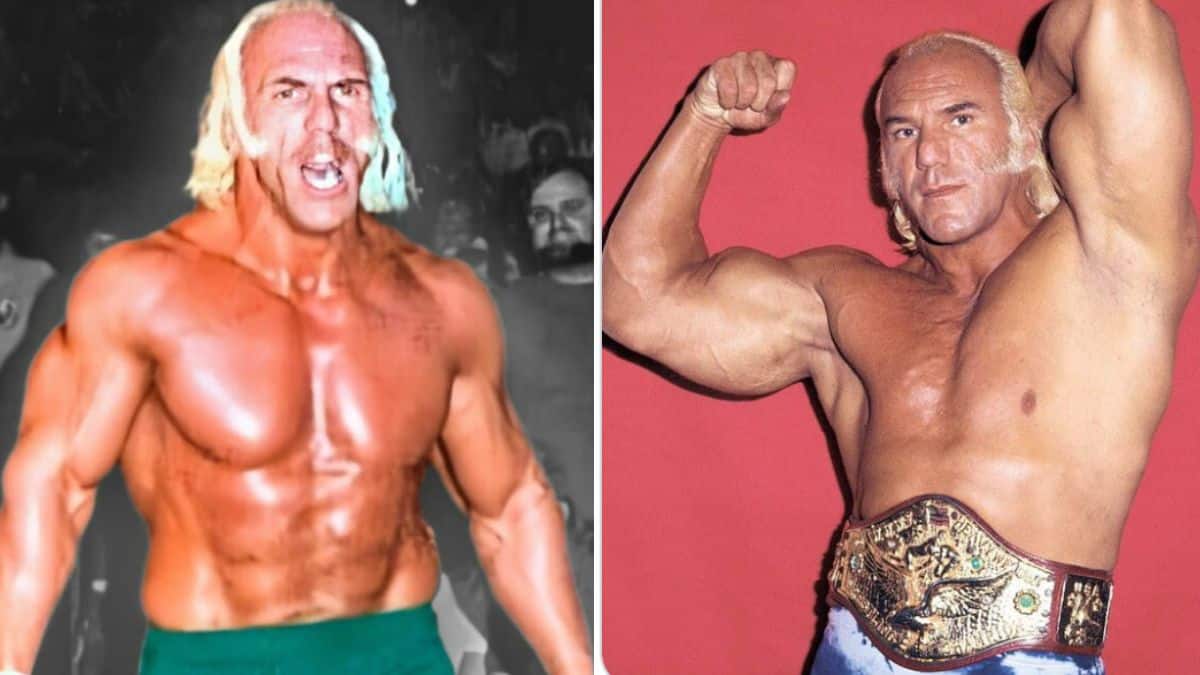
WWE Hall of Famer ‘Superstar’ Billy Graham Dies at 79, Wrestling Legends Pay Emotional Tribute
Eldridge Wayne Coleman, better known as ‘Superstar’ Billy Graham, died at the age of 79, according to his family and WWE. It was revealed that he had been suffering from a number of health problems for years. Graham was on life support in the ICU in the hours leading up to his passing.
As a former WWE champion and pioneer of the sport, Graham captivated audiences for decades. Before embarking on his professional wrestling journey, Graham dabbled in football and bodybuilding. In the years to come, Graham would join his first pro wrestling organization in 1975 (WWE).
He won three world titles during his career and took part in different leagues including, WWF, AWA, NWA, and WWWF. In addition, he defeated WWE Hall of Famer Bruno Sammartino back in 1977. Graham was known for flashy outfits, dyed hair, and used catchphrases often throughout his tenure. He was later inducted into the Hall of Fame in 2004 and is recognized as one of the most influential wrestlers of his generation.
In addition to his wrestling boots, Graham served as a commentator briefly after his last fight in 1979. After using an array of substances for years, Graham became an outspoken critic against the use of steroids.
WWE Issues Statement After Passing of ‘Superstar’ Billy Graham, Wrestling World Reacts
Below, you can find WWE’s official statement regarding Billy Graham’s death. It should be noted that Graham was placed on life support earlier this week and had dealt with various health issues like drug addiction, liver failure, and infections.
“WWE is saddened to learn that WWE Hall of Famer “Superstar” Billy Graham has passed away. We extend our condolences to Graham’s family, friends, and fans.” WWE shared via Twitter.
WWE is saddened to learn that WWE Hall of Famer “Superstar” Billy Graham has passed away. We extend our condolences to Graham’s family, friends, and fans.https://t.co/Qpykpjv616
— WWE (@WWE) May 18, 2023
It didn’t take long for the community to extend their best wishes and condolences.
“The Superstar Billy Graham Just Left Us THANK YOU FOR ALL YOUR INFLUENCE On My Career!” Ric Flair wrote.
The Superstar Billy Graham Just Left Us ?? THANK YOU FOR ALL YOUR INFLUENCE On My Career! pic.twitter.com/YH0eT2NM4p
— Ric Flair® (@RicFlairNatrBoy) May 18, 2023
“Before Billy Graham, performers in WWWF / WWF/ WWE were known as professional wrestlers. After Billy Graham left his mark, Vincent Kennedy McMahon decided everyone would be a WWE Superstar. A most heartfelt RIP to the man of the hour, the man with the power, too sweet to be sour!” Paul Heyman shared.
Before Billy Graham, performers in WWWF / WWF/ WWE were known as professional wrestlers. After Billy Graham left his mark, Vincent Kennedy McMahon decided everyone would be a WWE Superstar. A most heartfelt RIP to the man of the hour, the man with the power, too sweet to be sour! pic.twitter.com/bwL6UQ3c3h
— Paul Heyman (@HeymanHustle) May 18, 2023
“This is the version of Superstar Billy Graham I got to see in FL. He would come out to Kung Fu Fighting & I loved it! RIP to the most copied man ever in Pro Wrestling.” Sean Waltman said.
This is the version of Superstar Billy Graham I got to see in FL. He would come out to Kung Fu Fighting & I loved it! RIP to the most copied man ever in Pro Wrestling. pic.twitter.com/hLzoWaXDiD
— Sean Waltman (@TheRealXPac) May 18, 2023
“SUPERSTAR BILLY GRAHAM. ONE OF MY FIRST TEACHERS OF THE HEAT. THE REAL LEGEND BUBBA. HE LOVE ME I LOVE HIM. TOGETHER WE HIT THE GYM AND SHOCK THE EARTH. I LOVE YOU FOREVER BROTHER. RIP” The Iron Sheik wrote.
SUPERSTAR BILLY GRAHAM. ONE OF MY FIRST TEACHERS OF THE HEAT. THE REAL LEGEND BUBBA. HE LOVE ME I LOVE HIM. TOGETHER WE HIT THE GYM AND SHOCK THE EARTH. I LOVE YOU FOREVER BROTHER. RIP pic.twitter.com/0UEIy2HNgt
— The Iron Sheik (@the_ironsheik) May 18, 2023
In one of the final updates before his death, details were shared about Graham’s health conditions on his GoFundMe page.
“It has now been four months since Wayne has not been home, he has either been at the rehab center, or in the hospital. Due to ongoing issues from his lack of appetite he has now lost 80 pounds and subsequently continues to struggle with extreme weakness,” the April 26 update read.
“The Osteomyelitis infection in his ears, skull and sinus cavity remains his greatest challenge. He’s on strong IV antibiotics 3 times a day to treat this and the infectious disease doctor says he will need to be on them for at least 3 more months. As a result of this infection, he is currently completely deaf. We’re praying this is temporary, and will resolve as the infection is treated. He has intermittently also suffered with kidney issues, and been on dialysis. This in addition to Billy having heart and lung concerns, sores from being in bed for 4 months and depression.”
Given his charismatic attitude and colorful personality, Graham had a hand in shaping many rising stars in the wrestling community. It’s evident he had a major impact on the sport and helped elevate WWE to the next level of mainstream.
RELATED: 69-yo Hulk Hogan ‘Can’t Feel His Lower Body’ After Back Surgeries, Says WWE Star Kurt Angle
Fitness Volt sends its prayers and best wishes to ‘Superstar’ Billy Graham’s friends and family as they navigate through this difficult time.
Published: 18 May, 2023 | 1:24 PM EDT
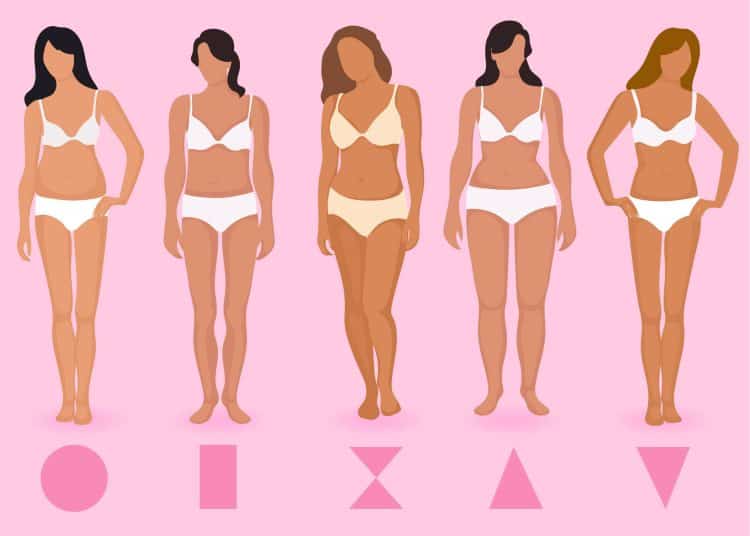
Understanding Female Body Types and Shapes
Humans come in all shapes and sizes. The average human shape doesn’t exist, even though society likes to create its ideals. When it comes to the female body, traditionally, the different varieties have been described by shapes as well as by fruit. Even though it’s possible to classify body types according to these categories, this is by no means an exact science. There is usually some overlap between the different types, and there is even quite a lot of variation within each type. However, you should be able to identify yourself in one of the body types.
In this article, we explore the ten most common female body shapes. We’ll also provide guidelines on how to identify which body type you are, provide tips on how to dress according to your body shape, and answer the most frequently asked questions on female body shapes.
10 Common Female Body Shapes
There are five main body shapes, with the other five being variants of them.
Those five basic shapes are:
Rectangle or Banana
Triangle or Pear
Inverted Triangle or Apple
Hourglass
Athletic
Fruits are often used to represent body shapes because they are easy for us to visualize. Let’s now break down the main female body shapes.
1. Hourglass Body Shape
The hourglass body shape is considered well-balanced, having a bust and hips that are about the same size and a narrow waistline. This creates the classic hourglass figure. The bust is large and rounded, and the hips are curvy. The hips and shoulders are aligned.
Dressing tips for the hourglass figure:
Make the most of what you’ve got by accentuating the curves. Do this by wearing high-waisted pants, wrap dresses, and tops with belts.
Go for fitted silhouettes that hug your body but are not overly tight.
Opt for V-necklines or scoop necks that will accentuate your hourglass figure.
Wear flared bottoms or bootcut jeans to provide lower body volume.
Strategically employ layers to provide dimensions and depth. This could include adding a jacket, scarf, or blazer to your ensemble.
Stay away from shapeless outfits.
Experiment with a range of patterns, including stripes, color blocks, and prints.
2. Pear Body Shape
The pear body shape is typified by narrow shoulders and bust and comparatively wide hips and thighs. This creates a lower body-heavy look that resembles an inverted triangle. The butt is generally rounded, and the waist is well-defined.
Dressing tips for the pear body:
Balance out the lower and upper body by choosing wide, detailed tops with embellishments like patterns and ruffles.
Wear off-the-shoulder tops and wide necklines.
Buy A-line and flared skirts that gradually flare down from the waist.
Go for dark lower body colors with lighter color tops.
Wear jeans with a straight flare to create a streamlined appearance from the hips to the thighs.
Look for structured fabrics to give the impression of a smooth silhouette.
Wear such statement accessories as scarves, chunky necklaces, and earrings.
Invest in form-fitting undergarments, including a well-fitted bra.
3. Apple Body Shape
The apple or inverted triangle body shape is identified by wide shoulders, a large bust, and narrow hips. The legs are generally proportionally smaller than the upper body, and the person tends to carry a bit of excess weight around the middle.
Dressing tips for the apple body:
Your goal should be to lengthen the body and draw the focus away from the midsection. You can do this by emphasizing your legs with above-the-knee skirts and tailored pants.
Select tops and dresses with an A-line silhouette to produce a slimmer waistline effect.
Employ draping around the midsection to cover undesirable areas.
Wear dresses and tops with an open V-neckline to emphasize the width of the upper torso.
Stay away from high-waisted bottoms.
Opt for structured fabrics rather than form-fitting materials.
Use layers, such as a fitted jacket, to draw attention away from your midsection.
Wear off-the-shoulder tops, necklaces, or detailed sleeves to emphasize the upper torso.
Wear a well-fitted bra that will lift and support the bust.
Wear flared pants that can help balance your proportions.
4. Rectangle Body Shape
The rectangular body shape is characterized by bust, waist, and hip measurements that are about the same. The shoulders are essentially straight, and the butt could be considered to be flat. The rectangular body shape bust could be considered small, yet the shape is generally recognized as athletic.
Dressing tips for the rectangle body:
Create the illusion of a defined waist by wearing a belt or choosing clothing with cinching or ruching.
Choose structured clothing such as tops with pleats, seams, or darts.
Wear a variety of necklines to help balance your figure. Experiment with things like V-necklines, scoop necks, and boat necks.
Make use of layering to add depth and dimension. Do this with jackets, vests, or cardigans.
Go for skirts or pants with such details as ruffles or pleats to help balance out the upper and lower body.
Experiment with print and patterns.
Add accessories like chunky necklaces, scarves, or bold belts to add interest.
5. Athletic Body Shape
The athletic body shape is characterized by being lean, muscular, and defined. It lacks the curves and hourglass shape of some of the other body shapes but looks fitter and healthier. The waist is narrow with a tight, defined midsection, and the hips are structurally narrower than the shoulders to accentuate a V-taper.
Dressing tips for the athletic body:
Accentuate the midsection by wearing a belt, cinched clothing, and wraps that detail at the waist.
Go for figure-hugging outfits that highlight your physique.
Choose clothes with such details as ruffles, bows, and pleats that may accentuate your curves.
Wear sweetheart and scoop necklines to enhance your curves.
Wear flared pants and skirts to help balance the upper and lower body.
Use layers to add depth to your silhouette by wearing a jacket or vest.
Experiment with dresses and tops that feature diagonal lines.
Wear high-waisted pants and skirts to enhance your curves.
6. Inverted Triangle Body Shape
The inverted triangle body shape is identified by having wide shoulders and a large bust in relation to the hips. The upper body is also disproportionately larger than the lower body, with narrow hips and slim thighs. The waist is typically narrower than the hips.
Dressing tips for the inverted triangle body:
Minimize the upper body and accentuate the lower body by choosing clothes that add volume, such as pants and dresses with pleats, patterns, and ruffles.
Choose flared jeans and pants to accentuate your lower body curves.
Go for V-necklines to de-emphasize your wide shoulders and create a vertical line to give the illusion of length through the torso.
Wear belts along with pants and dresses that cinch at the waist.
Add structured layers with the use of jackets and blazers.
Go for A-line dresses and skirts to accentuate your curves.
Stay away from clingy tops that will emphasize your broad shoulders.
By pants and skirts with bold prints and bright colors.
7. Oval Body Shape
A round midsection with skinny limbs typifies the oval body shape. The body is soft and flabby with very little muscular definition. The bust is generally well-endowed, and there is a minimal curve between the bust and hips.
Dressing tips for the oval body:
Your goal should be to minimize attention on the midsection. Do this by choosing tops and dresses with an A-line silhouette that will give the impression of a more defined midsection.
Use layers, such as jackets and vests, to enhance the length and create the illusion of a slim torso.
Opt for materials that drape over the body rather than those that are clingy.
Go for tops with V-necks or open collars that will help create a tall body illusion.
Consider buying shapewear that will help support the midsection and create a smooth silhouette.
Draw attention to your legs with above-the-knee skirts.
Use accessories such as necklaces, scarves, and shoes that draw attention away from your waistline.
Experiment with darker colors around the midsection and lighter colors on other parts of the body.
8. Diamond Body Shape
The diamond body shape is identified by a wide shoulder, a balanced or small bust, a narrow waist, and broad hips. The stomach area is wide and full, with excess weight in this area.
Dressing tips for the diamond body:
Choose V-neck or open-neck tops that add length to the body and de-emphasize the waist.
Go for A-line or flared skirts to add volume to the lower body and give the illusion of wider hips.
Wear monochromatic outfits with vertical lines that will lengthen your silhouette and de-emphasize the waist.
Stay away from tight-fitting clothing.
Make use of jackets and blazers to balance out the body.
Go with jeans that have a straight or wide leg that helps deliver a streamlined appearance.
Choose dark colors around the midsection with lighter colors on the rest of the body.
Wear heels to emphasize your legs and add length to the lower body.
Add layers to create depth by throwing on a jacket or cardigan.
Wear tops with vertical detail like seams and stripes to emphasize length rather than width in the upper body.
9. Top Hourglass Body Shape
The top hourglass body shape is characterized by a general hourglass figure with a bust that is slightly larger than the hips. The waist is smaller and more defined, and the hips are slightly curved.
Dressing tips for the top hourglass body:
Emphasize the waist by choosing outfits with belts or that cinch at the waist.
Wear wrap-around dresses and peplum tops.
Go for outfits that hug your curves, such as tailored dresses, skirts, and tops.
Choose V-necklines and sweetheart necklines that emphasize your neck and bust.
Wear structured fabrics to highlight your curves.
Go for flared and A-line bottoms to add volume to the lower body.
Stay away from shapeless clothing.
Buy well-fitting undergarments, including a supportive bra.
Wear high-waisted skirts and pants to help produce an impression of length.
Use dark colors around the middle of your body and lighter colors above and below.
10. Bottom Hourglass Body Shape
The bottom hourglass body shape is identified by hips that are slightly wider than the bust. The waistline is slim and defined. This body shape has full, rounded thighs and hips to create an out-of-proportion lower body. The shoulders and hips usually align.
Dressing tips for the bottom hourglass body:
Emphasize the waist by choosing clothing that cinches at the waist, including belts and fitted dresses.
Go for figure-hugging clothes that are tailored or produce a fitted silhouette.
Wear structured tops that have detailing around the bust and shoulders.
Buy A-line or flared skirts that will accentuate your hips and thighs.
Go for jeans with a flare or a bootcut that will help accentuate your curves.
Use jackets and blazers to layer your outfit.
Wear off-the-shoulder tops to give the impression of wider shoulders.
Read also: Guide to Male Body Types (Ectomorphs, Mesomorphs, and Endomorphs)
Female Body Shapes Summary Chart
You may immediately identify your body shape from the abovementioned descriptions. If you don’t, here’s a handy summary chart that focuses on the differences between the bust, waist, and hips:
Body Shape
Bust
Waist
Hips
Hourglass
Equal to or slightly larger than the hips
Smaller than the bust
Equal to or slightly larger than the bust
Pea
Smaller than the bust
Smaller than the bust
Larger than the bust
Rectangle
Equal to or slightly larger than the hips
Equal to or slightly larger than the bust
Equal to or slightly larger than the hips
Apple
Equal to or slightly larger than the hips
Larger than the bust
Smaller than the bust
Inverted Triangle
Larger than the hips
Smaller than the bust
Smaller than the bust
Diamond
Equal to or slightly larger than the hips
Smaller than the bust
Equal to or slightly larger than the bust
Top Hourglass
Larger than the hips
Smaller than the bust
Equal to or slightly larger than the bust
Bottom Hourglass
Smaller than the bust
Smaller than the bust
Larger than the bust
Oval
Larger than the hips
Larger than the bust
Equal to or slightly larger than the hips
Apple
Equal to or slightly larger than the hips
Equal to or slightly larger than the bust
Equal to or slightly larger than the hips
How To Use Body Measurements to Determine Your Body Shape?
To work out your body shape measurements, you must measure yourself in four places:
Shoulders
Bust
Waist
Hips
When taking measurements, wear something light, like a camisole. If you aren’t used to taking measurements, ask a friend to help you. With some practice, though, you should be able to take your measurements yourself. Here’s how to take your measurements accurately:
Shoulders
Place the tape measure around your shoulders as high up as possible without it slipping off. Make sure that the tape is at the same height on both sides. Record that measurement.
Related: Average Shoulder Width For Men and Women
Bust
Measure around the fullest part of your bust. Making sure that the tape doesn’t drop or droop in the back. Pull the tape taut but not too tight. Record that measurement.
Waist
Take your waist measurement around the belly button. For some people, the natural waist may be slightly higher than the belly button. You’re looking for the tiniest part of your waist. Again, the tape measure should be taut but not too tight. Record that measurement.
Measuring Waist
Related: Average Waist Size For Women and Men
Hips
Measure around the fullest part of your hips. This may be right at the hip bone or slightly lower. Record that measurement.
Now that you have taken the time to record your four key measurements make sure to use them when you’re ordering clothes online. Always check out the sizing guide on the seller’s website. Cross-check your bust, waist, and hip measurements with the sizing chart. If it is in between, always size up.
Now, here’s how to use your measurements to determine your body shape:
If your shoulder measurement is larger than your hips by two or more inches, or your bust measurement is larger than your hips by four or more inches, you are an inverted triangle
If your hip measurement is larger than your bust or shoulder measurement by two or more inches or larger than your bust by four inches or more, then you are a triangle. This is the most common body shape among women.
If your waist is larger than your bust, shoulders, and hips by two or more inches, then you are a circle.
If your shoulder, bust, hip, and waist measurements are all about the same, you are a rectangle. Your waist differential to your hips will be less than eight inches.
If your shoulders, bust, and hips are very similar and the waist is eight or more inches less than the hips, you have an hourglass figure. This is the most desired body shape.
Related: Average Butt Size For Women and Men
Are You Long or Short Waisted?
Women who know whether they are long or short-waisted can create balance and proportion in their dress style. For example, those with a long waist may be better off going for high-waisted pants with thick belts to reduce the appearance of a long waist. On the other hand, people with a short waist might opt for a crop top to give the impression of a longer waist.
Here is how to determine if you have a short or a long waist:
Stack your open hands on top of each other with palms against your skin directly under your bust.
If your lower hand covers, or goes below, your belly button, then you are short-waisted.
If your belly button is below your lower hand, you are long-waisted.
If your second hand is right at your belly button, you are proportionate.
FAQs
What are the factors that control your body shape?
A person’s bone structure can have an impact on their body type. For instance, a person with a wide hip bone structure and a narrow shoulder girdle will tend towards a triangle-shaped body. A person’s height can also affect their body shape. For example, taller people may appear to have a more elongated torso, tending toward a rectangular body shape.
Genetics also plays a part in determining your body shape. Your genetics determines how rapidly you gain or lose weight. It also dictates what parts of your body you store excess calories in.
Another factor that determines your body shape is hormones. Two hormones that are involved in fat storage are estrogen and progesterone. Your ability to control your body weight and minimize fat storage will largely depend on the levels at which your body produces these hormones.
Is it possible to change body shape?
Yes, it is possible to make changes to your body shape. However, because some of the key determinants of your body shape, such as your bone structure, height, and hormone production levels, are unchangeable, these changes to your body shape will not be major. The main way to change your body shape is to either lose stored body fat or gain lean muscle tissue.
Is there a universally desired body shape?
No, there is no universally desired body shape. However, in the Western world, the preference is for the hourglass figure with minimal body fat; other cultures prefer body shapes with more stored fat.
Conclusion
As we’ve seen, women come in all shapes and sizes, and each body shape is uniquely beautiful. Once you have identified your body shape, embrace it and love it. You may decide to make changes to it by reducing body fat and increasing lean muscle tissue. The most important thing is, rather than trying to attain some imaginary, idealized body shape, you must follow lifestyle practices, including regular exercise and healthy eating, to ensure your body is as healthy as possible.
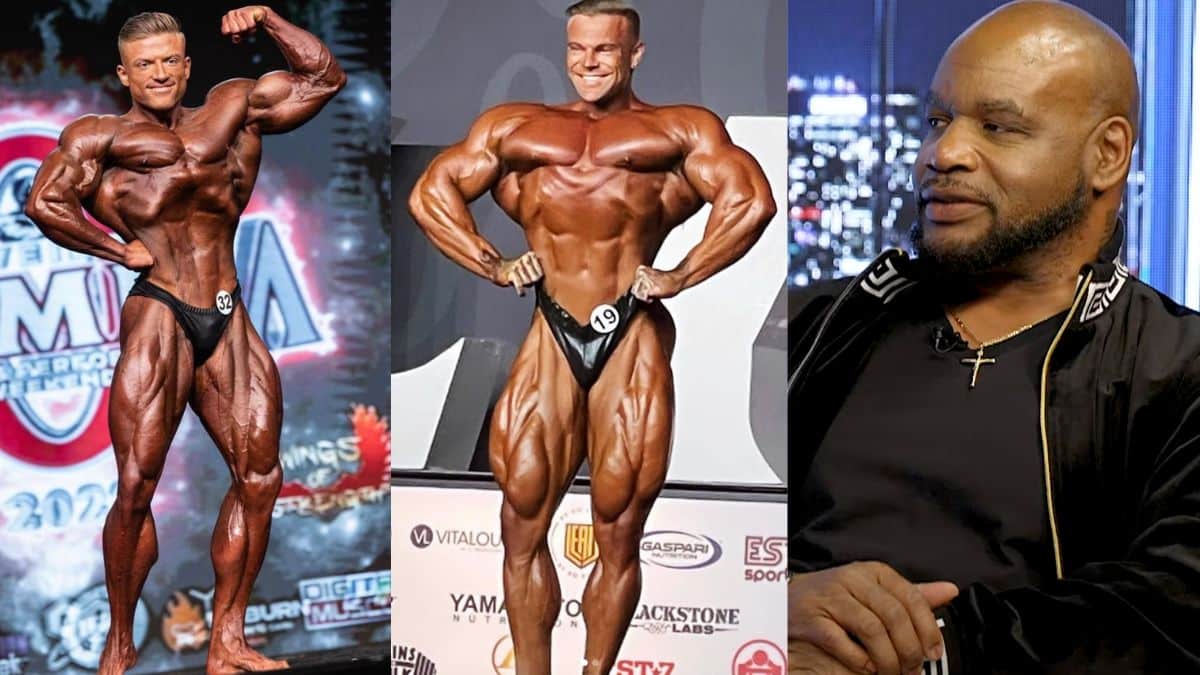
Chris Cormier, Olympia Judge: ‘Urs Kalecinski ‘Wants to Beat the Hell Out of Mike Sommerfield at 2023 Olympia’
Bodybuilding veteran Chris Cormier took a break from examining the Open class to discuss a few threats in the Classic Physique division. In a recent Prime Time Muscle podcast, Cormier and judge Terrick El Guindy opened up about the brewing rivalry between German stars Urs Kalecinski and Mike Sommerfeld.
The Classic Physique category has never been more exciting since its inception in 2016. Currently, Chris Bumstead sits atop the mountain, having earned a total of four consecutive Classic Physique Olympia titles. He took the reigns from two-time winner Breon Ansley in 2019.
Bumstead continues to defy the odds with steady improvements year-to-year. However, plenty of competitors have staked their claim in the division such as Brazil’s Ramon Queiroz, Mike Sommerfeld, and Urs Kalecinski. At last year’s 2022 Mr. Olympia competition, Urs Kalecinski managed to move up to third place from fourth the year prior. Meanwhile, Sommerfeld trailed behind ‘The Miracle Bear’ in fifth.
Given their competition history, Cormier and Terrick El Guindy insist a rivalry between the two has developed. In addition, they outlined what a battle may look like between Sommerfeld and Kalecinski later this year.
Chris Comier & Terrick El Guindy Talk Urs Kalecinski vs Mike Sommerfeld Rivalry
According to Terrick El Guindy, Kalecinski and Sommerfeld unfollowed each other on social media as a result of their heated competitive history.
“No, they unfollowed each other [Urs Kalecinski and Mike Sommerfeld] on Instagram. They don’t like each other. Yes, so that you know the history of these two competitors. Mike Sommerfeld and Urs Kalecinski… they competed, they came out of the IFBB Pro League in Mexico at the Tijuana Pro.”
“I’ve been able to judge that show the last two years, incredible event, we’ve crossed the border, he’s [the promoter] has a great hotel, great food and a lot of great competitors. On that specific day, Mike Sommerfeld beat Urs Kalecsinki. Everybody was impressed by these two German guys. Who the hell are they, they looked incredible.”
El Guindy added that Sommerfeld defeated Kalecinski at the Tijuana Pro, though Kalecinski got the upper hand on the Olympia stage.
“Going into the Mr. Olympia, obviously, Mike Sommerfeld was supposed to be the better one but it didn’t turn out like that. Urs Kalecinski impressed everybody and got in the top five and Mike Sommerfeld fell. So this whole year Mike Sommerfeld all he heard in Germany was how great Urs was, Urs this, Urs that, oh my God, Urs Kalecinski he’s the new guy, he’s the new Dennis Wolf, he’s the new this.
He probably got pissed off and fed up. He almost wanted to tell everybody, ‘I beat this guy in Tijuana. He just beat me once.’ It turned out that in the Mr. Olympia they faced each other, Sommerfeld was in the top five with Urs, and now the rivalry is real. You can’t just talk about Urs Kalecinski coming from Germany, you have to talk about Mike Sommerfeld,” said Terrick El Guindy.
Looking at both competitors as objectively as possible, Cormier said Sommerfeld had muscle maturity on his side whereas Kalecinski had more ‘upside’ due to his young age. Cormier believes Kalecinski still needs to add thickness to his arms.
“The thing is, I’ve kind of been in contact with both of these guys,” Cormier replied. “I’m friends with both of them. I try to help them with what I see they need help with, some posing, stuff like that. Nothing more than that, but just trying to be a helpful hand to the younger generation, you know. Well, I think the most upside is with Urs. The maturity is going to go with Mike, he’s probably a little bit thicker. Urs still has the thing… he needs to underuse those arm movements so much for me and he’s got to get those arms a little thicker.”
El Guindy implied that Sommerfeld posted comparison pictures next to Kalecinski to send a message to his rival.
“Comparison pictures with Urs Kalecinski [posted by Mike Sommerfeld] and all those pictures were beneficial to Mike. And obviously, he’s sending a message to Urs, ‘I’m better than you.’ Some people are very critical of Mike Sommerfeld, ‘You didn’t pick the right angles,’ you know how they do that,” said El Guindy.
“Urs is younger than that he’s like 24 or 25,” added Cormier.
Looking ahead, El Guindy predicts a tense on-stage showdown between Sommerfeld and Kalecinski in November.
“You want to be the best bodybuilder of that country. You talk to Rafael Brandao in Brazil, you mention any other bodybuilder he gets pissed, he’s like, ‘I’m the only one.’ Ramon Dino, he’s the only one. He doesn’t want anybody talking about anybody else. In Germany, you can’t just say that. There’s probably some following from Urs, probably some following from Mike Sommerifeld, and what the really want to do is shut that door. What Urs wants to do is beat the hell out of Sommerfeld at the next Mr. Olympia.”
Lastly, Cormier highlighted that former two-time Arnold Classic winner Terrence Ruffin will likely push into the top three at the 2023 Mr. Olympia show.
“I think so [Terrence will contend with Ramon Dino at 2023 Olympia]. He’s not that tall but he’s very good. He can make his body transform. He can make his body transform before your eyes.”
While they might be enemies when they compete, the division’s top contenders aren’t against training with each other during the off-season. Urs Kalecinski teamed up with Cbum recently for a brutal arms training session.
Considering their competition history, fans, especially those in Germany, are looking forward to seeing two of their country’s biggest stars compete at the most significant bodybuilding event of the year.
RELATED: Chris Bumstead and Ramon Rocha Queiroz Destroy A Massive Back Workout
You can watch the full video below:
Published: 18 May, 2023 | 12:08 PM EDT
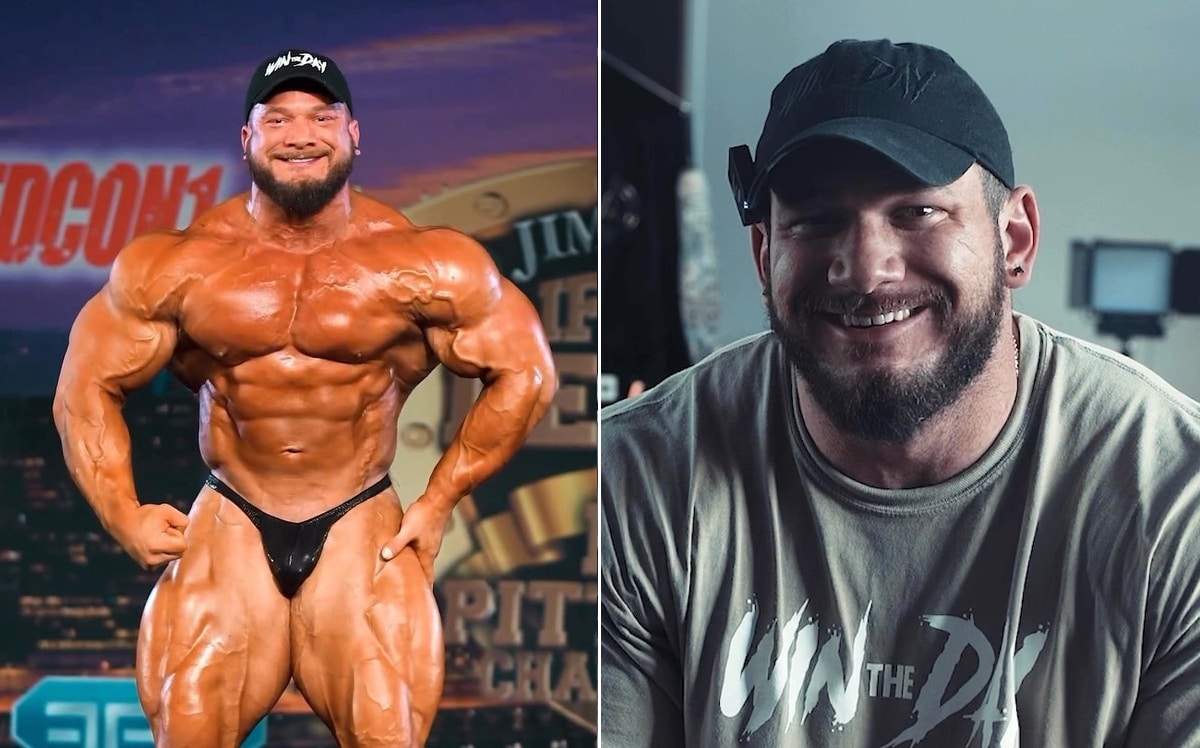
Hunter Labrada: “I Am One of the Best in The World Left on the Table, I’ll Put that to the Test”
Men’s Open pro Hunter Labrada is eager to step back on a competitive stage in 2023. In a recent Instagram video, Labrada updated fans on his mental outlook roughly 15 weeks out from his next competition, the 2023 Tampa Pro.
Hunter, son of IFBB Pro bodybuilding legend Lee Labrada, is one of the sport’s most exciting stars. His muscularity, tight waist, and full chest made him an instant standout on stage. Given his father’s long-standing success as an Olympian, many fans are hopeful that Hunter could one day win the sport’s most prestigious title.
Last year, Labrada was considered a heavy favorite heading into the 2022 Mr. Olympia show. However, at the event, he faced a historic lineup of talent with several new faces making their mark on the category, such as Derek Lunsford, Andrew Jacked and Michal Krizo. Ultimately, Labrada took seventh place while Hadi Choopan went on to win gold.
The 31-year-old admitted mistakes were made during the prep and peak for his last Olympia show. In February, it was revealed that Hunter Labrada threw his name in the hat for the upcoming 2023 Tampa Pro and Texas Pro. A little over three months before he takes to the stage, Labrada updated fans on how he’s approaching contest prep this year.
Hunter Labrada ‘Confident’ Ahead of 2023 Tampa Pro: “I’m Perfectly Capable of Winning Them”
Looking at his upcoming season, Labrada is confident he’s one of the best in the world and believes he has the tools to win his next two contests.
“First and foremost this year is about making myself proud. I lost sight of why I was doing this a lot last year. It was especially hard with how much I was traveling, I got a very isolated feeling. I’ll be the first one to tell you: I’m training to win these next two shows, Tampa and Texas I am training to win them. I feel like I’m perfectly capable of winning them. Outside of the people that are already qualified for the. Olympia, I think I am one of the best in the world left on the table. I’ll put that to the test.”
I’m confident I can get that done. Outside of success on a bodybuilding stage and as I do this more and more, more, I realize it’s less and less and less important. It’s at the end of the day what I do for a living but the happiness and impact I’m able to make with it is far more important and paramount to me. One of my biggest goals this year outside of the competitive placings, which I’m not going to sit here and lie, I’m very competitive and I’ll be devastated if I don’t win. And I’m going to do everything in my power to win those shows,” said Hunter Labrada.
Given Labrada’s busy schedule year-to-year, the Open bodybuilder said his primary goal is to stay ‘mentally present’ moving forward.
“This year one of the biggest goals and one of the biggest things to me personally is to be mentally present, feel everything, experience everything, yes I’ll be tired but that doesn’t give me an excuse to not be a good husband, a good father, to not be a good friend, so to really place a lot emphasis on everything outside of the actual nuts and bolts of bodybuilding this year because I feel like if I do that, the nuts and bolts of bodybuilding will take care of itself too.”
“The biggest emphasis for me this year is to be present and have fun doing what I’m doing. From a very young age, I never really stopped and smelled the roses. Anytime, football, coming up as an amateur, winning nationals, it was always what’s next, what’s next what’s next? I really want to make sure I’m able to take some time and enjoy this year, I think it’ll be a good one. Regardless of the contest placings, the places I’ll get to go, the people that I’ll get to see, the things I’ll get to do, they are once-in-a-lifetime things that not everybody gets to do.”
Aside from contest appearances, Labrada has taken part in a few key guest posing obligations. First, he traveled to Washington for the Emerald Cup and then joined a slew of other top Men’s Open pros at Jim Manion’s 2023 Pittsburgh Pro. He shared the stage with Derek Lunsford, Samson Dauda, Nick Walker, Mamdouh ‘Big Ramy’ Elssbiay, and Shaun Clarida.
RELATED: Hunter Labrada Shares 277.6-Lb Ripped Physique Weeks From 2023 Tampa Pro, Texas Pro; Gives Exercise Selection Tips
Hunter Labrada is confident that he can win the 2023 Tampa Pro and Texas Pro. He is also focused on staying mentally present and having fun during his bodybuilding journey.
Published: 18 May, 2023 | 9:15 AM EDT
Forearm Pull-Up Pain – Causes, Treatment, and How to Avoid
Pull-ups are one of the best exercises you can do for your upper body. Doing pull-ups will widen your lats, build your biceps, strengthen your lower traps, and develop your grip. Pull-ups also let you know if you are getting a little too chunky, as excess body fat always makes them feel harder!
Unfortunately, even good exercises go bad, and pull-ups can sometimes cause forearm pain.
While this could be nothing more than a mild annoyance, pain often worsens and can become debilitating. As the forearms are involved in almost every upper and many lower body exercises, pain in your lower arms could even stop you from training.
In this article, we explain why pull-ups can cause forearm pain, how to treat it, and how to stop it from returning.
Please Note: This article is for educational and informational purposes only. It should not be used for diagnosing or treating health problems or diseases. Those seeking medical advice should consult with a licensed physician.
Why Pull-Ups Cause Forearm Pain
So, why do your forearms hurt when you do pull-ups? While we can’t diagnose the precise cause of your forearm pain, there are several reasons that pull-ups can cause lower arm discomfort.
These include:
Forearm overload
Compared to the other muscles involved in pull-ups, the forearms are the smallest and weakest link in the kinetic chain. As such, it’s not surprising that pull-ups sometimes cause forearm pain.
Think about it; those slender muscles must produce enough force to support your entire body weight. This is no mean feat. Overloading the forearms could cause a lot of localized discomfort.
Forearm muscle weakness
In addition, unless you actually train your forearms, they’re probably not as well-developed as the other muscles in your arms. Apart from dedicated bodybuilders and powerlifters, exercisers tend not to do additional training for their forearms.
Stronger muscles tend to be more resilient and enduring. If pull-ups hurt your forearms, they could be telling you that they need some extra work to make them stronger.
Forearm overuse
The forearms are a hard-working group of muscles, and they’re involved in almost all upper-body and some lower-body exercises. As such, doing pull-ups could be “the straw that broke the camel’s back” that causes pain in this overused body part.
Overuse is often accompanied by inflammation and swelling. But, because you keep on training, this never gets a chance to subside. Instead, your forearm pain worsens, affecting your ability to perform all your upper-body exercises.
Depending on what tissues have become inflamed, your pain may have a specific name, such as carpal tunnel syndrome, radial tunnel syndrome, or tennis elbow. However, such conditions require a medical diagnosis to confirm.
Prevent Forearm Pain
Forearm muscle stains
Muscle strains are tears that disrupt the integrity of your muscle fibers. Muscle strains usually occur when you stretch a muscle too fast or too far or lift more weight than you are used to. For example, if you are new to pull-ups, have weak forearms, or have started doing weighted pull-ups, you may have strained your forearm muscles.
Muscle strains are graded according to their severity and depth. Grade one strains are mild and involve minimal amounts of muscle fiber damage. In contrast, grade three muscle strains are much more severe and involve complete muscle or tendon ruptures which usually require surgery to repair.
Forearm tendonitis
Tendons attach muscles to bones. They’re made of tough, inelastic connective tissue, and they transmit the forces produced by your muscles into the joints you want to move.
While tendons are very robust, they also have a poor blood supply, which means they take a long time to heal when damaged. Tendons are also prone to overuse and inflammation, which is called tendonitis.
If you have recently started doing more pull-ups than usual or just doing more grip or forearms training, your forearm tendons may be inflamed and painful, which you feel when doing pull-ups.
Forearm splints
Forearm splints are an injury where overuse leads to inflammation of the connective tissue in the forearm region. This could be the fascia surrounding the forearm muscles, the periosteum that covers the bones, the muscles, or the tendons and ligaments.
Forearm splints are usually caused by overuse and increasing training volume and intensity too quickly. Shock loading and high-impact movements, e.g., plyometric pull-ups, can also cause forearm splints, as can doing heavy negatives.
General forearm pain is often referred to as forearm splints. The lower body equivalent of forearm splints is shin splints, which is a common lower leg injury in runners.
Forearm compartment syndrome
Muscles are enclosed in a layer of connective tissue called fascia. Fascia is tough, relatively inflexible, and surrounds, separates, and connects all the muscles and organs in your body.
If your forearms get too big for the fascia surrounding them, pain can be the result. This is called compartment syndrome. This condition makes your forearms feel tight and restricted, and the muscles may burn and throb. The pain tends to be worse when you’re training but lessens soon afterward. This is because getting pumped makes the muscles expand within their fascial sheath.
Compartment syndrome is more common in the calves but can also affect the forearms.
Delayed onset muscle soreness
Doing more exercise than usual often causes delayed onset muscle soreness or DOMS for short. This is thought to be caused by localized inflammation and the accumulation of metabolic waste products, such as lactate. DOMS typically comes on 12-24 hours after training and can last several days.
The good news is that DOMS tends to decrease as you get used to your new workout, which is called the repeated but effect.
Tight forearm muscles
Muscle tightness is a common source of pain. Tight muscles usually have a reduced blood flow which leads to an accumulation of irritating waste products. They may also have localized tenderness, called trigger points.
While most exercisers know to stretch their hamstrings, quadriceps, and even their pecs, fewer spend time stretching their forearms. As such, there is a high probability that your forearms are tight and are causing your forearm pull-up pain.
Improper grip/technique
There is more to a safe, effective set of pull-ups than simply grabbing the bar and heaving your chin up to meet it. Your grip needs to be firm but not so tight your hands go into spasm, and you need to avoid jerking the bar. Shock-loading your forearms increases the risk of pain and injury.
The bar itself is also important. If it’s too thin or too thick, it’ll put undue stress on your fingers, hands, and forearms. A very narrow grip is also harder on your wrists and forearms.
So, make sure you grip the bar correctly – not too tight or too wide – and do your reps smoothly and without swinging or jerking. These techniques will make pull-ups harder, but they’ll also be safer.
How to Treat Pull-Up Forearm Pain
Most pull-up forearm pain originates in your soft tissues, i.e., muscles, tendons, and ligaments. Soft tissue injuries are generally treated the same way – with PRICE.
No, PRICE is not a miracle drug or special taping method. Instead, it is an acronym for the steps you need to take to promote healing.
Please note: This information is not meant to replace advice from a trained medical professional.
P – Protection: Protect your forearms from further injury. Invariably, this means dropping pull-ups from your workouts until the pain subsides. After all, if pull-ups hurt your forearms, it doesn’t make a lot of sense to keep doing them, as you’ll probably make the problem worse.
Find exercises that don’t cause pain and do them instead. For example, lighter lat pulldowns may allow you to continue training without aggravating the affected area.
R – Rest: Depending on the severity of your injury, you may need to take a break from training. Or, at least, you may need to stop doing exercises that directly challenge your forearms, such as most back and biceps exercises.
You may be able to continue doing upper body pressing exercises, provided you don’t grip the bar/dumbbells/handles too tightly.
Avoid testing your injury to see if it still hurts. This can lead to reinjury and a longer recovery period. Rest a little longer than you think you need to allow the tissues to fully heal.
I – Ice: Ice reduces inflammation and also provides natural pain relief. Apply ice to the affected area for 15-20 minutes, 3-5 times per day. Reduce the duration and frequency of your icing sessions as the injury heals.
Avoid painful ice burns by never applying ice directly to your skin. Instead, use an ice pack or washcloth as a barrier between the ice and your forearm.
C – Compression: Like ice, compression helps reduce inflammation and swelling. Wrap the affected area with an elastic bandage or use a forearm sleeve to apply medium, even pressure to the affected area. However, make sure you unwrap your forearm from time to time to ensure there is good blood flow into the affected area. If your fingers are cold or numb, you have probably cut off the blood supply.
E – Elevation: Raising your forearm above head height will help reduce swelling and inflammation. There is no need to keep your arm raised all the time, but you may get some pain relief if you elevate your arm when seated for long periods, e.g., at night when relaxing in front of your TV.
Other strategies that may enhance recovery and reduce forearm pain include:
NSAIDs and OTC painkillers
If your forearm pain is severe, you may want to dull it by using over-the-counter (OTC) anti-inflammatory drugs like ibuprofen or aspirin. You can also use painkillers like paracetamol.
In addition, there are pain-relieving and anti-inflammatory gels that you can apply directly to your injured forearm. This is useful for people who find taking pills upset their stomachs.
However, do not use medicines to mask the pain so you can continue training. That will just make things worse.
Massage
Massage can help speed up the healing of chronic injuries. It’s also valuable for the latter stages of injury repair, i.e., 5-7 days after it happened. Massage improves blood flow and speeds up the removal of waste products from the injured area. It also provides natural pain relief and can help restore range of motion.
The forearms are very easy to self-massage, so you don’t need to hire a therapist to do it for you.
Apply even pressure with your non-injured hand and work up the forearm toward your heart. Use oil to lubricate your skin and make the massage go more smoothly. Start with light pressure and increase gradually as the area warms up.
You can also use a massage gun to help speed up your recovery. Still, good massage guns can be expensive and offer little additional benefit compared to a hands-on massage. That said, they allow you to get a good massage without using oil or even rolling up your sleeves, so some people may find them more convenient.
Stretch
Gentle stretching can help ease the tension in your forearms, increase blood flow, and promotes proper soft tissue remodeling. There are several ways to stretch your forearms, but the most convenient is probably the prayer stretch:
Place the palms of your hands together in front of your chest.
Gently press your hands downward to extend your wrists and stretch your forearms.
Hold for 30-60 seconds, increasing the depth of the stretch as you feel your muscles relax.
Take care not to force this movement, and ease off if you feel burning or shaking in your muscles.
Be a patient patient!
No one likes being injured, and it can be tempting to try and rush the recovery process so you can get back in the gym sooner. However, returning to training before you are ready could result in reinjury and an even longer layoff.
So, be patient and let nature run its course. It’s better to rest a little longer than return to training too soon, hurt yourself again, and then have to restart the recovery process.
For most people, being patient is the hardest thing to cope with when injury strikes.
Use this time to work on other aspects of your fitness, such as training your legs and core or doing more cardio and stretching. There is no need to be completely inactive.
How To Avoid Forearm Pain In The First Place
As the old saying goes, an ounce of prevention is worth a pound of cure. In other words, it usually takes less effort to avoid injuries than it does to treat and heal them. Use the following tips to reduce your risk of developing forearm pain in the first place.
Warm up properly
While we can’t guarantee that warming up will prevent all injuries, it should reduce your risk. Warmer muscles stretch and contract more efficiently, so they’re less likely to be damaged when you start working hard.
Most people focus on their warm-ups on big joints and muscle groups, such as the hips and shoulders, hamstrings, and pecs. However, if you are doing a very forearm or grip-centric exercise like pull-ups, you should warm up your lower arms, too.
So, in addition to your usual warm-up, make sure you include some wrist rotations, forearm flexions and extensions, and some light stretches to ensure this area of your body is as ready as possible for what you’re about to do.
Take care when using overly thin and thick pull-up bars
Very thin or thick pull-up bars put a lot of stress on your forearm muscles, increasing your risk of injury. Skinny bars force you to close your hand tighter than usual, putting your fingers in a mechanically disadvantageous position. Thicker grips force you to keep your hands more open, which makes it harder to maintain your grip.
Avoid forearm pain by introducing thick bar pull-ups gradually into your program and avoiding thin bars whenever possible. You can make a thin bar less stressful to grip by wrapping it in tape, wearing gloves, or using clip-on handles.
Don’t grip the bar too tightly
Pull-ups are a very grip-centric exercise. However, a lot of people make the mistake of gripping the bar too tightly. This “death grip” could be the reason for your forearm pain. Avoid this by only holding the bar hard enough to support your weight. There is no need to try and crush the bar. Use no more and no less hand pressure than you need.
Use lifting straps
Lifting straps provide more friction between your hands and the bar, so you don’t have to grip it as tightly. This takes the stress away from your forearms. While many people avoid using straps so they can develop a firmer grip, if you experience forearm pain during pull-ups, reducing lower arm engagement may help cure the problem.
Learn how to use lifting straps here.
Use gym chalk
Sweaty hands mean you’ll need to grip the bar tighter during pull-ups. This increases the stress on your forearms. Like lifting straps, lifting chalk increases the friction between your hands and the bar, so you won’t need to hold on so tightly.
Keep a bag of powdered chalk or a bottle of liquid chalk in your gym bag so you can use it before every set of pull-ups. Chalk is a real forearm and grip saver!
Stretch your forearms between workouts
A lot of strength training exercises involve your forearms. Your forearms are also often flexed during everyday activities, such as driving and using a computer keyboard. As such, tight forearms are common. Despite this, relatively few people spend much, if any, time stretching their lower arm muscles.
Avoid tight forearms and the pain they can cause by stretching them between workouts. This kneeling forearm stretch is one of the best ways to do it:
Kneel down and place your hands on the floor, fingers facing your knees. Your arms should be straight and your palms flat.
Gently lean back and press the heels of your hands into the floor.
Hold for 30-60 seconds, and then relax.
You can also stretch the muscles that extend your wrists by turning your hands over and pressing the backs of your hands into the floor.
Train your finger extensors
Muscles are generally arranged in opposing pairs. For example, the biceps oppose the triceps, and the quadriceps oppose the hamstrings. These paired muscles affect the same joint, with one flexing and the other extending it.
If one muscle in the pair gets much stronger than the other, an imbalance will occur. Muscular imbalances can cause pain and dysfunction.
As such, you need to work on your finger extension strength as well as your grip. While your finger extensors will never be as strong as the finger flexors, they still need to be trained so they are not weak.
One easy way to do this is to include rubber band finger extensions in your grip workouts. Just a few sets a couple of times per week will be sufficient for most people.
With your fingers straight and together, take a large rubber band and loop it around your fingertips and thumb. A standard stationary-type band should suffice.
Open your hand and spread your fingers and thumb apart as far as possible.
Slowly close your hand and repeat.
Try some different grips
There is more than one way to position your hands during pull-ups. You may find that some feel more comfortable and are less stressful for your forearms than others. For example, if overhand medium-width pull-ups with a full grip around the bar bother your forearms, you could try a thumbless narrow grip instead.
You may also find that underhand and neutral grip pull-ups are more comfortable than the overhand version.
Experiment to see which feels best. You could change hand positions workout-by-workout to spread the stress to different forearm muscles and avoid overloading the same ones repeatedly.
Read more about your grip options here.
Strengthen your forearms
Weak forearms are more prone to injury than stronger forearms. If you know your grip and lower arms are weak, it’s time to start training them. There are lots of exercises you can do to strengthen your forearms and grip, including wrist and reverse wrist curls, hammer curls, and dead hangs. Add a forearm exercise or two to your upper arm workouts or train your grip on separate days as preferred.
However, take care not to train your grip and forearms too hard or too often, as doing so could result in more forearm pain.
Forearm Pull-Up Pain – FAQs
Do you have a question about treating or preventing forearm pain? No problem, because we’ve got the answers!
1. How do I know what type of forearm pain I have?
There are several different conditions that cause forearm pain, including compartment syndrome, tendonitis, and muscle strains. However, they can sometimes present similar symptoms, so you may not be able to determine which one you’ve got.
For this reason, it’s always best to seek qualified medical advice and get an accurate diagnosis.
This is important because the treatment for one condition could actually make another problem worse.
So, use the PRICE protocol, but if the pain is severe or persists, get it checked out by a sports injury doctor.
2. Can I train around forearm pain?
Forearm pain doesn’t always mean you can’t train. So, while you should avoid exercises like pull-ups, pulldowns, deadlifts, rows, and curls, you still do leg presses, leg extensions, leg curls, and may even be okay doing squats, bench presses, overhead presses, etc.
In simple terms, exercises that involve a tight grip are out while you let your injuries heal. However, activities involving minimal forearm engagement should be fine, provided they don’t cause pain.
Learn more about how to safely train around injuries here.
3. How long does it take for forearm pain to subside?
Sadly, this question is unanswerable as it depends on the cause of your pain and the nature of your injury. Other factors affecting the healing process include how much you rest the painful area and what other treatments you use.
The one thing you must avoid doing is trying to rush the healing process; it will take as long as it takes. Returning to training before you’ve healed could result in reinjury and more time off.
4. If pull-ups hurt my forearms, can I do lat pulldowns instead?
Overhand lat pulldowns and pull-ups work many of the same muscles. The main difference between these exercises is the amount of weight used.
You can scale pulldowns to match your current level of strength, but doing pull-ups means lifting your entire body weight with just your arms. Pull-ups are much more strenuous than pulldowns.
As such, you can do pulldowns instead of pull-ups if you wish, providing they don’t also hurt your forearms.
5. Are hand grippers a good way to strengthen my forearms and grip?
Hand grippers are a convenient, time-efficient, and cost-effective way to train your forearms and grip. You can use them at home while relaxing in front of the TV, at work between meetings or phone calls, or even while on your morning commute.
There are lots of different strengths and styles of hand grippers to choose from, so shop around to find one you like. Also, don’t use your hand gripper too often, i.e., every day; otherwise, you could end up with an overuse injury, negating the benefits of forearm and grip training.
Read More on Forearm Pain:
Forearm Splints — All You Need to Know
How To Prevent Forearm Pain When Curling
Closing Thoughts
Like all types of pain, forearm pain tells you something is wrong and you should stop what you are doing. Ignoring pain could make the problem worse.
The good news is that most types of forearm pain are due to soft tissue injuries, which usually heal fully in a relatively short time. Resting and controlling the inflammation will have you back in the gym in no time.
However, if the pain is severe or persists despite resting and icing the area, you should get your forearm pain checked by a medical professional. While serious forearm injuries are rare, it’s always better to be safe than sorry.