
 All Posts By Muscle Insider
Board Certified PHD
Fat vs. Muscle Weight: How to Tell the Difference
Many exercisers judge their progress by their body weight. Religiously they hop on the scales, hoping to see their weight moving toward their goal. Whether you want to build muscle or lose fat, stalled scales can be a source of frustration, leaving you wondering if you need to change your diet or your workout – again.
Here’s the problem with relying on your weight to assess your progress: the scales cannot differentiate between fat, muscle, or any of the other substances that make up your total body mass.
As such, you could be succeeding despite the reading on the scale. For example, you could lose fat, gain muscle, and your weight remains unchanged. This may look like a failure on paper, but in reality, it will have a significant impact on how you look, feel, and perform.
In this article, we discuss the differences between fat and muscle, and how to really tell if you are making good progress.
An Introduction to Body Composition
When you get on your scales, whatever device you are using measures your total body mass. This includes whatever clothes you are wearing and any food in your digestive system.
Broadly speaking, your body mass can be broken down into two components:
Fat mass
Fat-free mass (FFM)
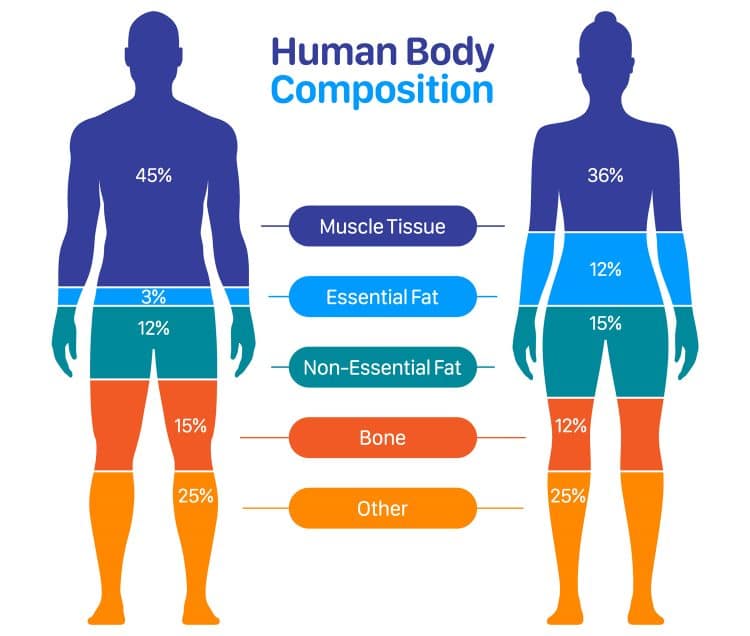
The relationship between your fat mass and FFM mass is generally referred to as your body composition, which is expressed as a percentage. This percentage, e.g., 15%, is the amount of your total weight that’s made up of body fat. The remaining percentage is deemed to be your fat-free mass.
Your FFM can be sub-divided into several more components, including:
Water
Skin
Organs
Bones
Substrates and chemicals
So, when you lose or gain weight, the quantities of any of these components could have changed. For example, you could be more or less hydrated, have more or less glycogen (stored glucose) in your liver and muscles, or have lost bone mass.
Your weight can even fluctuate throughout the day. Most people gain and lose several pounds each day. For example, you may weigh less after a workout because of dehydration but more after a meal because of the undigested food in your stomach. Most people are lightest on waking and heaviest at the end of the day.
However, none of these transitory changes means you’ve gained or lost muscle or fat. Instead, the only thing that has changed is your body weight. This is akin to weighing yourself naked and then fully clothed.
Because of all these potential variables, your weight is an unreliable indicator of your body composition. Instead, you need to be able to differentiate between changes in fat and fat-free mass. Body composition changes are MUCH more important than your body weight and tend not to fluctuate as much.
Related: FFMI Calculator: Find Your Fat Free Mass Index
Body Fat Basics
In simple terms, body fat is stored energy. When you eat too much food, your body converts it into fat for later use. Fat cells are called adipocytes, and body fat is stored as adipose tissue.
Cosmetologist Using Caliper To Measure Body Fat
Then, if you fail to consume enough food and have insufficient energy, your body will release and burn body fat for fuel. It’s estimated that one pound of body fat contains around 3,500 calories.
However, body fat is more than just an inert substance your body can use for energy; it’s also an organ with several additional functions. That’s why very low body fat levels are often considered unhealthy and can even be dangerous; you NEED body fat to live and function correctly.
The additional functions of body fat include:
Shape
Insulation and temperature regulation
Protection of internal organs, including the brain
Storage and utilization of vitamins A, D, E, and K
Protein utilization
Hormone regulation, e.g., production of the satiety hormone leptin and the hunger hormone ghrelin
Body fat can be classified according to where it’s located in your body – visceral and subcutaneous (1). Visceral fat is stored around the internal organs and is considered to be a risk to health. Visceral fat is also known as belly fat and can only be accurately detected by MRI or CT scan.
In contrast, subcutaneous fat is found between the skin and muscles and presents less of a health risk than visceral fat. You can see and even pinch subcutaneous body fat. You also store a small amount of fat in your bone marrow.
Body fat can be divided into two more categories – white fat cells and brown fat cells.
White fat makes up the majority of fat in adults and is used for energy and energy storage. Brown fat, on the other hand, is mainly used for thermogenesis or heat production. Babies have a lot of brown fat and use it to stay warm in infancy, while adults tend to have less.
Because of its myriad functions, a certain amount of body fat is deemed essential, and lowering your body fat below this level could harm your health.
The percentage of essential body fat is:
2-5 percent for men
10-13% for women
While athletes can achieve very low levels of body fat, e.g., for bodybuilding competitions, they usually only maintain this level of extreme leanness for a few days or weeks. Then, out of season, they return to a more sustainable and healthy body fat percentage.
Try: Body Fat US Navy and Body Fat Skinfold Calculator
Muscle Basics
There are three types of muscle tissue in the human body. Each is highly specialized and has specific functions. The three types of muscle tissue are:
Cardiac muscle – found in the heart
Smooth muscle – used to make tubes and organs
Skeletal muscle – responsible for movement
Of these three, skeletal muscle is the most important for body composition.
There are over 600 muscles in the human body, ranging from huge to tiny. For example, the gluteus maximus is the biggest skeletal muscle, the sartorius is the longest, and the stapedius, an auditory muscle, is the smallest. Some muscles are very well known, such as the biceps, while others are much less so, such as the quadratus lumborum.
Muscles are contractile, meaning they shorten to produce force. Innervated or controlled by motor nerves, muscles cross joints and are connected to your bones by tough fibrous cords and straps called tendons. Muscles are made up of bundles and bundles of muscle fibers. The smallest contractile unit of a muscle is called a sarcomere.
Broadly speaking, there are two types of muscles:
Tonic
Phasic
Tonic muscles produce low amounts of force for long periods to maintain your posture. They’re the endurance muscles of the human body. In contrast, phasic muscles produce force intermittently and on demand to produce movements. Phasic muscles tend to be more powerful but are quick to fatigue.
All muscle fibers fall into one of three types:
Type 1a – also known as slow twitch muscle fibers. Type 1a fibers are red in color and have an excellent blood supply. They are very enduring but are not very strong, and nor do they have much potential for hypertrophy or growth.
Type 2b – also known as fast twitch muscle fibers. Type 2b fibers are white and have a relatively poor blood supply. They’re very powerful but also tend to fatigue quickly. They have the greatest potential for hypertrophy.
Type 2a – this type of fiber is trainable and adapts to the demands placed on them. They can become like type 1a or type 2b fibers depending on the kind of workouts you do. They can switch back and forth between jobs as required, e.g., if you quit lifting weights and take up running.
Your muscle fiber mix is determined by your genetics. Some people are slow-twitch dominant and naturally good at endurance activities such as long-distance cycling. Other people are equipped with more fast-twitch fibers and tend to be naturally stronger, faster, and more muscular.
Regardless of this, because of type 2b fibers, you can always train and improve your strength or endurance despite the dominance of one particular fiber type. However, your potential is limited by your genetics, which is why some people are better at certain sports than others.
Fat vs. Muscle – The Differences
Now you know a little more about fat and muscle, let’s take a moment to compare these two types of tissue:
Contractility
While you can flex and contract your muscles, you cannot contract fat. This is why someone can be big but weak or small but strong.
Sure, strongman competitors and some powerlifters carry a lot of body fat, but beneath that fat are some massive muscles. Many heavyweight lifters believe that “it takes mass to move mass,” and the extra weight can be helpful in dragging and pushing events.
Summary: Muscle contracts, while fat does not.
Blood Supply
Muscle tissue has e very good blood supply, even those muscles deemed to be fast twitch. This ensures they receive a steady supply of oxygen, and that carbon dioxide, the by-product of aerobic respiration, can easily be removed.
Blood supply increases with training, so even more, oxygen can be delivered to the working muscles. This is achieved through capillarization, which is the increase in the number of capillaries (thread-like veins) that supply the muscle.
Adipose tissue also has a blood supply. However, it tends to be lower than for muscle tissue.
Summary: Both muscle and fat have a blood supply. However, the blood supply to muscles tends to be greater.
Metabolic Activity
Metabolic activity is the amount of energy your body burns at rest. It’s also known as your basal metabolic rate, or BMR, and is expressed in calories per 24 hours. A higher BMR can make it easier to lose or maintain a healthy body weight and body fat percentage.
Muscle is more metabolically active than the same amount of fat. For example, it’s estimated that a pound of muscle uses 4-7 calories per hour. In contrast, a pound of fat uses just two (2).
As such, depending on body composition, two people who weigh the same can have very different resting metabolic rates, with the more muscular person burning more calories per 24 hours, even without added physical activity. This explains why some muscular people need to eat more to maintain their weight.
Summary: Muscle tissue burns 200-300% more calories than fat.
Density
Contrary to what many people believe, muscle is not heavier than fat, and a pound of fat and a pound of muscle both weigh one pound!
However, muscle IS denser than fat. This means a pound of muscle takes up less space than a pound of fat. Because of this, you can lose fat, gain muscle, and completely change your clothing size despite your body weight remaining relatively unchanged.
Fat has a density of about 0.9g/cm3, and muscle has a density of 1.06g/cm3 (3+4). So, if you put one pound of muscle and one pound of fat on a scale, there would be more fat than muscle.
Summary: Muscle is roughly 10% more dense than fat. As such, fat takes up more space than the same amount of muscle.
How to Tell If You Are Gaining or Losing Fat or Muscle
Because of things like fat vs. muscle density and how changeable your body weight can be, it’s clear that the scales are not a reliable way to assess your progress. In fact, the scales can tell you are failing when, in fact, you are knocking it out of the park and making significant changes to your body composition.
So, how can you tell if you are gaining or losing fat or muscle? Use the following strategies and discover the truth.
Get a body composition assessment
Body composition assessments determine your body fat percentage. There are several assessment options to choose from, all offering varying degrees of accuracy. But, at the end of your test, you will have an estimate of your body fat percentage.
Assessment options include:
Monitoring your body fat percentage over the coming months will reveal if you are losing or gaining fat or muscle.
You’re gaining weight but losing inches
Gaining or maintaining weight while losing inches, e.g., around your hips or waist, is an excellent indicator that you are shedding fat while building muscle. Remember, muscle is denser than fat, so fat takes up more space on your body. The process of losing fat while gaining muscle is often called recomping.
Read more about recomping here.
You’re getting stronger
Strength increases are a good indicator that you’re building muscle. After all, muscle is contractile tissue, whereas body fat is not.
However, you can also get stronger because of improved neurological function and better lifting technique. That said, if your lifts are increasing from week to week, it’s a safe bet that at least some of your progress is due to increased muscle mass.
Conversely, while the occasional bad workout doesn’t mean much, if you are getting consistently weaker, you could be losing muscle. Although, consistent training should make this less of a likelihood.
Your muscle definition is improving
Has the outline of your abs started to emerge? Can you see some separation between your quadriceps or deltoids? Are your veins more visible? Congratulations – this strongly suggests your body fat percentage is starting to fall.
Most of your body fat is subcutaneous, i.e., between your skin and muscles. As your levels of subcutaneous body fat decrease, there will be less tissue between your skin and your muscles, so the underlying musculature will become more visible.
The best way to see and track this is with progress photos.
Remember, though, your definition will worsen if you gain body fat. So, if your abs and veins are fading away, it may be because your body fat levels are starting to rise.
Changes in clothing size
Your clothes are an excellent way to measure your progress. For example, if your pants are getting loose around the waist, it’s safe to say you are losing fat. Conversely, if they’re getting tight, you are probably gaining fat.
Your belt notch is often a much better indicator of body composition changes than your scales.
Body composition assessments are the most accurate way to determine if you are gaining or losing fat or muscle. However, you can also use things like your clothing sizes, gym performance, and definition to assess your progress.
While these things aren’t as quantifiable as body composition testing, they will tell you subjectively if your muscle and fat mass are changing, which is something the scales cannot do.
Fat vs. Muscle Weight – FAQ
Do you have a question about fat vs. muscle weight or body composition? No problem, because we’ve got the answers!
1. Can I lose fat and build muscle at the same time?
Contrary to what many people think, you can gain muscle while losing fat. As you know, fat and muscle are entirely different things, and they exist independently. As such, you can burn fat for energy and use that energy to work out and build muscle.
However, it is worth noting that pursuing these two goals simultaneously often means slower progress than focusing on one goal at a time, i.e., bulking and then cutting.
2. What is the ideal body fat percentage?
The ideal body fat percentage varies from person to person. For example, a competitive male bodybuilder may get their BF% as low as five percent for a competition. In contrast, a heavyweight powerlifter could be strongest with their body fat at 30%.
As such, your body fat percentage should match your goals. That said, the accepted fat percentages by gender and age are:
Sex
Age
Low
Normal
High
Very High
Female
20 – 39
< 21
21.0 – 32.9
33.0 – 38.9
39
40 – 59
< 23
23.0 – 33,9
34.0 – 39,9
40
60 79
< 24
24.0 – 35.9
36.0 – 41.9
42
Male
20 – 39
< 8
8.0 – 19.9
20.0 – 24.9
25
40 – 59
< 11
11.0 – 21.9
22.0 – 27.9
28
60 – 79
< 13
13.0 – 24.9
25.0 – 29.9
30
3. Is it possible to be fat and fit?
Having a high body fat percentage doesn’t mean you can’t be fit. There are many examples of overweight athletes performing incredible feats of strength and endurance. Football, baseball, wrestling, boxing, and field athletes are often heavy, and yet they compete at the highest level of their chosen sports.
That said, there is a massive difference between being fit and being healthy. Fit means you can handle the demands of your chosen activity, while healthy means the absence of disease. As such, it’s entirely possible to be fit but unhealthy.
For example, being over-fat can increase your risk of diabetes, heart disease, and hypertension, all of which can shorten your life.
So, yes, you CAN be fat and fit, but it’s much harder to be fat and healthy.
4. What is the best body recomposition workout and diet?
Body recomposition involves losing fat while building muscle. Invariably, achieving these goals consists of a combination of strength training, cardio, and an intelligent diet.
Strength training is critical for maintaining or increasing muscle mass and is usually involves a bodybuilding-style program. Cardio helps burn fat by expending additional calories. In addition, your diet needs to support training, recovery, and muscle growth while reducing your calorie intake to promote fat burning.
While it’s beyond the scope of this article to tell you how to achieve body recomposition, you can read all about it in these two articles:
5. What are the best exercises for burning fat and building muscle?
The best exercises for body recomp are challenging, burn a lot of calories, and provide plenty of overload for the target muscles. They are usually compound in nature, meaning they use multiple joints and muscles together.
Good examples include:
Squats
Deadlifts
Bench press
Overhead presses
Pull-ups/chin-ups
Exercises that combine two or more movements are also good options for body recomp. Examples include:
Front squat to push-press (thrusters)
Clean to overhead press
Sumo deadlift high pull
Burpees
Clusters (squat clean and thruster)
Read more about the best body recomp exercises here.
Fat vs. Muscle Weight – Closing Thoughts
While there is nothing wrong with keeping track of your body weight, the scales don’t tell the whole truth about your progress. In fact, they can be very misleading and even make you think your workouts and diet are failing you.
That’s because the scales cannot tell the difference between fat and muscle weight, and, as you know, these are very different substances.
Tracking your body composition is much more accurate and will reveal far more about your progress.
So, stop living and dying by your daily weigh-ins. Instead, pay more attention to how your clothes fit, your waist measurement, your gym performance, and your muscle definition. Better yet, get a body composition assessment and discover your true body fat percentage.
After all, your weight doesn’t really matter, and it’s what that weight is made up of that counts.
References:
Mittal B. Subcutaneous adipose tissue & visceral adipose tissue. Indian J Med Res. 2019 May;149(5):571-573. doi: 10.4103/ijmr.IJMR_1910_18. PMID: 31417024; PMCID: PMC6702693. https://www.ncbi.nlm.nih.gov/pmc/articles/PMC6702693/
University of New Mexico: Controversies in metabolism https://www.unm.edu/~lkravitz/Article%20folder/metabolismcontroversy.html
Abe T, Thiebaud RS, Loenneke JP. The mysterious values of adipose tissue density and fat content in infants: MRI-measured body composition studies. Pediatr Res. 2021 Nov;90(5):963-965. doi: 10.1038/s41390-021-01376-y. Epub 2021 Jan 27. PMID: 33504969. https://pubmed.ncbi.nlm.nih.gov/33504969/
Ward SR, Lieber RL. Density and hydration of fresh and fixed human skeletal muscle. J Biomech. 2005 Nov;38(11):2317-20. doi: 10.1016/j.jbiomech.2004.10.001. Epub 2004 Dec 30. PMID: 16154420. https://pubmed.ncbi.nlm.nih.gov/16154420/
Is Rice Good For Weight Loss? — Busting Myths
Rice — a beautiful nutrient-dense grain that is delicious, easy to cook, and a staple food around the world. Depending on their culture, people have rice in their meals throughout the day.
However, there has been much debate about the effects of white rice on your health. Brown rice has emerged as a solid competitor to white rice over the last couple of decades. The comparison has been especially confusing for folks trying to lose weight.
Besides brown and white, rice comes in various shapes, colors, and sizes, which include arborio rice, basmati rice, black rice, bomba rice, jasmine rice, and parboiled rice. However, for the scope of this article, we will stick to white and brown rice.
Interestingly, all white rice starts as brown rice. Brown rice is put through a milling process to increase its shelf life; however, the process removes the rice’s husk, bran, and germ, wiping out much of its nutrition, including fiber, vitamins, and minerals. The white rice is then artificially fortified with nutrients and polished to make them look more palatable.
The Rice Dilemma
If you are a fitness enthusiast, you probably know that rice is a staple in a bodybuilder’s diet, as it is a convenient carbohydrate source to add size during the bulking phase. Knowing this, dieters trying to lose weight sound the alarm when they see rice in their diet regimen.
Unbeknownst to newbie exercisers, as long as the foods you eat are nutrient-dense and healthy and you stay within your daily calorie intake goal, you don’t need to worry about eating a particular food.
This doesn’t end here. How rice is processed also determines its impact on your weight loss journey. Brown rice is minimally processed, whereas, depending on the brand and type, white rice can undergo significant treatment.
With this said, can white rice be used during your weight loss journey? Let’s find out.
White Rice and Brown Rice Nutrition Comparison
One cannot overlook the white and brown rice comparison during a weight loss regimen. Given below is a comparison of brown and white rice and their macronutrient and calorie content:
Nutrient/Type
White Rice (100g)
Brown Rice (100g)
Calories (Kcal)
130
111
Carbohydrates (g)
28
23
Protein (g)
2.7
2.6
Fats (g)
0.3
0.9
Although the difference between brown and white rice’s total calories and macronutrients is insignificant, their overall health impact varies greatly.
A British Medical Journal study found that people who eat high levels of white rice may have an increased risk of developing type 2 diabetes. On the flip side, consuming whole-grain foods such as brown rice lower the risk of stroke, heart disease, and type 2 diabetes. These food sources also help lower your cholesterol levels. [1]
Read also: Black Rice vs. Brown Rice: Is One Superior Overall?
Brown and White Rice Glycemic Index (GI) Comparison
The glycemic index represents the relative rise in the blood glucose level two hours after consuming a carbohydrate-containing food. A food is assigned a value of 1-100 depending on its impact on blood sugar levels. [2]
People with diabetes must monitor their carbohydrate intake and the GI score of the foods they consume to ensure they are on top of their health, as these factors can influence your blood sugar levels.
Short-grain white rice has a high GI (70 and above), whereas brown rice has a low GI (around 50). Remember, the GI level can change depending on the type of rice and the manufacturer.
Folks with diabetes should favor brown rice over white rice to keep their condition under check. Remember, whole grains such as brown rice take longer to cook than white rice. Plus, overcooking them can hamper their GI score.
Since white rice is a high GI good, it rapidly dissolves into your bloodstream. White rice consumption leads to a quick increase in blood sugar levels. It can be a point of concern during a weight loss regimen, as it can result in increased hunger and potential overeating. Plus, studies show that diets high in refined grains are linked to more abdominal fat. [3]
Benefits of White Rice for Weight Loss
The advantages of including white rice in your weight loss diet include the following:
Satiety
White rice is rich in carbohydrates. A 100 grams serving of white rice contains 28 grams of carbohydrates, compared to 23 grams of brown rice. White rice can contribute to the feeling of fullness, especially when coupled with a balanced diet that contains a healthy mix of high-protein foods and healthy fats. Feeling full keeps you from snacking on junk food throughout the day.
Versatility
White rice is an incredibly versatile food source. You could have it at any point throughout the day. Furthermore, it goes well with several dishes as a side. Depending on your daily calorie goals, you could easily alter your white rice portion size.
Since cooked rice lasts about four days in the fridge, most people prefer cooking it in bulk, making it incredibly convenient. This convenience also makes your meal prep easier and helps you stick to your diet.
Quick Source of Energy
Since white rice is a high-GI food, they digest quickly and easily in your stomach. The fast absorbability of rice makes it a perfect food for your pre and post-workout meals. Consuming rice before a training session ensures you have enough energy to last a high-intensity training session.
Having white rice after a workout help replenish your glycogen stores and kickstart your recovery. You must ensure you eat your pre-workout meal with rice at least a couple of hours before your training session to give it enough time to digest and avoid nausea or vomiting. On the other hand, you can have a post-workout meal containing rice half an hour after a workout or as soon as you are ready to eat real food. However, you could gulp down a protein shake right after your workout to begin muscle protein synthesis and rebuilding muscle.
Reasons To Choose White Rice Over Brown Rice For Weight Loss
Until now, we have discussed several benefits of brown rice, which is usually the preferred type of rice for folks trying to lose weight. We must, however, also talk about some of its drawbacks for a fair comparison. Here are a few reasons why some people might prefer white rice over brown rice for weight loss:
Brown Rice Contains Antinutrients
Although brown rice has more fiber, antioxidants, vitamins, and minerals than white rice, it also contains antinutrients. Antinutrients are plant compounds that hinder your body’s ability to absorb certain nutrients. It means brown rice might have more of everything, but your body can’t absorb it.
Phytic acid, or phytate, is the antinutrient in brown rice that hinders your body’s ability to absorb iron and zinc from food [4][5]. Eating brown rice in all meals daily can lead to mineral deficiencies over the long term.
Since white rice has no bran, it has less than half of the phytic acid in brown rice. Individuals dealing with iron and zinc deficiencies should switch to white rice for weight loss.
Brown Rice Contains Arsenic
Arsenic, a naturally occurring substance, is found in air, water, and soil and is known to cause cancer. Brown rice generally has a higher content of the toxic heavy metal than white rice. [6]
Arsenic is the most significant chemical contaminant in drinking water globally. Since rice is cultivated in water, it gains a high amount of arsenic. Besides cancer, prolonged consumption of arsenic-laden foods can increase your risk of contracting type 2 diabetes and hypertension. [7]
White rice usually has lower amounts of arsenic than brown rice, as the bran and the germ are removed to make white rice.
Although bran removal results in the reduction of some nutrients in white rice, it also significantly reduces the phytic and arsenic content of the grain, making it a suitable food source for people dealing with certain health conditions.
Tips To Incorporate White Rice Into Your Weight Loss Journey
Although white rice is a high-carbohydrate food that provides energy for the body, the gluten-free food source gets tough competition from brown rice, which has more fiber, antioxidant, vitamin, and mineral content than its processed counterpart.
With that said, you can still eat white rice for weight loss. Make the following adjustments in your diet to accommodate white rice in your shredding regimen:
Include Fiber-Rich Vegetables, Lean Proteins, and Healthy Fats
Since white rice is a processed grain, it lacks fiber, minerals, vitamins, and antioxidants. You must include a healthy amount of vegetables in your diet to make up for these micronutrients. Nutrient-dense vegetables, lean proteins, and healthy fats will ensure you don’t run into nutrient deficiencies associated with a diet heavily reliant on white rice.
Pairing white rice with vegetables, protein, and healthy fats will make your meals more delicious by adding variety to your diet plan. It will also slow your metabolism, helping you stay satiated for longer and promoting overall health and weight management.
Control Portion Sizes
White rice is a calorie-dense food source. In the initial phase of your weight loss journey, you must carefully weigh your food to ensure you are not going over your daily carbohydrate intake goals, as it can ruin your progress.
Using smaller plates, bowls, and spoons can help curb the risk of overeating. Plus, eating balanced meals with a balance of carbs, proteins, and fats can fill you up quickly and keep you satiated for longer.
Mindful Eating To Maintain a Calorie Deficit
A caloric deficit for weight loss. To be in a calorie deficit, you must expend more calories daily than you consume. You could achieve a calorie deficit by eating less than usual, exercising more, or a combination of the two.
Overshooting your daily calorie goal is incredibly easy while eating carb-rich white rice. You must carefully plan your meals to ensure you don’t consume excess calories. Weigh your physical activity levels and metabolic rate while determining an ideal calorie deficit for weight loss.
Balance Your Carbohydrate Sources
Since white rice is a processed carbohydrate source with most of its fiber, vitamins, minerals, and macronutrients removed, you must add other high-quality sources of carbs to your diet to compensate for the nutrient deficiencies.
Quinoa, oats, buckwheat, sweet potato, and of course, brown rice are some nutrient-dense carbohydrate sources that should be a staple in your meals. Further, you should limit your white rice intake to one cup daily to limit your blood sugar level spikes and ensure a balanced macro and micronutrient intake.
Adding multiple carbohydrate sources to your diet will make your diet regimen more interesting by adding variety. Also, there is no harm in using brown and white rice in your diet regimen together. Both types of grains have a distinctive taste, which can help make your diet more appealing.
Avoid Additions
Although we have already established that all rice is not created equal, we must take it a step further; all white rice is not the same. You must avoid white rice dishes with additions that significantly increase your caloric intake. For example, sushi, fried rice, paella, and risotto are a no-go on a weight loss program.
Furthermore, you must also avoid instant rice as they are fully cooked and then dehydrated, which leads to further nutrient degradation. Consider purchasing rice in bulk and cooking enough in a single go to last you 4-5 days.
Frequently Asked Questions
How much rice should you eat during your weight loss journey?
More than half of your daily carbohydrate comes from whole-grain foods, such as oats, quinoa, whole-grain pasta, and bread.
You should limit your white rice intake to one cup of cooked rice daily to reduce your risk of chronic health issues. Plus, you must opt for ‘enriched’ white rice as some nutrients are added back to this type of rice, making it a better fit for your weight loss journey. Also, choose long-grain white rice variants such as basmati and jasmine over short-grain types like arborio rice, as they are less starchy.
Is brown rice best for weight loss?
Brown rice contains more fiber, magnesium, selenium, folate, and manganese than white rice, which makes it a better grain for weight loss than white rice. Nonetheless, you could also use white rice to achieve your weight loss goal, provided you stick to your calorie deficit and eat a balanced diet to meet your macro and micronutrient objectives.
Can you have white rice before a workout?
Since white rice is a processed carbohydrate with a high GI value, it metabolizes into glucose more quickly. You can have a suitable amount of white rice 2-3 hours before a training session to ensure you have enough energy to take you through an intense workout.
Note: The content on Fitness Volt is for informative purposes only and should not be taken as medical advice to diagnose, prevent, or treat health problems. If you’re suffering from a health issue, are pregnant, or are under 18 years old, you should consult your physician before starting any new supplement, nutrition, or fitness routine.
Wrapping Up
Rice comes in different forms. The unprocessed forms are usually brown, beige, or even black in color. On the other hand, processed rice is white. Although white rice has some drawbacks compared to its bran-rich counterpart, such as its high glycemic index, it can still be included in a healthy weight-loss diet when consumed in moderation and paired with nutrient-dense foods like vegetables, lentils, and healthy fats.
Consume white rice before a training session to ensure you have enough energy stores to last a workout. Conversely, having white rice post-workout can ignite your recovery. Remember, since white rice is a processed grain, you must limit your intake to one cup daily to ensure it doesn’t interfere with your weight loss objective.
Finally, factors, including overall calorie intake, portion sizes, physical activity levels, and individual metabolic, play a crucial role in your weight loss journey, and different people react to brown and white rice differently. You must consult a healthcare professional or registered dietitian for personalized guidance on incorporating white rice into your weight loss program.
References
LeWine, H. E., Dr (n.d.). Glycemic index for 60+ foods. Harvard Health Publishing. https://www.health.harvard.edu/diseases-and-conditions/glycemic-index-and-glycemic-load-for-100-foods
Hu EA, Pan A, Malik V, Sun Q. White rice consumption and risk of type 2 diabetes: meta-analysis and systematic review. BMJ. 2012 Mar 15;344:e1454. doi: 10.1136/bmj.e1454. PMID: 22422870; PMCID: PMC3307808.
McKeown NM, Troy LM, Jacques PF, Hoffmann U, O’Donnell CJ, Fox CS. Whole- and refined-grain intakes are differentially associated with abdominal visceral and subcutaneous adiposity in healthy adults: the Framingham Heart Study. Am J Clin Nutr. 2010 Nov;92(5):1165-71. doi: 10.3945/ajcn.2009.29106. Epub 2010 Sep 29. PMID: 20881074; PMCID: PMC2954448.
Saleh ASM, Wang P, Wang N, Yang L, Xiao Z. Brown Rice Versus White Rice: Nutritional Quality, Potential Health Benefits, Development of Food Products, and Preservation Technologies. Compr Rev Food Sci Food Saf. 2019 Jul;18(4):1070-1096. doi: 10.1111/1541-4337.12449. Epub 2019 Jun 4. PMID: 33336992.
Gupta RK, Gangoliya SS, Singh NK. Reduction of phytic acid and enhancement of bioavailable micronutrients in food grains. J Food Sci Technol. 2015 Feb;52(2):676-84. doi: 10.1007/s13197-013-0978-y. Epub 2013 Apr 24. PMID: 25694676; PMCID: PMC4325021.
National Cancer Institute (n.d.). Arsenic. Cancer.gov. https://www.cancer.gov/about-cancer/causes-prevention/risk/substances/arsenic
Wei Y, Zhu J, Nguyen A. Rice consumption and urinary concentrations of arsenic in US adults. Int J Environ Health Res. 2014;24(5):459-70. doi: 10.1080/09603123.2013.857393. Epub 2013 Nov 18. PMID: 24236891.
Flex Lewis Talks Steroid Use, Says He Could’ve Won Open Mr. Olympia: ‘I Beat Hadi & Lunsford’
Welsh bodybuilding icon Flex Lewis pioneered the gold standard for the Men’s 212 division during his days of competition. Although he was eyeing a move to the Open division, he chose to hang up his posing trunks officially last year. In a recent episode of Bradley Martyn’s Raw Talk, Lewis opened up on his steroid use and argued that he could’ve won Mr. Olympia in the Open based on the results of the 2022 Mr. Olympia.
Flex Lewis made a name for himself as a 212 competitor with insane arms, overall muscle development, and next-level conditioning. In 2011, Lewis narrowly missed out on 212 Olympia gold to Kevin English in his debut. He returned with a vengeance the next year and secured his maiden Sandow trophy at the 2012 Mr. Olympia.
He went on a dominant run that saw him win seven 212 Olympia titles in a row from 2012-2018. Besides the Olympia, Lewis also went undefeated in other contests such as the EVL Prague Pro, the inaugural 212 event at the Arnold Sports Festival, and more.
Lewis was considering the idea of moving to the Men’s Open class but eventually decided against it. He announced his retirement from competition in May 2022 due to health problems stemming from contest prep issues. Since stepping away, Lewis dropped down in size significantly. He showed off his downsized look weighing 213.6 pounds last June.
Flex Lewis / Instagram
Flex continued to lean down and even got on a personalized TRT (testosterone replacement therapy) plan to help him achieve his new physique goal. He offered a jacked physique update presenting his new look in Sep. 2022. Then, he laid out an intense arms workout routine targeting triceps and biceps while teasing the possibility of a comeback months later.
In Nov. 2022, Flex Lewis teamed up with budding Men’s Open prospect Andrew Jacked to help him get ready for the 2022 Mr. Olympia. He mentored Jacked through a grueling quads training session. The pair regrouped for another taxing back workout weeks later.
The 39-year-old showed off his shredded physique in an update earlier this year. He laid out the diet and training regimen he utilized to gain weight after dropping 60 pounds as he reported a weight of 200 pounds. Lewis has not completely shut the door on competing again. He revealed he would be willing to entertain a comeback, but only if it’s for a seven-figure deal.
Flex Lewis opens up on his steroid use & cautions others
Flex Lewis / Instagram
In a recent YouTube video, Flex Lewis discussed details pertaining to his steroid use.
“The truth of the matter is I went through a sport where I had a weight cut,” said Lewis. “I had to make a class. I never had the ability to have an incredible off-season and if I was to do more to get in shape then I would make weight. I was able to retire very healthy, obviously injuries and stuff like that, but I have two kids whilst I’ve been prepping, retired with all my hair. This means nothing or something.
“Take it from me. I have nothing to hide by saying this legitimately I’ve done obviously more than the average gym-goer but I never used and abused my body. Thankfully, I had a coach, Neil Hill, who is known for being very conservative. His mindset was if you can grown on ABC why do you need XYZ?”
He issued a warning to others against using gear too much.
“Anybody young that makes the decision to go that route, first of all, whatever they do they are going to respond but the tren aspect of things, holy sh*t! There’s people joining the gym and talking about taking that stuff. I didn’t use that stuff until four weeks out from my show. That’s the god’s honest truth. There was no reason for me to use it in the off-season for obvious reasons I had to make a weight cut. But somebody now just to look good in the gym, there’s so many. You can forget kids to be honest with you if you’re running this for day in day out for years and years.”
“In terms of the supplementation that some of these guys are taking, you start off with that, that’s not going to make you a better bodybuilder. It’s actually going to be a detriment to you because you are going to destroy your receptors and then when you go okay I’m not growing so now I have to take more and that’s the mentality. More is better. It’s not. It’s the glass gets full then there’s nowhere else to go.”
Lewis highlighted the dangers of using Trenbolone for regular gym-goers.
“I have an end goal to compete, to be the best in the world, by adding things periodically you knew what was working what wasn’t working but then in the off-season you’re eating and drinking everything. A lot of these guys train their a** off Monday to Friday and then chase pu**y at the clubs on the weekends and they’re doing stacks that some guys are doing pre-contest which blows my mind. The trending word I see everywhere is tren. It blows my mind. That’s so mainstream that guys are coming up to me like what do you think about this?”
Lewis: ‘I Could Have Been the First Champ-Champ’
Flex Lewis is confident he could have become the first athlete to win titles in 212 and the Open division at the Mr. Olympia contest.
“I truly believe I would’ve won the Olympia or been the first ever champ-champ but it’s a woulda, coulda, shoulda right? But if you look at the people who just came first and second, I beat them both. Hadi just won, I beat him in Korea and Derek Lunsford came second, who took over the reign from me as a 212 champ, incredible guy, will be a champion in the future but I’ve beaten him too. So, it would’ve been a great mix for me to be up in that.
“I felt [the direction of Open bodybuilding] was going there. That’s one of the reasons why because originally when I had this mentality of shifting from the 212 to the Open, people were telling me no they’re always going to go for the biggest guy. But then shape and structure started coming through because of guys like Chris Bumstead and the Classic Physique getting such a great response.
“I wanted to have the best of both worlds, bringing Classic lines, symmetry, and structure, and bring it to the Open class.”
Lewis revealed many people were trying to convince him to return, including a judge who attempted to lure him out of retirement following Olympia.
“There’s a lot of people trying to get me back out of that mentality but I was okay. I moved on, done a lot of different things. I had to process it my own way.”
“When I made that decision, I had to stand on my two feet and say no. Everybody wanted me to come back. After the Olympia, you know any judge came up to my ear and basically said hey you could have won this. You could do it next year, good hype. My heart was in this sport since I was 19. I devoted my life to this craft and right now, I’ve set myself up for that segue. But that transition was tough though.”
Flex Lewis gave fans a look into three of his favorite exercises for building massive triceps two weeks ago. He joined forces with Strongman legend Eddie Hall for a collaborative arm workout session days later.
You can watch the full video below:
RELATED: Retired Bodybuilder Flex Lewis Crushes a Sleeve-Ripping Arms Workout on Fans’ Demand
Lewis is the winningest Men’s 212 competitor in the history of the Mr. Olympia show with seven wins. He appears content with his achievements and has moved on to other business ventures.
Published: 16 May, 2023 | 10:16 PM EDT

Hadi Choopan & Andrew Jacked Give Huge Off-Season Updates, Jacked Reveals Weight of 301.6-lb (136.8-kg)
Reigning Mr. Olympia Hadi Choopan and rising sensation Andrew Jacked are some of the biggest names in the Men’s Open division. Choopan created history by winning his maiden Sandow trophy at the 2022 Mr. Olympia while Andrew Jacked, real name Chinedu Andrew Obiekea, took the bodybuilding world by storm last year. In a recent Instagram post, Jacked shared an impressive physique update revealing he’s tipping the scales at a gigantic 301.6 pounds (136.8 kilograms).
Andrew Jacked emerged as a promising Men’s Open prospect with an incredible combination of muscularity, shape, and proportions. Dubbed the ‘Mona Lisa of bodybuilding,’ Jacked kicked off last season with a dominant win at the 2022 Texas Pro, beating the likes of Martin Fitzwater, Steve Kuclo, and former 212 Olympia champ Kamal Elgargni. He followed up with another impressive performance at the 2022 Arnold Classic UK to score back-to-back wins. Though, it only took his win in Texas to guarantee his spot on the Olympia stage.
There was a lot of hype behind Andrew going into the 2022 Mr. Olympia. He presented a stellar package and cracked the top ten in his maiden performance, finishing eighth. Following the result, his coach George Farah revealed that Jacked nearly withdrew from the contest due to illness.
Specifically, George Farah explained that Andrew was suffering from bronchitis and a 102-degree fever but refused to use it as an excuse while performing atop the Olympia stage. Instead, Jacked fought through adversity and finished 8th. Fellow Men’s Open standout Nick Walker later praised Jacked’s performance and backed him as a potential title contender in the future.
Earlier this year, Jacked signed up for the 2023 Arnold Classic. He enlisted the help of renowned gurus Chris Aceto and Chris ‘Psycho’ Lewis to get ready for the competition. Four-time Mr. Olympia Jay Cutler extended his support for Andrew to come out on top of the contest. In the end, Andrew finished third behind Walker and champ Samson Dauda.
Andrew Jacked shares a massive physique update weighing 301.6-lb (136.8-kg)
In a recent Instagram post, Andrew Jacked shared a gigantic physique update where he tipped the scales at a shocking 301.6 pounds (136.8 kilograms).
“10days into the offseason,” wrote Andrew. “301.6Lbs/136.8kgs still maintaining leanness whilst putting on decent mass.”
Two months ago, Andrew Jacked reported positive results after getting his blood work completed. He also spilled the beans on his first meeting with IFBB head judge Steve Weinberger, who regularly officiates the biggest contests in the world such as the Mr. Olympia and Arnold Classic shows.
Jacked announced his return to action for the upcoming 2023 Texas Pro, where he will look to win and earn an invite to the upcoming 2023 Mr. Olympia. He plans to defend his title successfully as this contest served as his first pro show victory in the IFBB Pro League.
Meanwhile, Iranian bodybuilder Hadi Choopan first gained attention for his insane muscle mass, definition, and conditioning in 2019. He won the Vancouver Pro and secured an invite to the Mr. Olympia show, where he made a statement with a third-place finish. He has proven to be one of the most consistent athletes in the sport as he never placed below fourth in any of his Mr. Olympia appearances.
Last season, Choopan dethroned former two-time champ Mamdouh ‘Big Ramy’ Elssbiay at the 2022 Mr. Olympia. Former 212 Olympia champ Derek Lunsford came close but fell to Choopan, who became the first Iranian-born champion in the history of the sport. Upon his reentry back home, he received a warm welcome back as a ten-foot-tall statue was built to honor Choopan’s achievement.
After Dauda’s win at the 2023 AC, coach Milos Sarcev backed him to potentially beat Choopan and Lunsford if he kept improving. IFBB athletes’ representative Bob Cicherillo voiced a similar sentiment in his analysis of the frontrunners for the upcoming 2023 Mr. Olympia. Legendary bodybuilder Ronnie Coleman picked Lunsford to win the title as well. On the other hand, bodybuilding veteran William Bonac is confident Choopan could add a second Sandow trophy to his collection.
Hadi Choopan shares jacked off-season physique update
In a recent Instagram post, Hadi Choopan shared a shredded physique update in the off-season.
“Run go home run,” cautioned Choopan.
Hadi Choopan gave fans a look into his training in the 2023 off-season two weeks ago. He laid out an intense lower-body workout routine that he’s utilizing to get ready for the next Olympia.
RELATED: Samson Dauda, Milos Sarcev Say Back Thickness Key to Defeating Hadi Choopan: ‘No Breaks from Training’
Choopan is leaving no stone unturned to defend the title successfully when he returns to the stage. However, it will be no easy task as he faces danger from Lunsford, Jacked, Dauda, and a slew of other hungry contenders.
Published: 16 May, 2023 | 7:04 PM EDT
2023 New York Pro Preview, Competitors List & Top Names to Watch
The 2023 New York Pro takes place this weekend and serves as the third most significant event of the IFBB Pro League calendar. With Blessing Awodibu away from the stage, a new champion will be crowned on May 20. This contest will feature a total of nine divisions: Men’s Open, Classic Physique, 212 Bodybuilding, Men’s Physique, Women’s Bodybuilding, Women’s Physique, Figure, Bikini, and Wellness.
In addition to 2022 champion Blessing Awodibu’s absence, the 2021 New York Pro winner, Nick Walker, has opted to use the extra time to prepare for 2023 Mr. Olympia. Whoever claims Steve Weinberger’s New York Pro title over the weekend will gain substantial momentum in their quest to shine on the Mr. Olympia stage in November.
With the event set to kick off Saturday in Teaneck, NJ., fans are eager to see their favorite athletes vie for gold and a coveted 2023 Mr. Olympia invitation. Find a full competitors list and names to watch below:
2023 New York Pro Lineup
Men’s Open Bodybuilding
Heading into New York, fans expect Tonio Burton to make a statement. Having competed in 212 and the Open, Burton continues to make strides and sports a freaky physique. Last year, he won a Men’s Open show at the 2022 Legion Sports Fest Pro and plans to secure another title this weekend.
However, Burton will have to get through a couple of threats, such as veteran Maxx Charles and Nate Spear. At the 2022 New York Pro last year, Charles took third and intends to inch closer to gold in his next appearance.
On the other hand, Stuart Sutherland has shown promising updates during prep for his New York debut, weighing as much as 253 pounds. Spear, who last competed at the Boston Pro (7th) appears to have added size as well. Other notable standouts include Joe Seeman and Slavoj Bednar.
Slavoj Bednar
Tonio Burton
Maxx Charles
Lionardis Cardoza Delfino
Walter R. Debbs
Jason Hebert
Mike Hulusi
Josef Kveton
Keunwoo Park
Joe Seeman
Nathan Spear
Robin Strand
Stuart Sutherland
Brent Swansen
Mariusz Tomczuk
Eric Wood
Classic Physique
Having just claimed gold at the 2023 Pittsburgh Pro, Michael Daboul is an obvious favorite heading into this weekend’s event. Considering he’s already in shape and riding momentum, it will take a massive effort to overshadow him on stage. As a former Men’s Physique competitor, fans expect a big turnout from Matthew Greggo in his debut for Classic Physique. Greggo’s last contest came last year in seventh place at the 2022 Tampa Pro.
In addition, Junior Javorski is in the running for gold. He competed against the 2023 Arnold Classic champion Ramon Dino but ultimately left town in sixth. He also has ambitious plans this weekend and is aiming to earn his Olympia invitation.
Eric Abelon
Munkhsaruul Altangerel
Zeek Andrews
Kherlan Batbayar
Brandon Coope
Michael Daboul
Camilo Diaz
Javie Duarte
Jorge Luis Guerrero Gallegos
Matthew Greggo
Callum Hinze
Junior Javorski
Hubert Kulczynski
Tyler Okowinsky
Rickoy Palmer
Rob Van Sant
Herbert Surita Sotillo
Alexander Westermeier
Jeremiah T. Willies
Andrew Wilson
212 Bodybuilding
Defending champion Noel Adame plans to silence any doubters on Saturday. He dominated the show last year to win his first New York Pro title, showcasing an impressive blend of conditioning and balance.
Kerrith Bajjo plans to steal the 212 spotlight again after a successful season last year. He won the Texas Pro before taking seventh at 2022 Olympia. In light of his recent physique updates, fans believe Bajjo could make a run for first place.
Noel Adame
Kerrith Bajjo
Peter Castella
Anthony S. Dellaventura
Ralph Farah
Ho Yeon Jang
Sung Yeop Jang
Jason Joseph
Shuqing Lin
Marc Lobliner
Jose Marte
Diego A. Guerra Montoya
Babacar Niang
Jicheng Qian
Michael Schneider
Nate Telow
Jordan Wise
Men’s Physique
Men’s Physique favorite Ryan Terry will make a quick turnaround after narrowly finishing second to Corey Morris at last weekend’s 2023 Pittsburgh Pro show. Given his record of success and massive chest, he hopes to earn a victory after the close call in Pittsburgh.
Meanwhile, Charjo Grant also stands out as an early favorite. He last appeared in December on the Mr. Olympia stage where he impressed in fourth place. And while Vitor Chaves took 13th at the 2022 Olympia, many in the bodybuilding community refuse to dismiss his chances on the East Coast.
Daniel Ammons is a surefire frontrunner as well as he found loads of success on stage in 2022. He enters this show on the heels of back-to-back wins at the Tampa and Texas Pro.
Philip Acevedo
Daniel Ammons
Joseph Angell
Vitor Chaves
Andrew J. David
Matthew J. Gelia
Juan Manuel Gochez
Maxim Golovatii
Charjo Grant
Aaron Harvey
Jarrett Jenkins
Dennis Kloster
Ephfram Lawhorne
Joseph Mencel
Gage Moran
Sidy Pouye
Francisco Rodriguez
Ryan Terry
Dawid Wachelka
Deke Walker
Richard Young
Miguel A. Zapata
Women’s Bodybuilding
In Women’s Bodybuilding, 2022 Toronto Pro Supershow fourth-place finisher Gisela Nunes Chan is determined to shine in her latest outing. Tamara Makar, who took ninth at last year’s Tampa Pro, is on track to bring her best look to date. However, the biggest favorite of the night is likely Donna W. Salib, who enters the contest as the defending New York Pro champion. Before calling it a season last year, she took 14th at 2022 Olympia.
Saqweta Barrino
Gisela Nunes Chan
Tamara Makar
Rene Marven
Vera Mikulcova
Donna W. Salib
Andrea Saurer
Towanda D. Smith
Julia Whitesel
Women’s Physique
Saturday will feature the reigning 2022 Women’s Physique Olympia Natalia Abraham Coelho. She brought exceptional conditioning to Las Vegas last year and defeated former two-time Olympia champ, Sarah Villegas in a huge upset. Coelho enters this contest with added momentum as she won the 2023 Pittsburgh Pro title a week ago.
Candice Carr
Natalia Abraham Coelho
Sarah Crail
Debbie Gaccione
Ann Gruber
Yuna Kim
Amandine Kolly
Alexis Lowery
Angela Noury
Diana Schnaidt
Joseli Schoenherr
Tanja Schroder
Becky Short
Christine Siegrist
Michele Steeves
Jennifer Taylor
Christina Wilson
Figure
Top five Figure Olympia finisher Natalia Soltero is aiming for another pro show victory. Last weekend, she walked away in second following a very close competition against Cherish Richardson at the Pittsburgh Pro. The event was certainly memorable as it featured a star-studded lineup of Open class guest posers.
Yukhno Aksana
Jessica Baltazar
Danielle Barros
Yukina Betz
Lynn Centino
Angelika Chapman
Lu Faustin
Annelies Charlotte Fortuin
Rebecca Godwin
Constance Jones
Julie R. Medina
Rene Miller
Traci Miller
Nina Paulus
Maria Luisa Baeza Diaz Pereira
Danielle Rose
Kelly Sammut
Nakeisha Scruggs
Jiyoon Seo
Natalia Soltero
Andrea Villalobos
Thais Cabrices Werner
Aksana Yukhno
Jennifer Zienert
Bikini
Aimee LeAnn Delgado is on a roll in 2023 with three consecutive pro show victories. Earlier this year, Delgado dominated the Klash Series Pro, the Wasatch Warrior Pro, and most recently, claimed gold at the Pittsburgh Pro, where she defeated popular three-time Bikini Olympia winner Ashley Kaltwasser.
Maria Acosta
Marnie Al-Saraf
Bridget Bailey
Shenese Case
Aimee LeAnn Delgado
Ivi Escandar
Valerya Fedorenko
Eli Fernandez
Christina Friscia
Rudie Guerrero
Reijuana Harley
Langsha He
Yume Kurokawa
Noemi Lavacca
Alice Rocha
Angely Rojas
Rachel Schartz
Areum Song
Nedjie Thompson
Petra Voldanova
Jessica Wilson
Wellness
Even with a smaller competitors list, fans expect a fiery Wellness contest given that Gisele Machado is participating. She last competed at the 2023 Pittsburgh Pro and took first place. Since she earned an Olympia invite already, she’s aiming to prevent other competitors from making their way to the Olympia stage in November.
Carol Canrarero
Lili Dong
Daisha Johnson
Edna F. De Souza
Gisele Machado
Tefani-Sam Razhi
RELATED: Dan Solomon Reveals 2023 Olympia Will Return To Orlando, Florida In First Week of November
As it stands, the 2023 Mr. Olympia Qualification System has undergone notable changes. Most importantly, IFBB Pro League athletes can no longer qualify for the annual Mr. Olympia competition based on points. The point system has been removed and bodybuilders must win a pro show to guarantee passage to the biggest event of the year.
With the 2023 New York Pro set for November 20, fans are excited to see the bodybuilding season move forward. The 10 winners from this contest will have the opportunity to face the respective champions of their division in less than six months.
Published: 16 May, 2023 | 5:19 PM EDT
Eddie Hall & Martins Licis Revealed as Captains for 2023 World’s Strongest Nation
Giants Live has announced exciting news regarding one of their competitions later this year. This event is called 2023 World’s Strongest Nation, and it will be held in Liverpool, England on November 18th, 2023. This competition will feature two nations, “Team UK” and “Team USA”. However, someone has to be there to lead the teams, which is why Eddie Hall and Martins Licis will be captains of their own teams.
This will be the second edition of the 2023 World’s Strongest Nation contest, as the same two countries battled in 2022 as well. In addition, both Eddie Hall and Martins Licis were also the captains of Team UK and Team USA last year as well. However, the original captain for Team USA was supposed to be Robert Oberst, but he withdrew for unknown reasons and Licis took over the role.
Eddie Hall and Martins Licis now have some time to analyze and think about who the members of their teams will be. Both men will choose four men and four women who will compete for the glory of their nation.
Related: Nick Best Reveals How a Bench Press Injury Saved His Life from Cancer
During last year’s clash between Teams UK and USA we got to see some exciting events and mind-blowing feats of strength. The most notable one came from Gabi Dixson who put up an incredible performance during the Hercules Hold event. Gabi managed to outperform the majority of athletes in this event, including both men and women. The only athlete she could not beat was the legendary Mark Felix, who held the pillars 20 seconds longer than her. However, she still beat the likes of Martins Licis, Kevin Faires, and Gavin Bilton.
The 2022 World’s Strongest Nation competition ended with Team UK outperforming Team USA. Accordingly, it is reasonable to expect that Team USA will make additional roster changes this year. However, the full lineups will also be revealed soon enough.
Eddie Hall and Martins Licis have both shown their great abilities as leaders, but that is mostly due to their incredible careers. Both men have been crowned as the World’s Strongest Man, Hall in 2016 and Licis in 2019.
Eddie Hall was also the first man to deadlift 500 kilograms (1,102.3 pounds), but the record was later broken by Hafthor Bjornsson. A few years later, the resentment between Hall and Bjornsson grew and they arranged a boxing match. Hall lost on a decision from the judges and began a new chapter in his life. He is now preparing for his bodybuilding debut which is scheduled to take place in late 2024.
On the other hand, Martins Licis is still a very active Strongman athlete who has won eight major competitions during his career, including one in 2022. He came out victorious in the 2022 Arnold Strongman Classic, and took part in some more competitions during the year. However, once the 2022 season concluded, Martins decided to temporarily stop competing. He stated that he won’t take part in any competitions in 2023, but he was still lured by the captain’s role in the 2023 World’s Strongest Nation competition.
Related: Strongman Brian Shaw Shows Off Superhuman Strength By Rolling Up Frying Pan
After witnessing the impressive inaugural edition of the World’s Strongest Nation competition, it is safe to say that this year’s event will be equally thrilling and captivating. Eddie Hall and Martins Licis have also proven to be great captains and showmen. So, they will make sure to make their duel as entertaining as possible.
Published: 16 May, 2023 | 3:24 PM EDT
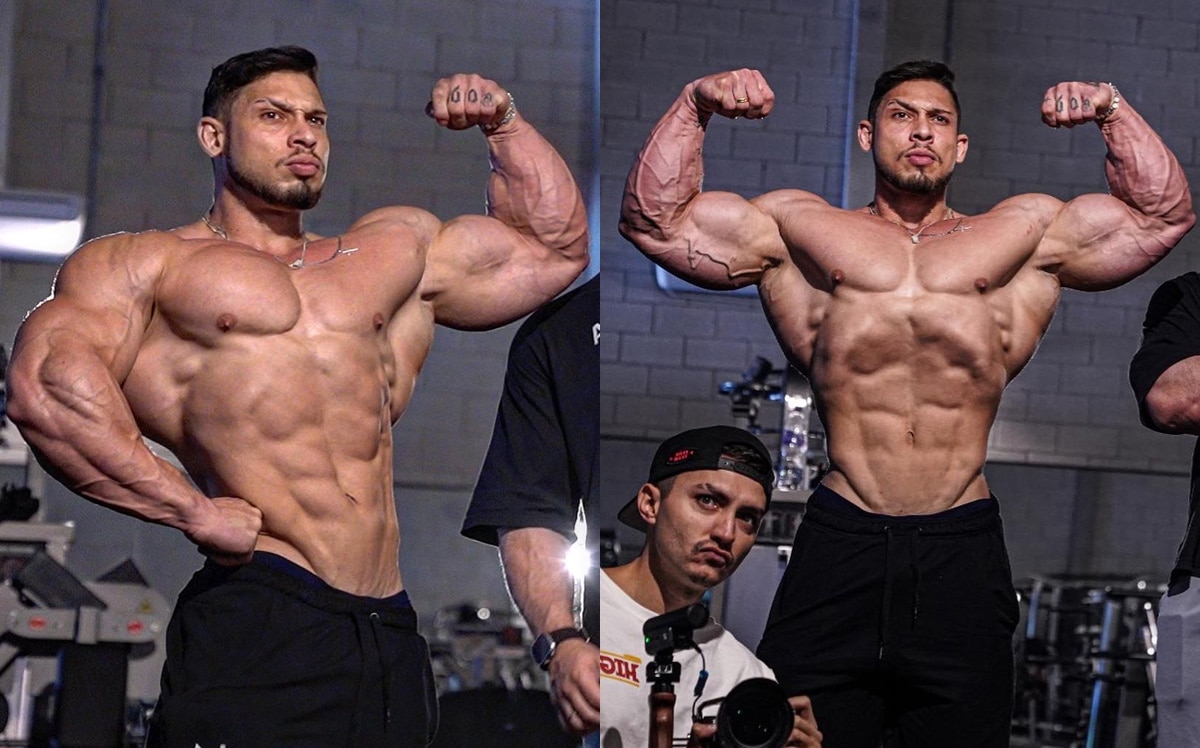
Ramon Queiroz Unveils Massive 251-Lb Physique Update in 2023 Off-Season, Crushes Chest Workout
Rising Brazilian star Ramon Queiroz is on a mission to win his first Classic Physique Olympia title later this year. In a recent YouTube video, Queiroz pushed through a chest workout and shared a physique update.
Queiroz has quickly become one of the biggest names in his respective division, courtesy of his popping biceps, thin waist, and sharp conditioning. He gained steam in the IFBB Pro League following his second-place finish at the 2021 Europa Pro Championships. In his Olympia debut, he finished fifth.
Forging ahead with a huge following, Queiroz took to the 2022 Arnold Classic in Columbus, Ohio. Ultimately, he came close to gold but was denied the title by two-time champion Terrence Ruffin. Nevertheless, fans instantly recognized Queiroz as a future threat to four-time Classic Physique Olympia Chris Bumstead.
Last December’s Mr. Olympia contest saw Bumstead secure another Classic Physique title. However, before Ramon got the chance to step on stage, he was nearly disqualified after initially missing the height/weight cap requirement. Since the Classic Physique weight cap is based on an athlete’s height, some have argued that taller competitors such as Bumstead have a distinct advantage over shorter competitors.
Back in March, Queiroz won his first Classic Physique Arnold Classic title. En route to the victory, he defeated Germany’s Urs Kalecinski and Alex Cambronero. Given his recent victory, many fans have dubbed him a promising contender for the biggest show of the year.
251-Lb Ramon Queiroz Showcases Intense Chest Training Session & Impressive Physique Update
Find a list of the exercises used by Queiroz below:
Despite pushing each other on stage, Bumstead and Queiroz aren’t opposed to teaming up in the training room. Shortly after the 2023 Arnold Classic, they joined hands for a laborious back workout, which featured six movements.
While Bumstead has been eying retirement for quite some time, it’s uncertain when he’ll actually pull the trigger on his career. He made it clear that he will assess his physique and mental outlook year-by-year, but as of right now, his sole focus is on winning a fifth Classic Physique Olympia title. Should he decide to stop competing, many believe Queiroz becoming an Olympia winner is a foregone conclusion.
Considering his success in Ohio, Ramon Queiroz is the leading man to upset Cbum in November. Since Bumstead still has room to grow in Classic Physique, fans have questioned whether or not the weight/height cap should be adjusted to offer a more even playing field for other competitors.
RELATED: Chris Bumstead Opens Up on Pressures of Being Dominant: “I’m Afraid That I’m Going to Lose”
Watch the full video below from the Max Titanium YouTube channel:
Published: 16 May, 2023 | 1:04 PM EDT
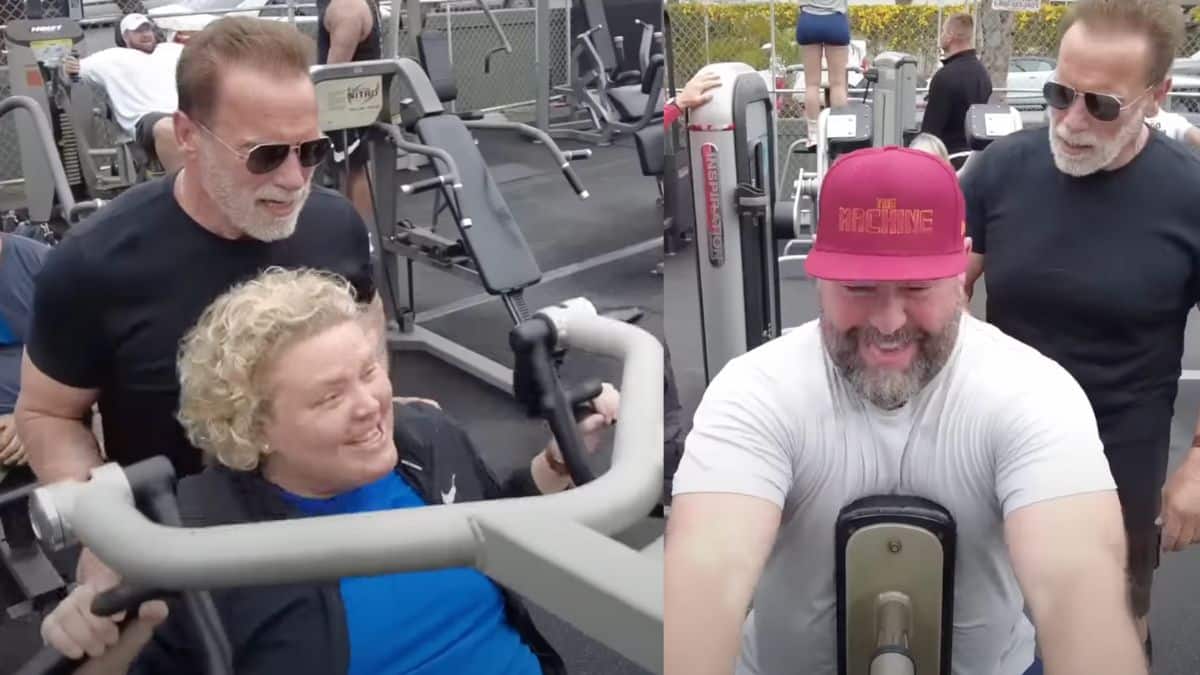
Arnold Schwarzenegger Leads Workout, Discusses Sleep & Alcohol with Comedians Bert Kreischer & Fortune Feimster
Bodybuilding legend Arnold Schwarzenegger‘s love for the pump was on full display in a special workout collaboration. In a recent YouTube video, Schwarzenegger joined comedians Bert Kreischer and Fortune Feimster for an upper body training session.
Competing in the 1970s and 80s as a bodybuilding pro, Schwarzenegger reached the top of the sport with exceptional proportions, crazy bicep peaks, and one of the best chests of all time. While navigating his career, Schwarzenegger shared the stage with IFBB Pro League icons such as Frank Zane, Franco Columbo, and Sergio Oliva en route to winning seven Mr. Olympia titles.
As a movie star and former governor of California, Schwarzenegger is a pioneer of the sport and has played a major role in making bodybuilding more mainstream. In addition to starring in the 1977 docudrama Pumping Iron, the 75-year-old runs the annual Arnold Sports Festival, which he co-created with the late Jim Lorimer in 1989.
In a change of pace, Schwarzenegger decided to promote his Netflix series FUBAR with comedians Bert Kreischer, and Fortune Feimster. He put them through a four-exercise routine that worked the delts and chest, which you can find below.
Arnold Schwarzenegger, Bert Kreischer, and Feimster Push Through Workout Demonstration
Schwarzenegger led the training session and started with machine lat pulldowns.
“Simple pull-down machine, all the way down until you hit the bottom, and then all the way up, and down, and up, and down,” said Arnold Schwarzenegger. “Bert is next, nice and easy nice and easy, stand up grab the top part [and then sit down]. All the way down, go all the way down. Don’t stretch the biceps, we’re training the wings [delts].”
During Fortune’s sets, Schwarzenegger instructed her to go deeper into the contraction.
“No pain, no gain,” said the icon. “I’m just [training] maintaining, but I don’t train heavy anymore too many heart surgeries.”
“Oh, well those are coming for me,” said Bert Kreischer.
Bert asks Schwarzenegger to count her set in German.
“This makes me sound like I’m in trouble,” shared Fortune Feimster.
Schwarzenegger moved to machine incline presses. Then, he revealed his max deadlift was 710 pounds.
“For the chest, all the way down and then all the way up,” Schwarzenegger suggested. “A pump up routine: how to get delts and chest. The key thing is to do it the right way, when you go down in squat position, then you use your thighs and back at the same time [for a deadlift]. 710 [pounds was my max deadlift.”
For his next demonstration, Schwarzenegger offered guidance while performing machine-seated rows.
“This is a stretch exercise, you stretch and you flex.”
Schwarzenegger revealed that he commonly used hotel fitness centers for staying in shape during acting projects. According to Arnold, his best movie physique was displayed during Conan, The Barbarian 2.
“Be careful with the shoulders and just push forward and push them together as much as you can,” said Arnold. “Yes, I’ve had surgeries, shoulders, hips, knees, yeah, the whole body.”
When asked about the quality of his sleep and alcohol consumption, Schwarzenegger had the following to say:
“Six or seven hours, yeah very well, not always. No [I don’t drink alcohol]. Not much, not very often, maybe a little bit of wine, but that’s maybe once a week. I used to drink more, like 10 shots of Schnapps, but not anymore.”
Finally, Schwarzenegger discussed his recently released Netflix series FUBAR. He then stressed that luck doesn’t exist.
“There’s no such thing as luck, there’s talent, and then talent meets opportunity, that’s luck,” said Schwarzenegger. “For her to jump into a high-action series with big players, it’s an opportunity. Why is there an opportunity? Because the talent is there and everybody thought it was to be funny, the intense scenes, stabbing, throwing, cutting the throat and all that stuff, but there’s comedic stuff too there that makes people laugh.”
Whether it’s detail-oriented training sessions or advice on living a healthier life, Schwarzenegger is dedicated to longevity. In a previous newsletter, the Austrian native shared how caffeine can serve as a ‘champion performance-enhancer,’ if used as a pre-workout option.
Schwarzenegger offered the comedians advice on proper form and follow-through despite their lack of experience. Even with his busy schedule, Schwarzenegger is determined to spread the knowledge he’s acquired over the years.
RELATED: Arnold Schwarzenegger Recommends ‘Wave Training’ To Get Out Of A Rut
Watch the full YouTube video below:
Published: 16 May, 2023 | 11:27 AM EDT
10 Best Core Exercises For Beginners (Killer Workout Included)
Core exercises are like a tough-love friend; they push you to be your best self even though you sometimes hate them for it. You might grumble and groan through the workout and even experience an ab cramp during one of those dreaded crunches, but in the end, you can’t help but love the results they bring.
Besides improving your physique aesthetics, core exercises can help improve your overall strength, balance, and stability, which can boost your performance in functional exercises and daily activities.
Contrary to what most people think, all core exercises are not the same. Some core exercises are more complex than others. For example, the front lever, back lever, L-sits, and toes-to-bar are best left to advanced lifters.
Before you move on to advanced core exercises, you must build a solid foundation by drilling the more basic movements. The best core exercises for beginners are versatile exercises that can be included in various training regimens and programmed according to your goals.
In this article, we cover the best core exercises for beginners, an ab workout that will help you achieve a ripped six-pack, tips for making the most of your training regimen, and the benefits of training your core.
What are Core Exercises?
Whether you want to perform a crunch, handstand, deadlift, or clean and jerk, you need a solid core. In contrast to the prevailing view, your ‘core’ isn’t limited to your abdominal muscles. It also includes your lower back, hips, and pelvis. Since your core includes multiple muscles, you must perform different exercises in your core workout to train the target muscles from several angles for optimal results.
The exercises in this article help boost the strength, stability, and flexibility of the core muscles, which are essential for proper body mechanics, balance, and posture.
Core exercises can be done in all three planes of movement:
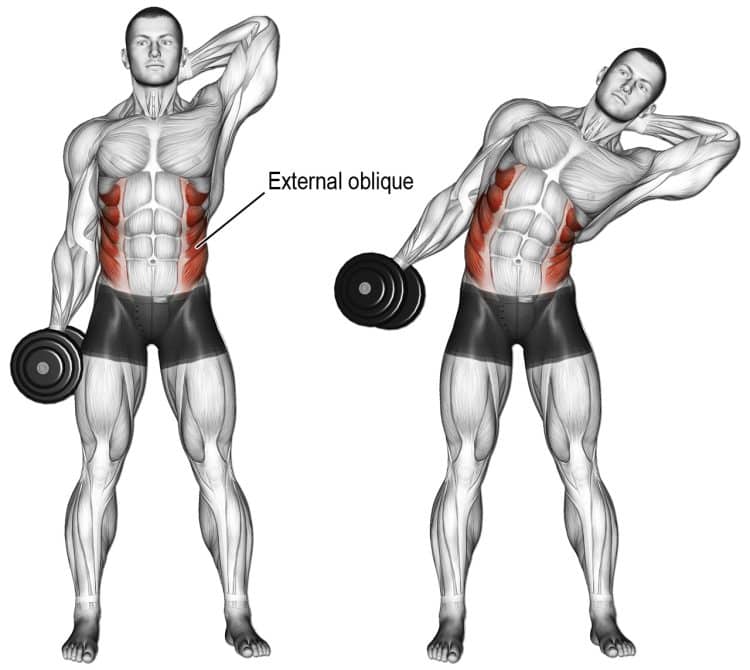
Frontal Plane: Dumbbell side bend and hyperextension oblique crunch
Saggital Plane: Crunch and hanging leg raise
Transverse Plane: Russian twist and windshield wiper
We will include exercises in all three planes to ensure overall core development. To make the core workout for beginners more accessible, we have only included bodyweight exercises. It also allows you to perform them anywhere.
10 Best Core Exercises For Beginners
These are the most effective core exercises for beginners:
Plank
The plank is one of the most popular core exercises. It is an isometric exercise that allows for optimal muscle contraction without visible movement. This exercise is a must-have in every ab training regimen.
Steps:
Lie face-down on the floor.
Your body should be in a straight line from head to heels throughout the exercise.
Position your elbows under your shoulders and your forearms parallel to each other.
Get up on your toes.
Hold this position for the recommended time while contracting your glutes and abs.
Pro Tip: You could also perform a high plank variation of this exercise, which is considered more challenging. The high plank variation involves staying in a push-up position.
Check out our complete plank guide here!
Side Plank
Obliques are often overlooked in an ab workout; however, we are not leaving any stone unturned in this article. The side planks are a frontal plane exercise that will work your obliques and the rectus abdominis muscle.
Steps:
Lie on your left side on an exercise mat.
Your legs should be stacked, and your right arm should rest on your side.
Plant your left elbow under your shoulder.
Brace your core and glute and drive your left elbow into the floor to lift your hips off the floor. Your body, from head to toe, should be in a straight line.
Hold this position for the recommended time.
Repeat on the other side.
Pro Tip: Make the exercise harder by performing hip dips while holding the plank. Ensure that you keep your shoulders pulled back and down throughout the exercise.
Check out our complete side plank guide here!
Sit-Up
The sit-up is a staple in most ab training workouts. It works your rectus abdominis muscle with a focus on the upper abs.
Steps:
Lie supine on the floor with your knees bent and feet planted flat on the floor.
Hold your hands in front of your chest or at the sides of your head.
Lift your upper back off the floor by driving your lower back and hips into the floor.
Your torso should be a few inches away from your quads at the top.
Slowly lower to the starting position.
Repeat for recommended reps.
Pro Tip: Avoid interlacing your fingers behind your head, as it can strain your neck. Keep your reps slow and controlled, and avoid using momentum during the concentric (upward) motion.
Reverse Crunch
The reverse crunch is an incredibly effective exercise for the more stubborn lower abs. It might look easy, but it will smoke your core in no time.
Steps:
Lie on your back on the floor. Bend your knees and plant your feet on the floor.
Extend your arms at your sides.
Lift your feet off the floor and bring your thighs to your chest.
Pause and contract your abs.
Return to the starting position.
Repeat for reps.
Pro Tip: Extend your legs at the bottom of the movement to bump up the intensity of this exercise.
Check out our complete reverse crunch guide here!
Dead Bug
The dead bug is one of the best core exercises for beginners. Getting into the dead bug is easy, and it helps achieve optimal core activation.
Steps:
Lie flat on the floor while facing the ceiling.
Extend your arms so they are perpendicular to your torso.
Lift your legs off the floor; your legs should be at a 90-degree angle.
Slowly extend your right arm overhead while extending your left leg. At the bottom of the movement, both should be a few inches from hitting the floor.
Return to the starting position.
Repeat on the other side.
Alternate between sides for the recommended reps.
Pro Tip: Make the exercise harder by using ankle weights and dumbbells. You could perform this exercise for reps or time.
Check out our complete dead bug guide here!
Hollow Hold
The hollow hold is a variation of the dead bug. It is excellent for building a rock-solid core, which will translate to better performance in functional movements. The hollow hold is one of the best core exercises for CrossFit beginners.
Steps:
Lie face up on the floor with your body in a straight line from head to toe.
Extend your arm overhead.
Brace your core and glute, and lift your head, upper back, and arms off the floor. Your arms should be at a 45-degree angle with the floor.
Simultaneously, lift your legs until your body resembles a “V.”
Hold this position for as long as possible.
Pro Tip: Holding your hands together makes the exercise a little easier. On the flip side, you can hold onto dumbbells or a weight plate to make it harder.
Check out our complete hollow hold guide here!
Superman
The Superman exercise is the mirror opposite of the hollow hold. This exercise targets your lower back and glutes and can help improve your mobility.
Steps:
Lie face down on the floor with your arms extended overhead.
Lift your head and chest off the floor so that your arms are a few inches off the floor.
Contract your core, glutes, and lower back, and lift your knees and thighs off the floor.
Hold the position for as long as possible.
Pro Tip: Maintain a neutral head throughout the exercise to avoid straining your neck. Lift your arms and legs as high as possible.
Check out our complete Superman guide here!
Russian Twist
The Russian twist works your core in the transverse plane. It will help develop your obliques and six-pack. After mastering the movement, hold onto a kettlebell, dumbbell, or weight plate for better muscle stimulation.
Steps:
Sit on the floor with your knees bent and feet flat on the ground.
Lean back so your torso forms a 45-degree angle with the floor, and lift your feet off the floor.
Extend your arms straight in front of you. Your palms should be over your knees.
Keeping your pelvis stable, turn to your right side.
Slowly return to the starting position.
Repeat on the left side.
Pro Tip: Perform this exercise on a decline bench for greater core engagement. Adjust the angle of the bench according to your experience level.
Check out our complete Russian Twist guide here!
Lying Leg Raise
This exercise works your middle and lower abs. Keep your knees locked out and pull your toes toward your torso while performing the lying leg raise for optimal lower ab engagement.
Steps:
Lie face up on the floor with your body in a straight line.
Keeping your knees locked, lift your legs toward the ceiling until they are perpendicular to the floor.
Slowly return to the starting position.
Repeat for reps.
Pro Tip: Place your hands under your hips for leverage. You could also perform this exercise on an elevated platform like a flat bench for an extended range of motion.
Check out our complete lying leg raise guide here!
Heel Tap
Think of heel taps as crunches for your obliques. Maintain a constant rep tempo on this exercise for optimal midriff engagement.
Steps:
Lie supine on the floor with your knees bent and your feet flat on the ground.
Your heels should be next to your hips.
Extend your arms at your sides.
Lift your shoulders, upper back, and head off the floor.
Turn to your right side and touch the side of your foot.
Return to the starting position.
Repeat on your left side.
Alternate between sides for recommended reps.
Pro Tip: Increase the distance between your hips and heels as you get better at this exercise. You could also aim for touching your toes instead of the side of your feet.
Check out our complete heel tap guide here!
Best Core Workout For Beginners
Now that you know about the best core exercises for beginners, it is time to put the knowledge to work. We have programmed these 10 beginner-friendly core exercises into a HIIT workout, which can be completed within 15 minutes.
High-intensity interval training (HIIT) workouts are incredibly effective at annihilating your midsection quickly and helping you achieve washboard abs.
In this workout, you’ll perform each exercise for 60 seconds. You are allowed a 30-second rest between exercises. Feel free to take a small breather (1-5 seconds) if you are unable to perform an exercise unbroken.
Tips To Maximize Core Workout Results
Here are a few tips to get the best bang for your buck from your core workouts:
If your goal is to build a diced midsection, you must also focus on your diet. Furthermore, you must enter a calorie deficit to shed excess body fat.
As you get better at these exercises, you can make them more challenging by adding resistance using weight plates, dumbbells, kettlebells, or resistance bands.
Breathing plays a vital role during core workouts. You must exhale sharply during the concentric part of the motion to achieve optimal core activation. Breathe in as you return to the starting position.
Spend 5-10 minutes warming up your core with light dynamic and static stretches to reduce the risk of muscle cramps.
It is common to experience ab cramps (especially for beginners) during ab workouts. Spend 5-10 seconds between sets rubbing down your abs to reduce the risk of cramping.
Benefits of Core Exercises For Beginners
Given below are the advantages of adding core exercises to your training regimen:
Aesthetics
Who are we kidding? Most people do the borning crunches because of the aesthetic benefits attached to them. A chiseled midsection makes you stand out and is one of the best indicators of physical fitness.
Improve Functionality
Most compound exercises like the squat, bench press, deadlift, and Olympic lifts require a strong core. Doing core exercises can improve your performance in the gym and daily activities. [1]
Boost Balance, Stability, and Flexibility
Core exercises can improve your balance, stability, and flexibility as it works your midsection, lower back, hips, and pelvis. Perform core exercises regularly for at least 12 weeks to start noticing the difference. [2]
Improves Posture and Reduces the Risk of Lower Back Pain
Folks that spend most of their days hunched over a computer or phone are at a higher risk of developing poor posture and lower back pain. Performing core exercises can strengthen your spine-supporting muscles, which can help improve your posture and lower the risk of lower back pain and injury during training.
Do Not Require Any Equipment
All the best core exercises for beginners in this article are bodyweight movements that can be done anywhere at your convenience. Plus, core exercises are incredibly versatile and can be squeezed into any workout.
Wrapping Up
Adding core workouts into your training regimen helps you achieve more than a carved midsection. It improves your balance and stability, boosts your overall functionality, promotes a better posture, and reduces your risk of lower back pain and injury.
This article covers the 10 best core exercises for beginners. Follow the 15-minute HIIT workout detailed above to set your midriff on fire in a short period. Pair these exercises and workout with a robust diet and recovery program to achieve a diced six-pack. Best of luck!
More Core Exercises and Workouts:
References
Okada, Tomoko; Huxel, Kellie C; Nesser, Thomas W. Relationship Between Core Stability, Functional Movement, and Performance. Journal of Strength and Conditioning Research 25(1):p 252-261, January 2011. | DOI: 10.1519/JSC.0b013e3181b22b3e
Manjusha K, Nithya Narayanan Kutty, Shilpa Chandran. The Effectiveness of Core Strength Training to Improve Functional Mobility and Balance in Geriatric Population: A Literature Review. Ortho Res Online J. 9(1). OPROJ. 000701. 2021. DOI: 10.31031/OPROJ.2021.09.000701
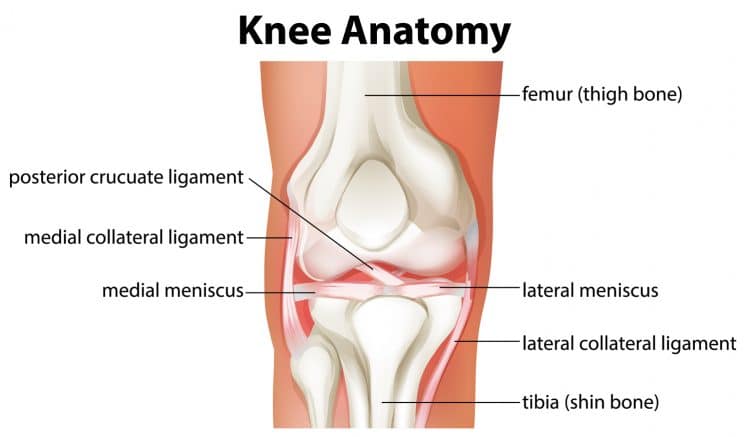
The 10 Best Quad Exercises for Bad Knees
No pain, no gain, or so the popular saying goes. However, there is a huge difference between the pain caused by fatigue and oxygen debt in your muscles and joint pain. While the former is part and parcel of an effective workout, the latter should set alarm bells ringing.
Exercisers ask a lot of their knees, and as such, knee pain is very common. High-impact activities like running are often associated with painful knees, and so is heavy strength training.
However, that doesn’t mean that knee pain signals the end of your exercising or lifting career. In fact, staying in shape can prevent some types of knee pain from progressing and may even make the pain more manageable (1).
That said, if you have knee pain, you should modify your workouts to avoid making it worse. You should also get the source of the pain checked out to ensure that you aren’t inadvertently turning a minor injury into a major one.
In this article, we reveal ten of the best quadriceps exercises for lifters with bad knees.
Knee Anatomy Basics
The knee is a hinge joint that opens (extends) and closes (flexes) and can laterally and medially rotate slightly when bent. It comprises the femur or thigh bone and the tibia, which is the bigger of your two shin bones. The ends of the bones are covered with a smooth, slippery substance called hyaline cartilage, which aids in the movement of the joint.
As a weight-bearing joint, the knee must be very strong and stable. As such, it’s held together by tough, inelastic cords called ligaments, and the end of the femur sits in small cartilaginous cup-like structures called the meniscus.
These structures (hyaline cartilage, ligaments, and meniscus) are prone to wear and tear and injuries. In some cases, surgical repair is necessary, while in others, rest and rehab are all that is needed. In most cases of knee pain, these are the cause of the problem, e.g., a torn ligament or meniscus or worn hyaline cartilage.
The knees are controlled by several muscles, including:
Quadriceps – also known as the quads and consisting of the vastus lateralis, vastus intermedius, vastus medialis, and rectus femoris. The quads extend your knees.
Articularis genus muscle and tensor vastus intermedius – two small but powerful knee extenders sometimes listed as part of the quadriceps group.
Popliteus – a small muscle behind the knee that initiates flexion.
Hamstrings – the collective name for the semimembranosus, semitendinosus, and biceps femoris, which are located on the back of your thighs. The hamstrings flex the knee.
Sartorius – also known as the tailor’s muscle, the sartorius is the longest muscle on the human body. It is responsible for the flexion of the knee.
Gastrocnemius – the larger of the two calf muscles, gastrocnemius works with your hamstrings to flex your knee.
While knee pain can be unpleasant, it doesn’t have to mean quitting your workouts. Instead, providing you avoid activities that exacerbate or worsen your pain, you can often train around whatever ails your knees.
In fact, stronger quadriceps help stabilize your knees, which is why it’s worth seeking out quads exercises even if you have bad knees.
The 10 Best Quad Exercises for Bad Knees
Is knee pain making it hard for you to build the quads of your dreams? We hear you! Try these exercises to see if they provide the workout you want without the discomfort. However, it’s generally best to get knee pain checked out by a medical professional. In some cases, continuing to train may make it worse.
1. Seated straight leg raises
If bending your knees causes pain, you need a quads exercise that lets you keep your leg extended. Seated straight leg raises put plenty of tension through your quads, emphasizing the often hard-to-hit rectus femoris. This is a common quads exercise in early-stage post-injury rehab.
Steps:
Sit on the floor with your legs extended in front of you. Place your hands behind your hips and use your arms for support. Pull your toes up to increase quads engagement.
Contract the quads of the leg you want to train first.
Keeping your knee straight, lift your foot 12-24 inches off the floor.
Lower your leg and repeat.
Switch legs and do the same number of reps on the other leg.
Muscles Targeted:
Primary: Quadriceps.
Secondary: Hip flexors.
Benefits:
A joint-friendly isometric quads exercise.
Virtually no stress on the knee joint.
No equipment is required.
Tips:
Use an alternating leg action if preferred.
You can make this exercise harder by wearing ankle weights or putting a resistance band around your legs.
Pause for 2-3 seconds with your leg raised to make this exercise more challenging.
2. Wall squat
The wall squat is another isometric or static exercise that puts plenty of stress on your muscles but virtually none on your joints. The key to this exercise is pushing as hard as possible to fatigue your muscles in 30 seconds or less. Long, passive holds are much less time-efficient.
Steps:
Stand with your back to a smooth wall, feet about 18 inches away.
Lean your back on the wall and then slide down until your thighs are roughly parallel to the floor. Your shins should be vertical.
Push your lower back into the wall and hold for the prescribed duration.
Muscles Targeted:
Primary: Quadriceps, hamstrings, gluteus maximus.
Secondary: N/A.
Benefits:
An intense but joint-friendly exercise.
No equipment required.
Easy to adjust the difficulty of your workout by changing how hard you push your back into the wall.
Tips:
Adjust the angle of your knees for comfort.
Do not hold your breath.
You can also do this exercise using one leg at a time:
3. Split squat
Lunges and squats are popular leg exercises, but despite their effectiveness, they can also be hard on your knee joints. Split squats are more knee-friendly than both these exercises but still deliver a similarly effective quads workout.
Steps:
Stand with your feet together and your arms by your sides.
Take a large step forward and stop. Your feet should be roughly shoulder-width apart.
Bend your legs and lower your rear knee down to within an inch of the floor. Keep your torso and front shin upright.
Extend your legs and continue for the prescribed number of reps.
Switch lead legs and repeat, doing the same number on the opposite side.
Muscles Targeted:
Primary: Quadriceps, hamstrings, gluteus maximus.
Secondary: Core.
Benefits:
A good exercise for quadriceps strength and hip mobility.
An excellent balance exercise.
Ensures that both legs are developed equally.
Tips:
Do this exercise next to a railing or wall for support if necessary.
You can also do split squats with dumbbells.
Put your front foot on a raised step to increase your range of motion and make this exercise more challenging.
4. Reverse lunges
Lunges are an awesome leg exercise, but unfortunately, they can also be hard on your knees. This is especially true for forward and walking lunges. Reverse or backward lunges are much more knee friendly but no less effective for strengthening your quads.
Steps:
Stand with your feet together and your arms by your sides.
Take a large step backward, bend your legs, and lower your rearmost knee down to within an inch of the floor. Your torso and front shin should remain vertical.
Push off your back foot and return to your starting position.
Do your next rep with your opposite leg.
Continue alternating sides for the duration of your set.
Muscles Targeted:
Primary: Quadriceps, hamstrings, gluteus maximus.
Secondary: Core.
Benefits:
A knee-friendly alternative to regular lunges.
A good exercise for mobility and balance.
Easier to master than forward or walking lunges.
Tips:
Step backward off a raised platform for a bigger range of motion and a more intense workout.
You can also do this exercise with dumbbells.
Take a shorter step to increase knee flexion and therefore quads engagement.
5. Goblet box squats
Bad knees do not have to step you squatting. However, you may find that descending no deeper than parallel is helpful for alleviating knee pain. Squatting to a box ensures you descend slowly and go no further than is comfortable.
Steps:
Stand with your back to a knee-high exercise bench or plyo box. Your feet should be roughly shoulder-width apart.
Hold a kettlebell in front of your chest, upper arms tucked into your sides. Brace your core and pull your shoulders back and down.
Bend your knees and squat down until your butt lightly rests on the bench.
Drive your feet into the floor and stand back up.
Muscles Targeted:
Primary: Quadriceps, hamstrings, gluteus maximus.
Secondary: Core.
Benefits:
A very functional exercise.
A knee-friendly way to overload your quadriceps.
A very scalable movement – use more or less weight as needed.
Tips:
Use a lower box to increase your range of motion and, therefore, the difficulty of the exercise.
Raise your heels on blocks or weight plates to increase quads engagement.
Do this exercise without weights if necessary.
6. Backward sled drags
Most people view sled training as a conditioning tool. However, working with a sled can also build strength and muscle size. Reverse sled drags are a very effective and joint-friendly quads exercise. And yes, that burn and pump you can feel in your quads is entirely normal!
Steps:
Load up your sled and attach a handle to it. Take the handle in your hands and stand facing your sled.
Brace your core and pull your shoulders back and down.
Bend your knees slightly and then take small steps backward.
Continue for the required time or distance.
Muscles Targeted:
Primary: Quadriceps.
Secondary: Trapezius, rhomboids, biceps, core.
Benefits:
A low-impact quads and conditioning exercise.
A very functional workout.
An excellent calorie burner.
Tips:
Keep your torso upright or lean back slightly. Do NOT lead with your butt, as doing so could cause lower back injury.
Go heavy – this is a powerful exercise.
Use a waist harness instead of handles to remove your upper body from this exercise.
7. Deadlifts
Deadlifts are often viewed as a posterior chain exercise, meaning they work your glutes, hamstrings, and back. However, deadlifts also involve your quads, albeit with a relatively short range of motion. This makes deadlifts more knee-friendly than squats while allowing you to lift moderate to heavy weights.
Steps:
Place your barbell on the floor and stand behind it with your feet under the bar, shoulder to hip-width apart.
Squat down and hold the bar with a double overhand or mixed grip.
Straighten your arms, drop your hips, and lift your chest. Pull your shoulders back and down and brace your core.
Drive your feet into the floor and stand up, taking care not to round your lower back or allow your hips to rise faster than the bar.
Lower the weight back to the floor, let it settle for a couple of seconds, and repeat.
Muscles Targeted:
Primary: Hamstrings, gluteus maximus, quadriceps, latissimus dorsi, trapezius, core.
Secondary: Biceps, forearms.
Benefits:
A knee-friendly alternative to squats.
A very functional exercise.
A great way to build a bigger, stronger back.
Tips:
8. Standing quadriceps stretch
Your quads don’t just need to be strong; they need to be flexible too. The standing quads stretch is simple yet effective. Tight quads are a leading cause of knee pain, so stretching is just as important as lifting for people with bad knees.
Steps:
Stand with your feet together and arms by your sides.
Bend your leg, lift your foot behind you, and reach back and grip the top of your ankle with one or both hands.
Keeping your thighs together, gently pull your foot toward your butt to lengthen and stretch your quads.
Hold for 20-60 seconds, increasing the stretch as your quads relax and lengthen.
Lower your foot to the floor, swap legs, and repeat.
Muscles Targeted:
Primary: Quadriceps.
Secondary: Hip flexors.
Benefits:
A simple and convenient exercise.
Ideal for warm-ups.
Good for developing better balance.
Tips:
Push your knee backward to extend your hip and increase the stretch on your rectus femoris muscle.
Lean against a wall and use a hand for balance if required.
Keep your hips and shoulders square and level throughout.
9. Prone quadriceps stretch
While the standing quads stretch is an excellent exercise, it does require a reasonable amount of balance. Also, it’s not easy to hold for lengthy periods, which you may want to do during your cool down. Stretching your quads in the prone (lying face down) position is the obvious solution to both these issues.
Steps:
Lie on your front with your head resting on your folded right arm.
Bend your left leg and reach back with your left arm, taking hold of your foot.
Gently pull your foot into your butt and hold it for 20-60 seconds, increasing the stretch as your quads relax and lengthen.
Lower your foot to the floor, swap legs, and repeat.
Muscles Targeted:
Primary: Quadriceps.
Secondary: Hip flexors.
Benefits:
A very comfortable quads stretch that’s perfect for cooldowns.
Ensures you keep your hips level and square.
A relaxing exercise that’s ideal for longer developmental stretches.
Tips:
Loop a yoga strap or belt around your feet if you cannot reach it without straining.
Increase the depth of the stretch by resting your bent knee on a yoga block.
Rest your head on a cushion or folded towel for comfort.
Related: Quadriceps Stretch Guide: How-To, Muscles Involved, Benefits, and Variations
10. Half-kneeling quads stretch
Most quads stretches are done with the knees together. That’s great for your joint health but not so good for hitting your rectus femoris, which crosses the knee and the hip joints. The half-kneeling quads stretch puts your hips into mild extension, so it stretches the rectus femoris more. However, this exercise may be challenging if you have poor flexibility.
Steps:
Adopt a half-kneeling position with one foot flat on the floor in front of you and your opposite knee roughly two feet behind.
Bend your back leg, grasp your ankle, and pull your foot into your butt. Keep your torso upright, do not twist your hips or shoulders, and do not hyperextend your lumbar spine.
Remain in position for 20-60 seconds or more, increasing the stretch as you feel your muscles relax and lengthen.
Release your foot, swap sides, and repeat.
Muscles Targeted:
Primary: Quadriceps.
Secondary: Hip flexors.
Benefits:
Provides a deeper-than-usual quadriceps stretch.
An excellent hip opener.
A good movement for more advanced exercisers.
Tips:
Place your knee on a folded exercise mat, towel, or foam pad for comfort.
Loop a yoga strap or belt around your feet if you cannot reach it without straining.
Take care not to hyperextend your hip, as doing so could cause injury.
Quad Exercises FAQs
Do you have a question about the best quad exercises for bad knees? No problem, because we’ve got the answers!
1. What are some of the common causes of bad knees?
While some knee pain is idiopathic, meaning it has no obvious or known cause, others are caused by specific conditions or injuries. These include:
Bursitis – inflammation of the bursa, which are fluid-filled sacks that reduce the friction between tendons and bones.
Iliotibial band syndrome – where the iliotibial band, which runs down the outside of the thigh, rubs against the outside of the knee joint, causing inflammation and knee pain.
Knee crepitus – grinding, cracking, or popping within the knee joint, which could be a precursor of osteoarthritis.
Meniscal tears – damage to the meniscus.
Osteoarthritis – wear and tear of the hyaline cartilage within the knee joint.
Patellar tendonitis – inflammation of the tendon that connects the kneecap to the tibia.
Patellofemoral pain syndrome – pain behind the patella or kneecap caused by roughening of the inside of the patella.
Strains and sprains – strains affect the muscles, while sprains affect the ligaments.
Tendonitis – inflamed, swollen tendons, usually caused by overuse.
Tendonosis – degeneration of the tendons, often caused by ignoring chronic tendonitis.
Some knee conditions get better with rest or light training, which others need medical intervention to heal properly. As such, and with so many possible causes, getting knee pain properly diagnosed is vital.
2. How often should I train and stretch my quads?
It’s generally best to train a muscle 2-3 times per week or every 48-72 hours. This allows adequate time for rest, recovery, and muscle growth. Exercising a muscle more often than this could lead to overtraining and poor progress.
In contrast, you can stretch your quads daily or even several times a day. In fact, if you have tight quads, i.e., cannot get your heel to your butt during prone or standing quad stretches, more frequent bouts of stretching will help you restore lost flexibility sooner.
3. So, are squats bad for your knees?
Contrary to common opinion, squats are not bad for your knees (2). The original studies that reported a link between squats and knee pain were performed on veteran NFL players, many of which already had banged-up knees.
Rather, doing squats with appropriate loads and good form can help prevent and control knee pain.
That said, squats are not the only exercise for strengthening your quads. As revealed in this article, there are plenty of other knee-friendly exercises you can use instead.
4. Some exercise hurts my knees – what gives?
While the exercises in this article are all certified knee-friendly, that doesn’t mean they won’t cause some people knee pain. Instead, knee pain can be influenced by a host of factors, from injury status to muscle tightness to leg length to underlying joint structure.
So, if one or more of these exercises bother your knees, cut them from your workout and try something else. You may find that you can return to the offending exercise in a few weeks or months once whatever is affecting your knee has a chance to heal.
5. What should I do if my knees hurt?
If you experience knee pain, you should initially use the RICE method. RICE is an acronym for:
Rest – take a break from the activity(s) that cause pain.
Ice – use ice packs for 15-20 minutes 3-5 times a day to reduce swelling and pain.
Compression – wear knee supports to protect the joint and further reduce swelling.
Elevation – raise your knee above heart height to minimize swelling and keep your weight off the injured limb.
Once the pain subsides, you can gradually return to exercise, backing off it the pain returns or worsens. However, if the pain is severe or long-lasting, you should seek medical attention.
Read more about coping with and preventing knee pain here.
Closing Thoughts
Exercise is good for everybody’s body. Not only can it change the way you look and improve your body composition, but it can also make you healthier and could even lead to a longer life. Ironically, though, being physically active can also take its toll on your joints, and shoulder, hip, lower back, and knee pain are common in exercisers.
The good news is that pain doesn’t mean you have to quit working out. However, you may need to modify your training to work around any aches and pains that have developed.
Use the exercises in this article to train around bad knees while building bigger, stronger quads. In many cases, keeping your quads in shape will enhance knee stability, taking stress off your joints.
However, if your knee pain is new, severe, or long-lasting, get it checked out to make sure your workouts aren’t making it worse.
References:
1 – Susko AM, Fitzgerald GK. The pain-relieving qualities of exercise in knee osteoarthritis. Open Access Rheumatol. 2013 Oct 15;5:81-91. doi: 10.2147/OARRR.S53974. PMID: 27790027; PMCID: PMC5074793. https://www.ncbi.nlm.nih.gov/pmc/articles/PMC5074793/
2 – Hartmann H, Wirth K, Klusemann M. Analysis of the load on the knee joint and vertebral column with changes in squatting depth and weight load. Sports Med. 2013 Oct;43(10):993-1008. doi: 10.1007/s40279-013-0073-6. PMID: 23821469 https://doi.org/https:/link.springer.com/article/10.1007%2Fs40279-013-0073-6