
 All Posts By Presser
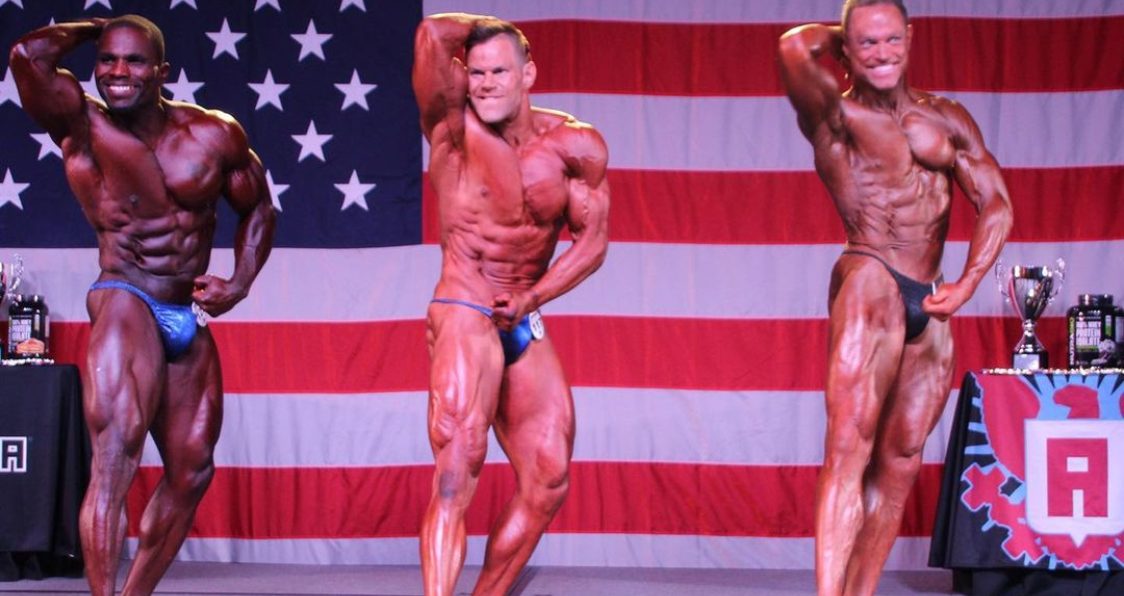
Mr. America 2021 Event Preview: How To Watch & Key Details
Everything you need to know about Mr. America 2021!
Mr. America has such a rich history, and while it has also had a bit of tumultuous ride, it is once again in the public eye as determined and incredible athletes compete for the coveted title. It began in 1939 and while much of its history is unknown, new promoters and those who care about the sport of bodybuilding are working tirelessly to get this event back on top. A successful event last year lends itself to an even better one this year as athletes prepare to take home the top prize and be crowned Mr. America.
Let’s take a look at all the important information you need to know as this historical event sets to kick off in a just few days. When it is, where it is, and how to watch are all included below, plus some key athletes to keep an eye on as they look to repeat and take the title two years in a row.
History Of Mr. America
Mr. America began in 1939 and was started by the Amateur Athletic Union (AAU). What Mr. America did was champion the idea of the Greek ideal, that perfectly sculpted physique dating back centuries, but a challenger to the AAU came and the newly founded IFBB led to a competition for the public’s support. What would happen is a slow decline that those ideals of Mr. America were replaced with money and massive physiques. The attention shifted from Mr. America to events like Mr. Olympia and soon enough, Mr. America would be passed around as the rights were sold several times.
Eventually, the AAU stopped holding the contest and this event would fall out of the public’s eye. But after a few revival attempts, a determined and hard working group at East Coast Fitness Concepts took the reigns and sought to bring back this historical and storied event. A successful year last year has brought hope that this year would be even better as athletes look to participate in the most incredible history of this contest and be crowned Mr. America.
Important Information To Know
With Mr. America fast approaching, here is some important information you should know with just a few days left until start time.
When: October 8-10, 2021
Where: The SHOWBOAT Hotel, Atlantic City, New Jersey
Tickets: For those interested in purchasing tickets, you can check out ticket prices here on the Mr. America website.
How To Watch
Mr. America will be broadcast on CBS Sports Network this year, bringing this sport and historical event to the public in a great way. Generation Iron will also be covering this event and will provide updates on the CBS Sports Broadcast as they become available.
With this event being broadcast on CBS Sports Network, it allows those who may be unfamiliar with bodybuilding the chance to learn and see just what makes this sport so great. Having the history and rich story tied to Mr. America, this event may make for great TV in that it has all the components you want. It has action, it has competition, it has love of the sport, and it has a winner who will be crowned Mr. America 2021.
Scoring & Event Layout
The judges will score competitors on 5 criteria, each ranging on a points scale: muscular development (1-5 pts), muscular proportion (1-5 pts), conditioning (1-3 pts), posing (1-4 pts), and general appearance (1-3 pts). The judges will also score athletes and arrange them by their placing. Once this is done, the points from the 5 criteria are placed into a perfect score out of 20 points and this score, on top of the placing, will be factored into the final result. The top three athletes in each category take home their respective positions.
As a part of this contest, three categories will be required to perform an individual stage performance, including Women’s Physique, Men’s Bodybuilding, and Men’s Classic Physique. These routines will not exceed 60 seconds for amateurs and 90 seconds for professional competitors. All other categories will perform an I-walk, where they will walk to back center stage and complete a front facing pose. They then walk to front center stage and perform ¼ turns before ending in an appropriate stage stance facing the judges.
Key Bodybuilders To Watch
With this event being a real success last year, we finally have some returning winners to look forward to as they seek to hold onto their title. On the men’s side, Johnny Dotson looks to defend his title in the Pro Men’s Physique while Joe LaCerra defends the Pro Classic category. For women, Dora Avila is set to repeat in the Pro Bikini category, while Jenna Bidoglio fights to defend Pro Figure.
We talked with Joe LaCerra and Jenna Bidoglio about their beginnings, training, nutrition, and excitement for this event. A common theme was the desire to participate in a sport they love so much and an event with such a rich history. While their respective routines were of course different, both are excited to come back and defend their title, looking to start a winning streak that puts them in the history books of Mr. America.
Wrap Up
Mr. America is a long and storied event full of rich bodybuilding history and incredible highlights. Do to unforeseen circumstances and the evolution of the sport, this historic contest had fallen away, seemingly leaving the public eye as others crept in to take the top spot. But with a comeback and revival for the ages, Mr. America has returned and competitors are excited to get back out to try and win this coveted title. This preview has everything you need to know about Mr. America as this event is set to kick off in just a few days.
Check out Mr. America’s website here for more information on this historic and amazing event!
Let us know what you think in the comments below. Also, be sure to follow Generation Iron on Facebook, Twitter, and Instagram.
*Images courtesy of Mr. America Instagram and Joe LaCerra Instagram
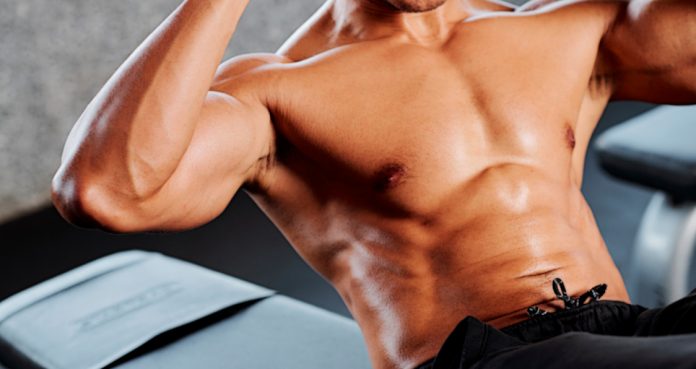
3 Reasons Why You Should Perform Explosive Lifts
Lifting explosively can change your training for the better.
When it comes to bodybuilding there are so many different methods that can be used to build muscle and burn fat that often times it can become confusing as to what exactly you should be doing when you get into the gym. There’s a notion that lower weight and higher reps can get you shredded.
Others talk about the fact that the only way to make your muscle grow is to lift heavy, while many others point out the fact that it doesn’t matter how heavy the weight is as long as you’re getting the proper contraction. In a way all of these statements are true which can drive a bodybuilder nuts trying to figure out which method is right for them. But one ideology that isn’t discussed nearly enough is the idea of lifting explosively.
While many may equate explosive lifting to powerlifting and weightlifter principles it can be a great way for a bodybuilder to get shredded fast. Rather than just always having your muscles experiencing tension at the bottom of the lift it’s a good idea to lift explosively as well. Everyone’s body works different of course, but lifting explosively is going to enhance your training.
1. Build More Strength
When you’re at the bottom of your lift rather than hold the position, exploding up will give you enhanced explosive power. It will help your body get used to the feeling of putting every ounce of muscle to work and strengthening the whole as a result.
2. Increased Muscle Recruitment
Speaking of muscles working together, by performing an explosive lift you’re more likely to recruit even more muscle fibers while performing your average lift. Whether it’s the squat or the bench press, by lifting explosively you are engaging a wider variety of muscle than you normally would have during a slow lift.
3. Burn Fat
What better reason is there to lift explosively. Not only will you be building muscle while you’re performing your lifts but you will also be eradicating fat. The principle works similar to HIIT as your metabolic rate increases with every explosion from the bottom to the top of the lift. Taking two seconds to reach the bottom of your lift then exploding upward will raise your metabolic rate that’s sure to help burning fat even when you’ve completed your training.
Do you lift explosively? Let us know in the comments and follow Generation Iron on Facebook and Twitter. Also, be sure to share, like, and comment to show your support.
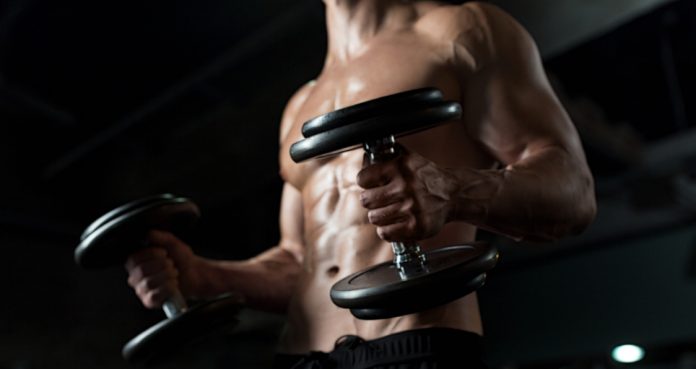
5 Exercise Swaps to Build Strength and Size
Adapting Strength Training
There may be times in the gym where you have to find alternative exercises to adjust training to cater for specific situations. One of the most common issues is injury. Often when injury strikes, training ceases entirely. However, this does not have to be the case as often it is possible to work around the injured site.
It is also not uncommon to attend the gym with the session all planned out, only to find that the gym is extremely busy and the equipment you need is being used.Instead of just skipping over the exercise, look to replace it with another effective exercise that will work the same muscle groups and movements.
The 5 Muscle Building Replacements
The following 5 exercises have been designed to allow you to continue training and build muscle size, no matter what scenario you are faced with.
Whether you are looking for some exercise variations or are restricted through injury, the following 5 exercises can simply and easily be swapped into the majority of training programs.
1) Reverse Grip Bench Press (Swapped for Incline Bench Press)
When it comes to bench pressing, a very common mistake is to allow the elbows to flare out and consequently place the shoulders in a compromised position.
An underhand grip prevents the elbows from flaring out to the sides and as a result, reduces the chances of sustaining an injury (1).In addition to increasing the risk of shoulder injury, this error also fails to effectively activate the upper pectorals, thus reducing the effectiveness of the exercise.While the incline bench has been found to increase activation of the upper pecs by 10%, an underhand grip has been found to increase this even further – by as much as 30%!Therefore, those looking to promote shoulder health and improve the strength and size of the upper pecs should utilize an underhand grip when benching.
Coaching Points:
Lie back on the flat bench and initially lift the bar from the rack using an overhand grip
In a controlled manner bring the bar over the chest and drop it down to the lower portion of the pecs
Let the bar rest on the chest and carefully switch from your overhand grip to an underhand grip ensuring that hands are slightly wider than shoulder-width
For every rep, ensure that the bar starts over the face and is dropped to the lower chest
Once contact is made with the chest, drive it back up in a slight arc so it returns to over the face
2) Barbell Power Row (Swapped for Single-Arm Dumbbell Rows)
Single-arm dumbbell rows are excellent for developing single limb strength and stability. However, when short on time, consider using a barbell to simultaneously work both sides.
Using a barbell will also allow you to lift a heavier load than the dumbbell will due to the improved stability associated with the barbell.Lifting a heavier load will place greater stress on the back and therefore cause it to adapt at a greater rate.The dumbbell row is often utilized as it does not place the same kind of stress on the lower back that the barbell row does (2).However, in the same way that a bench is often used to stabilize the spine in a dumbbell row, consider using a power rack during the barbell row to reduce lower back stress.Simply place the barbell on the rack after each rep to promote back health and reduce the risk of injury.
Coaching Points:
Set the pins slightly below the knees and start with the loaded barbell resting on the pins
Tip forward and grip the bar with an overhand grip that is shoulder-width apart
Brace the core and drive the chest up to protect the spine
Rip the bar into the waist while preventing the elbows from flaring and then return to the pins
3) Bent-Over Dumbbell Lateral Raise (Swapped for Cable Rear Delt Flies)
One of the biggest benefits of using the cables is that they effectively maintain tension on the working muscles throughout the duration of the exercise.However, if the cable machine is being used, it is possible to work the rear delts using dumbbells instead.One of the advantages of using dumbbells is that unlike the cable or rear dealt fly machine, they are portable and can be performed practically anywhere.Another positive is that heavy dumbbells are not required for this exercise; light loads will effectively get the rear delts firing. This makes it a perfect “at-home” exercise.Coaching Points:
Pick up a pair of dumbbells and stand tall before gently pushing the hips back to cause the trunk to lean forward
Keeping the arms extended, let the weight hang down with the palms facing each other
Engage the rear delts and squeeze between the shoulder blades to drive straight arms out to the sides of the body until approximately parallel with the floor
Hold the contraction for a moment before lowering the dumbbells under control
This exercise can also be performed while seated on a bench.
4) Step-Up (Swapped for Squats)
Although the squat should form a vital part of the majority of training programs, there may be times that it may have to be avoided or replaced with an alternative.On this note, it is important to recognize that the leg press is not a like-for-like swap for the squat considering that biomechanical differences that exist between the two (3).The squat tends to activate the hamstrings and glutes to a large extent whereas the leg press tends to limit the involvement of both of these muscle groups.A more suitable alternative is the step-up – which is practically a one-legged squat. Either barbells or dumbbells can be used for this exercise.When executing the step-up, ensure that the box or bench you select places the thigh in a position that is parallel with the floor. Any higher than parallel will fail to properly engage the glutes, quads, and hamstrings.Coaching Points:
Stand in front of the box with either a bar on the back or dumbbells in hand
Keeping the chest up and core tight, place the foot on the box and drive through the heel powerfully to rise up
Step onto the box with the other foot and then reverse the entire movement back to the floor
5) Cable Leg Raise (Swapped for Leg Extensions)
While the leg extension is a powerful isolation exercise for the rectus femoris (quad muscle), it may place undue stress on structures around the knee (4).Considering the fact that the rectus femoris muscle encompasses both the knee and hip joint, the cable leg raise may be a more effective alternative.The main difference between the two exercises is that the leg remains entirely straight during the cable leg raise, rather than hinging the knee in the leg extensions.Coaching Points:
Set a cable pulley to the lowest point, attach an ankle strap and secure the strap around the ankle
Standing tall and straight, engage the muscles of the legs to raise the leg out in front of the body until it reaches parallel with the floor
In a controlled manner, lower the leg until the foot touches the floor slightly behind the standing foot
Final Word
There is no reason to be stuck when injury strikes or when your favorite piece of gym equipment is being used. Instead, consider adopting a number of the aforementioned exercises to allow to exercise to continue.
References:
1-Bhatia, Deepak N.; de Beer, Joe F.; van Rooyen, Karin S.; Lam, Francis; du Toit, Donald F. (2007-8). “The “bench-presser’s shoulder”: an overuse insertional tendinopathy of the pectoralis minor muscle”. British Journal of Sports Medicine. 41 (8): e11. doi:10.1136/bjsm.2006.032383. ISSN 1473-0480. PMC 2465431. PMID 17138640.
2-Fenwick, Chad M. J.; Brown, Stephen H. M.; McGill, Stuart M. (2009-3). “Comparison of different rowing exercises: trunk muscle activation and lumbar spine motion, load, and stiffness”. Journal of Strength and Conditioning Research. 23 (2): 350–358. doi:10.1519/JSC.0b013e3181942019. ISSN 1533-4287. PMID 19197209.
3-Escamilla, R. F.; Fleisig, G. S.; Zheng, N.; Lander, J. E.; Barrentine, S. W.; Andrews, J. R.; Bergemann, B. W.; Moorman, C. T. (2001-9). “Effects of technique variations on knee biomechanics during the squat and leg press”. Medicine and Science in Sports and Exercise. 33 (9): 1552–1566. doi:10.1097/00005768-200109000-00020. ISSN 0195-9131. PMID 11528346.
4-D’Lima, Darryl D.; Fregly, Benjamin J.; Patil, Shantanu; Steklov, Nikolai; Colwell, Clifford W. (2012-2). “Knee joint forces: prediction, measurement, and significance”. Proceedings of the Institution of Mechanical Engineers. Part H, Journal of Engineering in Medicine. 226 (2): 95–102. ISSN 0954-4119. PMC 3324308. PMID 22468461.
4 Overrated Training Variables
Here are four overrated training variables.
A mark of a great coach isn’t solely in what they include in their toolbox, but also what they don’t include. Simple is often times better, but many coaches and fitness enthusiasts like to stuff every program and method inside their repertoire.
They like to jump on the latest buzzword or training method and thus, their checklist for a training program gets wildly complex with no rhyme or reason.
So, let’s go over some training variables you can ditch in your own training.
1. Time Under Tension
Most people don’t understand muscle growth and thus, dumb terms like time under tension is born. I’ll admit, this term isn’t all wrong, but the way people view and apply it is completely off. To understand why, let me explain the basics of muscle growth.
Your muscles don’t grow from time under tension per se. It grows from mechanical tension that gets translated into a chemical signal for your body to construct new muscle proteins. The keyword I want to hone in on is mechanical tension which is much different from time under tension.
Mechanical tension has little to do with time and more to do with individual muscle fiber producing force. When your muscle fibers contract slowly towards the end of the set, all muscle fibers within that muscle are recruited and the contractions velocity slows down, thus every rep performed in this state is hypertrophic irrespective of the time it remains in this state.
This is why no matter how you manipulate many variables like rep range, tempo, and load within the set makes little to no difference. If you reach the same proximity to failure, the set produces the same growth regardless of how much time under tension there was or how much constant tension there was.
Higher rep sets are longer and technically have longer time under tensions, but all research confirms they produce the same muscle growth as lower rep sets with the exception of sets that are too low (1).
Time under tension is often misapplied. People will cut range of motion or do deliberately slow concentrics to increase time under tension and think they’re growing more muscle. However, reducing range of motion grows less muscle in nearly every exercise confirmed by research, so this is a scenario where more time under tension is worse for your gains.
Furthermore, slowing down the concentric reduces the total load or reps you’re lifting which reduces mechanical tension.
Lastly, people will focus overly hard on their muscles, so they can feel that tension longer, but that doesn’t do much which brings me to my next point.
2. The Mind-Muscle Connection
The mind-muscle connection is referred to as an internal focus. You focus on the internal muscle that you want to target or is being targeted.
Whether you do it to increase the time under tension or to simply make the muscle work harder, this is generally a futile effort in more advanced lifters. Here’s why.
The motor neurons that recruit your muscles and the sensory neurons that you feel are 2 different things. Sometimes, they line up naturally and other times they don’t. You can feel sensation in a certain muscle and it’s not actually producing much mechanical tension.
Thus, internally focusing reduces your work output and can unfavorably change recruitment patterns. This reduces total work performance and can even compromise muscle growth. Your brain’s motor cortex is already a highly efficient specimen. If you select the proper exercise for a muscle and execute the proper technique (external cuing), your motor cortex will optimize the muscle recruitment pattern.
For example, one study compared internal against external focus on conventional deadlifts (2). The external focus group had better posture, stability, and less bar path variability. When you focus too much on the mind-muscle connection, you’re interrupting your brain’s already optimized recruitment pattern.
You don’t need to feel the muscle more. Instead of spending time focusing so hard on certain muscles, learn biomechanics, choose optimal exercises for that muscle, and focus on executing them well. Chase technique not muscle sensation.
For example, aiming for certain arm paths will bias certain pec divisions more during presses. Same goes for certain back divisions during rows. But there is no need to focus on specific muscles.
3. The Pump
We all grew up watching the beast Arnold Schwarzenegger. He was iconic and is well known for talking about the muscle pump before it even became a thing in the literature. He would describe how the pump feels better than sex and you should be chasing the pump every session.
Unfortunately, as amazing as Arnold was, he’s way off on this one. The pump doesn’t grow muscle. I might’ve just shattered your world view of muscle growth, but hey, hopefully, you’ll learn more after all this and not place your devotion to men you don’t even know.
Anyways, the pump in research is called metabolic stress. Metabolic stress is the accumulation of metabolite by-products. It’s what gives you that burning sensation within your muscles. Metabolites include lactate, phosphate, and hydrogen ion. This is not to be confused with lactic acid which is something different.
Metabolites provide lots of interesting mechanisms like swelling the muscles and causes reactive oxygen species, both of which don’t grow muscle. However, metabolic stress lowers the threshold for high motor units to be recruited.
So metabolic stress is the natural by-product of high rep training which allows those higher motor units to be recruited typically seen in the first few reps of lower rep sets.
To be clear, this pump doesn’t grow muscle, but rather is one way to make muscle growth possible via mechanical tension. So you should push hard during high rep sets, but you should never create a program around how much of a pump you can get. Doing so, can easily lead to less muscle growth.
For example, high intensity interval training, short rest periods, partial reps, and training to failure, all increase metabolic stress, yet all of these methods have the potential to grow less muscle.
Furthermore, blood flow restriction training causes massive metabolic stress, yet research finds it grows a comparable amount of muscle as traditional strength training.
So the pump is a good feeling to get. It’s a normal feeling to get. But you don’t go chasing it and the level of metabolites you feel doesn’t correlate with much. It’s mostly just for looking temporarily beefier for Instagram selfies.
4. Muscle Damage
When you were in high school PE class, the coach would teach you about the basics of muscle growth. They would talk about you have to tear muscles for them to grow back stronger. Then, they’d ramble about some dumb life analogy on how struggles make you better.
In fact, many personal training certifications teach the same thing. Yet, this is not substantiated by research. Research finds undisputedly, the only pathway to get the chemical response of new muscle growth is from a mechanical stimulus. A metabolic stimulus as we mentioned doesn’t directly grow muscle.
And believe it or not, muscle damage or tearing of the fibers doesn’t either. Muscle damage can correlate with soreness, but people don’t understand that soreness is a feeling.
As insensitive as it may sound, facts don’t always care about your feelings though. Muscles have neurological patterns ingrained in the brain that controls them. The more accustomed you are to a movement, the more effective it can coordinate that movement.
However, when you are doing something, you’re not accustomed to, your muscles can’t coordinate as well and thus, experience these micro tears. It’s called muscle damage and it can make you quite sore. However, more muscle damage doesn’t mean more muscle growth.
If you’ve never swam before, struggling across the deep end of the pool will make you quite sore, but swimming isn’t getting anybody buff. Furthermore, training at longer muscle lengths causes more muscle damage.
So certain training protocols or training with exercises you’re not accustomed to may cause more muscle damage, but it doesn’t correlate with more muscle growth.
In fact, muscle damage is inherently not a positive thing. By definition, muscle damage is muscle breakdown. Some studies show muscle damage increases the stimulation of muscle protein synthesis, but with no net gain in muscle growth. This means that muscle damage signals for repair, but not additional muscle growth.
Chasing muscle damage is also not a reliable metric of your training program. A sorer or more damaging workout isn’t necessarily a better workout. In fact, muscle damage in excess limits skill execution and performance/recovery markers, so muscle damage in excess is clearly detrimental.
Don’t Chase Feelings, Chase Performance
So as you can see, many common training variables are overrated. Remember, we live in a world where content is pumped out daily, so everybody will be making content on everything. Don’t grip on to every concept so tightly as they may simply be ineffective or overcomplicated.
But now you know better. You don’t have to necessarily optimize for time under tension, you don’t have to leave the gym painfully sore, and you don’t have to buy supplements that promises a filthy pump.
All these things have their own application, but most lifters shouldn’t be overly concerned about chasing these variables.
For more news and updates, follow Generation Iron on Facebook, Twitter, and Instagram.
References
Schoenfeld, Brad. “Strength and Hypertrophy ADAPTATIONS between LOW- vs. HIGH-LOAD RESISTANCE Training: A Systematic Review and Meta-Analysis.” Journal of Strength and Conditioning Research, U.S. National Library of Medicine, pubmed.ncbi.nlm.nih.gov/28834797/.
Chan, Alan, et al. “Effects of Attentional Focus and DUAL-TASKING on Conventional DEADLIFT Performance in Experienced Lifters.” International Journal of Kinesiology and Sports Science, www.journals.aiac.org.au/index.php/IJKSS/article/view/5665.
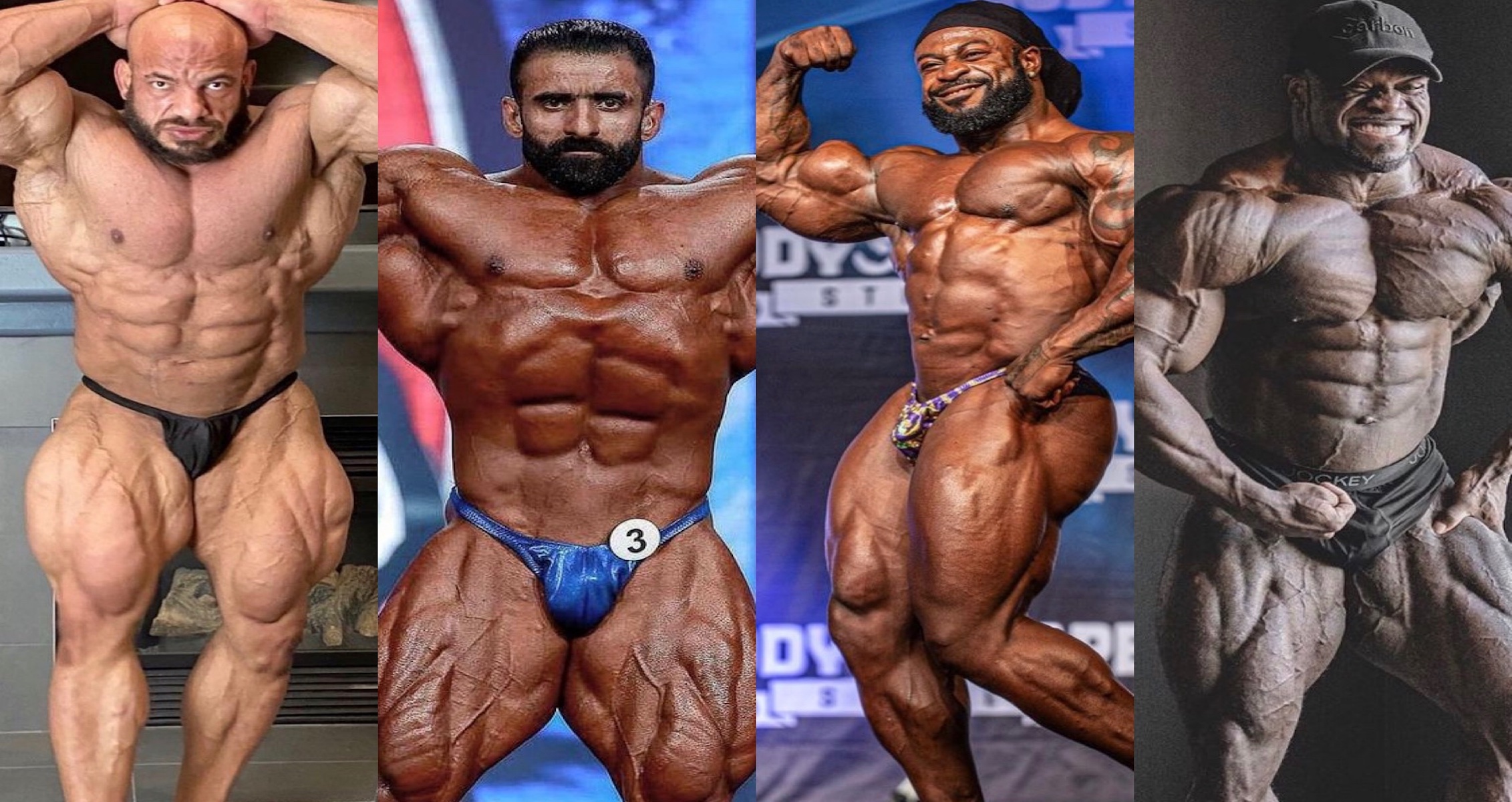
2021 Olympia: Men’s Open Preview & Predictions
Here is a breakdown and predictions in the Men’s Open division at the 2021 Olympia.
The 2021 Olympia will take place this weekend in Orlando. This is the biggest competition of the year and many of the top bodybuilders in the world will be on stage competing.
The list is impressive despite some big names being unable to compete in the event. Nathan De Asha is coming off a victory at the Arnold Classic UK but will be forced to miss the Olympia because of legal issues impacting his visa. Vlad Suhokuchro will also be absent because of travel issues. Other competitors such as Phil Heath and Dexter Jackson have also announced that they will not be competing.
This does not mean that the competition will be a bust — quite the opposite. The lineup is elite and you can find the entire list below, along with a breakdown and predictions for Men’s Open.
2021 Olympia List of Competitors
William Bonac (Netherlands)
Hadi Choopan (Iran)
Brandon Curry (USA)
Mamdouh Elssbiay (Egypt)
Regan Grimes (Canada)
James Hollingshead (UK)
Hunter Labrada (USA)
Patrick Moore (USA)
Hassan Mostafa (Egypt)
Andrea Presti (Italy)
Justin Rodriguez (USA)
Mohamed Shaaban (Egypt)
Iain Valliere (Canada)
Nicholas Walker (USA)
Akim Williams (USA)
Roelly Winklaar (Curacao)
Honorable Mentions
Justin Rodriguez
Justin Rodriguez has been improving each time he steps on stage and this includes a fourth-place finish at the Arnold Classic. Now, he will have a chance to see how he matches up with some other elite competitors. Rodriguez is a dark-horse heading into this competition and could crack the top six if all goes right.
Hunter Labrada
According to his father and legendary bodybuilding Lee Labrada, Hunter Labrada is destined to win an Olympia in his career. That will not be this year but he has a victory in the Chicago Pro this year. Labrada is just scratching the surface of his potential and this could be a stepping stone moving forward.
Men’s Open Top 6
6. Iain Valliere
Iain Valliere appeared at the 2020 Olympia and finished seventh. He has a chance to move up a spot and be a first callout competitor at this year’s event. It has been a strong year for Valliere. He took home titles in the Tampa Pro and Texas Pro on back-to-back weekends. He put on a show at the Arnold Classic and took home second place. Judges like Valliere and he could continue to strengthen his resume with a good performance this weekend.
5. Brandon Curry
It was a controversial victory for Brandon Curry at the 2019 Olympia. After being defeated last year, Curry knows the improvements that need to be made and he highlighted them during training. Curry can prove that his victory was not a fluke and that he still an elite competitor in the sport. He is continuing to improve and that can be shown on stage this year.
4. William Bonac
It is official. William Bonac will be present at the Olympia after missing the Arnold Classic. He was the reigning champion of the event and was unable to defend his title. Now, Bonac has been able to put all of his energy into the most-important competition of the year. Just being back on stage should be enough motivation for Bonac and he certainly looks the part. He is one of the best competitors in the world and will show it this weekend.
3. Nick Walker
Nick Walker has the New York Pro checked off his list and added the Arnold Classic this year. He has won the two biggest competitions outside of the Olympia and could make it three-for-three in Orlando. While Walker might not win the show, he is a first callout competitor that will put on a show. Walker has great size and has top notch conditioning. Walker is a relatively new name to bodybuilding and has already made a huge impact as a pro.
2. Hadi Choopan
It is all lined up for Hadi Choopan to finish near the top of the Olympia once again. He was able to arrive early this year and that means there was plenty of time to prepare. Choopan has been working with Hany Rambod and seems to be in incredible shape. Choopan has not competed since last year’s Olympia and qualified this year with a fourth place finish. In 2019, Choopan finished third so he has experience near the top. This year, he has a chance to set a new best placing and challenge for a title.
1. Mamdouh ‘Big Ramy’ Elssbiay
Olympia champions have went on streaks dating back to the days of Arnold Schwarzenegger. There has not been a repeat winner since 2017 when Phil Heath won his seventh-straight title. This is what Big Ramy can achieve this year and he has to be considered the favorite. If he comes in looking as shredded as last year, Big Ramy will be difficult to beat. There are some who believe that it is already in the bag. He has showed off his incredible physique leading up to the event and it looks like he is going to be in his best shape trying to win his second-straight Olympia.
Generation Iron will have full updates and coverage of the 2021 Olympia. For more news and updates, follow Generation Iron on Facebook, Twitter, and Instagram.
The Anabolic Doc: Don’t Be Fooled – Bodybuilders Suffer From Steroids Quietly
[embedded content]
The Anabolic Doc warns: Even healthy looking steroid users might be suffering in private.
Dr. Thomas O’Connor, aka the Anabolic Doc, has dedicated his entire career to studying the effects of steroids and other anabolic substances on athletes. He has always tried to bridge the gap between the hard truth of science, and the psychology and desires of athletes that use PEDs. He understands why athletes might be willing to take health risks for greatness. But he also wants to make one thing clear – long term steroid use will always have consequences.
While doctors and scientists have always been making such alarming claims, there are many who don’t believe it. This is largely due to the number of athletes who seem perfectly healthy after admitting to a career of steroid use. The Anabolic Doc wants doesn’t want people to be fooled – just because an athlete seems healthy in their older age, doesn’t mean they actually are. In our latest GI Exclusive interview, the Anabolic Doc explains how more often than not steroid users suffer quietly. Even if they outwardly appear to be healthy long term.
Most athletes who consider using steroids or other PEDs understand the risk they are taking with their health. Some athletes, in the pursuit of greatness, are willing to take that risk. But there are also a large swath of steroid users, both athletes and casual athletic individuals, who simply don’t know how bad the long term affects can really be.
This is due to the fact that famous athletes who get caught for steroid use, well, seem perfectly fine. Even long after retirement, a star athlete who had been caught doping seems to be living a normal healthy life. This kind of optics makes it easier to ignore the very real health issues that arise from long term steroid use. It’s this kind of optics that the Anabolic Doc wants to warn young steroid users about.
As the saying goes out of sight, out of mind. Things that are far off into our future are easy to ignore. This is especially true if there are no obvious warning signs publicly spoken about by iconic athletes. Outwardly, it appears that an athlete can use steroids, retire, stop taking steroids, and be perfectly fine – so long as they stop early enough. The Anabolic Doc can’t stress enough how untrue this idea is. While he can’t speak for every individual who takes steroids, his studies and experience prove this – most steroid users are suffering silently.
Dr. O’Connor details exactly the kind of private suffering that steroid users face down the road:
“We don’t know. Now, these men suffer quietly. I know, in this mind, because who comes to see me? They come to see me and they tell me the truth with their wife, their children, their mothers. And there’s a lot of tears. Because thy have heart disease and kidney disease. And they have psychiatric disease.”
The Anabolic Doc can’t speculate on specific high profile athletes or individuals – as he doesn’t know them personally. What he can rely on is the years of clients and data from studies that show how much suffering long term steroid users face. What goes on privately can be vastly different than what we see presented in public.
You can watch the Anabolic Doc’s full comments in our latest GI Exclusive interview segment above!
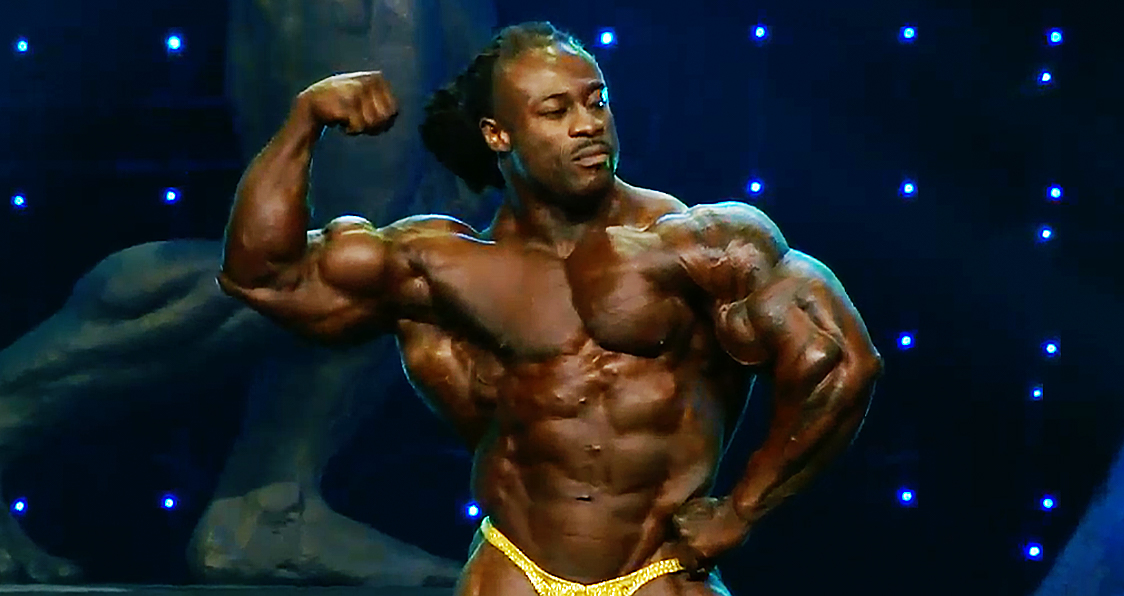
William Bonac Arrives In United States Ahead Of Olympia
William Bonac confirmed he has arrived and will be competing in the Olympia.
It has been a chaotic couple of weeks for William Bonac. He was forced to miss the Arnold Classic two weeks ago because of issues with travel. Bonac was the reigning champion of the event and was unable to defend his title. His plan was to return for the Olympia and it is going to happen this weekend.
Bonac recently announced that he has arrived in the U.S. and will be able to compete on the biggest stage of the year. Bonac took to Instagram on Monday to make the announcement but said he arrived in Orlando on Friday.
“We finally made it to the USA’ for the @mrolympiallc 2021.
I just want 2 take this opportunity 2 apologize 2 all of you ?that I am competing at @mrolympiallc
Actually we arrived at Friday evening needed the whole weekend to adjust to the different timezones.”
William Bonac went onto explain that there was a problem with his Esta and was forced to get a visa. He was able to get one in time and will be able to appear at the Olympia.
“Bonac has appeared in the previous seven Olympia competitions. This began back in 2014, when he placed 14th. Bonac has quickly turned into one of the best in the sport. His highest finish on the Olympia stage was in 2019. He finished second to Brandon Curry that year.
“First of all there were some misunderstanding with my Esta due the denial of the Waver proclamation to get me on time for the AC. My Esta got invalid because of this and was not returnable. So my only option was to get an visa in time, wich we did.
Thanks to God who made us meet some amazing people named @amw0lf& his fiancé @motivate.train.inspireThey were about to fly out to Orlando as well, for the amateur Olympia unfortunately @amw0lf lost his passport with his visa in it. Despite that he was day and night busy with my case until they finally got an appointment for me at the embassy. Thank you so much much my friend without you I wouldn’t be here!!!????
Now I got a visa, wich is even better so I don’t have to worry for the next 10 years.”
William Bonac would have been a force at the Arnold Classic and given champion Nick Walker a run for his money. Now, Bonac will have to make up for lost times and show his full ability on stage in Orlando. There are plenty of reasons to be excited about the upcoming Olympia competition and Bonac returning just adds another to the list.
For more news and updates, follow Generation Iron on Facebook, Twitter, and Instagram.
Robby Robinson and Nick Walker Continue to Trade Words on Social Media
Robby Robinson and Nick Walker Continue to Trade Words on Social Media
It seems as if Robby Robinson and recent Arnold Classic winner Nick Walker are continuing to share words online. After the legendary Robinson shared his opinion on the state of modern bodybuilding, a confrontation with Walker was all but inevitable. Accept it didn’t quite turn out in the way that many expected.
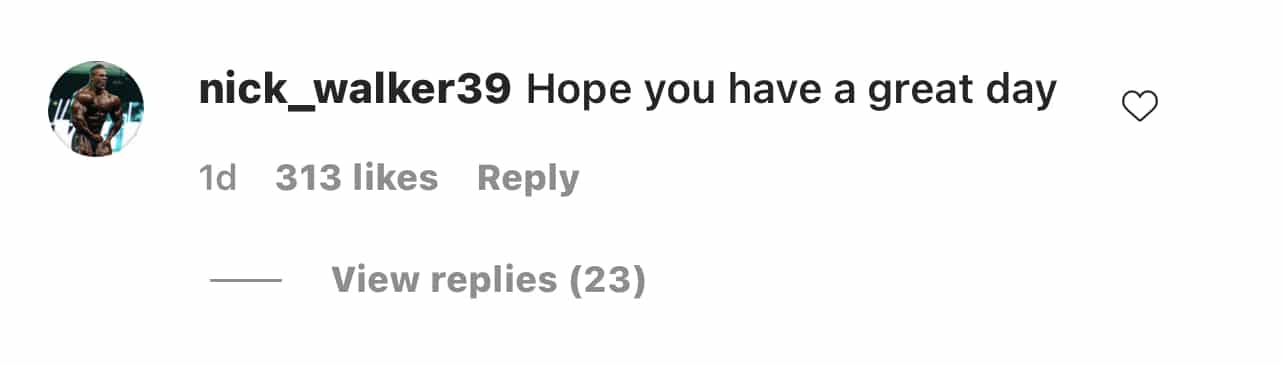
Rather than retaliating with harsh words and name calling, it appears that Nick Walker has chosen to take a more diplomatic approach. Walker commented on a recent post made by Robby Robinson in perhaps the least offensive comeback ever.
The Beef Continues
The post in question is a classic photo of Robby Robinson at the height of his powers. He looks truly impressive in the image and the epitome of the classic bodybuilder.
In the post Nick Walker took to the comments to say the following.
While someone could interpret this as Walker being tongue in cheek, there’s really no way to tell if the statement was meant to be hostile or goading. On face value alone it appears to be a very polite statement and nothing more.
Robinson Remains Undeterred
After the post and the comment, Robby Robinson put up another post, detailing that he has been harassed online for his opinions on Nick Walker.
I have gotten a bunch of [email protected] , nasty comments, cussed out..
To all INHALE…..
Nothing can you say to me, write, text me, the n word ,call me a grand pa, ( honored ) Dork, washed up..I am unconsumed by any ones fear. TOTALLY ARMED UNAFRAID. . .
If you think this is healthy. Something you would use as a MOTIVATIONAL EMPOWERMENT. Something you would ADMIRE .. THEN YOU need to have a long SERIOUS CONVERSATION WITH YOURSELF….RR .. STILL HAVE THEM ..
With all this back and forth the reality is that bodybuilding isn’t going to change. Many say that Classic Physique exists for those individuals with similar tastes to Robby Robinson. Men’s Open Bodybuilding is unlikely to return to the days of yore when competitors that looked like Robinson were the norm.
At this point the argument is likely to fall on deaf ears. Many like the massive physiques of bodybuilding these days. At this point it seems like mass monsters are here to stay.
What do you think of Robby Robinson and Nick Walker trading words online?
For more news and updates, follow Generation Iron on Facebook, Twitter, and Instagram.
News and Editorial Writer at Generation Iron, Jonathan Salmon is a writer, martial arts instructor, and geek culture enthusiast. Check out his YouTube, Instagram, Twitter, Facebook, and Sound Cloud for in-depth MMA analysis.
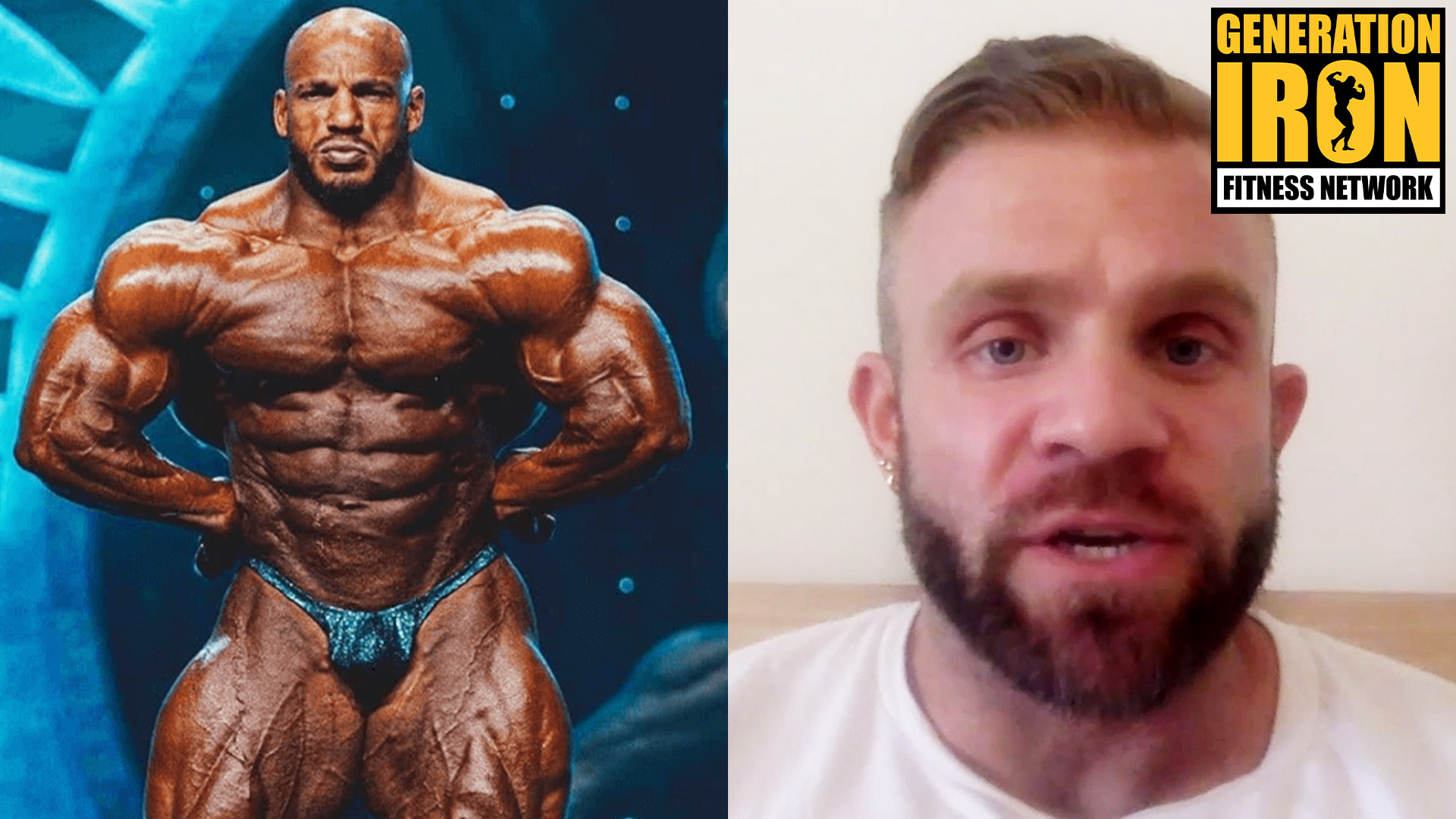
Iain Valliere: There Are Only Two Ways To Beat Big Ramy At Mr. Olympia 2021
[embedded content]
Iain Valliere breaks down the two approaches to beating Big Ramy ahead of the Mr. Olympia 2021.
We are less than one week away from the biggest bodybuilding event of the year – Mr. Olympia 2021. This will be Big Ramy’s first chance to defend his champion status. Will he prove his win to be more than just a fluke? Or will he be another athlete to join the one and done list of single Olympia champions? Only time will tell – but in the meantime we spoke with qualified Olympia competition Iain Valliere on whether or not Ramy can be defeated. He thinks it’s a tough mountain to climb – but there is a slim margin to beat Ramy. In our latest GI Exclusive interview, Iain Valliere details the only two ways that Big Ramy can be defeated at the Mr. Olympia 2021.
In 2020, Big Ramy showcased the greatest physique of his career. For the first time ever, his conditioning matched his enormous size. This made him a powerhouse and nearly unstoppable. Returning champion Brandon Curry could not hold up – nor could seven time former Olympia champion Phil Heath. Ramy was fully realized. It earned him a spot on the short list of Olympia champions.
It’s been a near year since that epic victory. We are just under a week before the Mr. Olympia 2021. This is our first time to see Big Ramy on stage competing again. Traditionally, Big Ramy’s biggest weakness has been the consistency of his conditioning. One year he will be close to on point. The next he would be completely off point. Just because Ramy won a Mr. Olympia title doesn’t mean the consistency problem will be fixed.
That being said, Big Ramy’s impressive physique in 2020 might also signal he has learned what is needed to keep his conditioning consistent. We’ll soon find out this weekend. During our conversation with fellow Olympia competitor Iain Valliere – we asked his take on Big Ramy’s physique and how he could be potentially toppled from his throne. The way Valliere sees it, there are only two viable tactics for defeating Big Ramy.
The first is to beat him in size. If a competitor can show up with insane size and conditioning to at the very least match Big Ramy – then he can lose the title. The second tactic is to look at Ramy’s weakness and exploit them. This means that a bodybuilder would focus less on size and more on absolute superior conditioning and aesthetics. Iain Valliere thinks that no competitor is currently poised to succeed with the first tactic. This leaves only conditioning and aesthetics as the superior route to defeat Ramy.
“I think there’s two ways to beat Ramy,” Iain Valliere stated in our interview. He continued:
“It’s going to come down to either a guy with really really crazy shape like a Brandon or a Nathan but compiled with really good conditioning. Or it’s going to come down to someone bigger with better conditioning. I don’t see anyone being bigger than Ramy so I think the way to beat Ramy is with detail and shape. I think trying to be bigger than the biggest guy is insanity.”
Looking back at the 2020 Mr. Olympia, Iain Valliere saw Brandon Curry as the closest competitor to take down Big Ramy.
“I think someone like Brandon last year could have closed that gap if his conditioning was a little better. Because he has the shape, he has the symmetry, he has that silhouette of, like, a very very dominant bodybuilder with the bubbliness and flow and tiny waist. Where he was just a little subpar was his conditioning in comparison [to Big Ramy]”
Iain Valliere goes on to state that Brandon Curry is still a superb athlete and is only critiquing his physique in comparison to Big Ramy. In fact, Iain Vailliere even takes himself out of the equation – stating that he is not in the right place to beat someone like Ramy at this year’s competition.
So it seems, according to Iain Valliere, the Mr. Olympia 2021 title will teeter on two factors. How on point Big Ramy is with his conditioning and how on point a rival competitor can raise the bar to exploit Ramy’s weaknesses. It all hangs on the delicate blade of a knife.
You can watch Iain Valliere’s full breakdown on tackling Big Ramy at Mr. Olympia 2021 by watching our latest GI Exclusive interview segment above!
3 Awesome Benefits to Supplementing With CBD!
Can CBD take your gains to the next level?
Cannabidiol, better know by its more popular abbreviation CBD, seems to be all the rage these days. So many individuals have been singing the praises of CBD from Joe Rogan to the average Joe looking to help with aches, pains, and even more serious ailments.
While many may look at marijuana as a drug, the reality is that the CBD portion of the substance has some very helpful effects for those seeking to heal not only their bodies, but their minds as well.
As a martial artist and fitness enthusiast, the reality of training is that you tax your body to produce a better version of yourself. That means hours of time on the mat shadow boxing, hitting the heavy bag, hitting the mitts, and grappling. But that’s not all. Strength and conditioning is also a big priority to keep the body in top form. From barbell squats, to the bench press, to dumbbell rows and even sprints, pushing the body to the limit in order to reap massive benefits has always been a mainstay for a martial artist.
The problem is, all that training eventually takes its toll on your body. The stress you put yourself under to learn new techniques and build a body ready for combat can be truly daunting. Because of such arduous training, its absolutely paramount for a martial artist to recover and rebuild their damaged bodies.
Enter CBD.
CBD has a host of different benefits that are perfect for anyone involved in fitness, bodybuilding, martial arts or anything that involves pushing your body and mind to the limit.
You can also check out our review guide for the top 6 CDB supplements for pain relief in bodybuilding right here.
Let’s break down the benefits of CBD:
Pain Relief
Perhaps one of the most important aspects of CBD is its ability to relieve chronic pain. For those who train their bodies day in and day out, pain inevitable. According to Health Line:
“Studies have shown that CBD may help reduce chronic pain by impacting endocannabinoid receptor activity, reducing inflammation and interacting with neurotransmitters (1).
“One study of 47 people with multiple sclerosis examined the effects of taking Sativex for one month. The participants experienced improvements in pain, walking, and muscle spasms. Still, the study didn’t include any control group and placebo effects cannot be ruled out (2).”
CBD Can Reduce Symptoms of Anxiety and Depression
Pain relief isn’t the only benefit of CBD. The substance has also been used to great affect in reducing symptoms of anxiety and depression in individuals. The stresses of being a professional athlete can be truly daunting not only on the body but the mind as well. Having a dose of CBD to bring things into balance mentally can help when you’re pushing through your next training session.
From Health Line:
“The group that received the CBD had significantly less anxiety, cognitive impairment and discomfort in their speech performance, compared to the placebo group (3). “
Can Reduce Cancer Related Symptoms
CBD has also been helpful in regards to cancer related symptoms including nausea, vomiting, and pain. This in and of itself demonstrates the power of CBD to aid in recovery even from chronic sickness.
“Those treated with an extract containing both compounds experienced a significant reduction in pain compared to those who received only THC extract (4).”
With so many benefits it’s easy to see why so many individuals are hopping on the CBD bandwagon. Combining a healthy diet, exercise, and CBD supplementation can go a long way to making you the best version of yourself you can be!
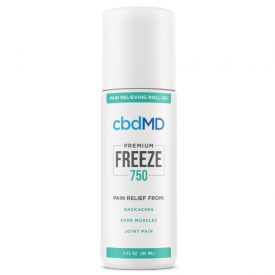
That said, check out some of the products from cbdMD. A company built on enhancing the overall quality of life for its consumers, while also bringing awareness and accessibility to CBD, cbdMD provides premium and innovative products to the market. One such topical is cbdMD Freeze Roller, a gentle, fast-drying gel perfect for relieving muscle and joint pain with the cooling relief of menthol and the soothing power of Superior Broad Spectrum hemp extract for one of the highest quality topicals around.
cbdMD Freeze Roller combines the instant cooling relief of menthol with the soothing power of Superior Broad Spectrum hemp extract for the best fast-drying gel to relieve muscle and joint pain.
Check out our list of the Best CBD Supplements for more awesome muscle and recovery products to enhance your training and performance as a bodybuilder and athlete.
For more news and updates, follow Generation Iron on Facebook, Twitter, and Instagram.
Managing Editor at Generation Iron, Jonathan Salmon is a writer, martial arts instructor, and geek culture enthusiast. Check out his Instagram, Twitter and Facebook to keep up with his antics.
Source:
Healthline