
 All Posts By Muscle Insider
Board Certified PHD
Sit-Ups Test Calculator: Testing Your Fitness at Home or Gym
Assess your core strength using our Sit-Ups Test Calculator. Uncover valuable insights, understand your results, and discover expert tips for enhancing your Sit-Up test performance.
Sit-up Test Calculator
Calculate
Reset
Results
Population Average:
Sit-ups
Your Sit-ups
Population Average
How to use Sit-Up Calculator
Using the Sit-Up Calculator is a straightforward process that requires just a few simple steps.
Select your gender
Enter your age
Number of repetitions you can perform
Click on the “Calculate” button
The calculator will determine your population average, score, and rating based on your input.
Understanding Results
The Sit-Up Calculator generates three essential results:
Population Average
Score
Rating
The population average represents the average number of sit-ups individuals in your age group and gender can typically perform. Your score indicates how your performance compares to the population average, while the rating categorizes your performance level, ranging from “Excellent” to “Very Poor.”
Sit-up Test Chart
The sit-up chart provides age and gender-specific benchmarks for sit-up performance. We used this same data to develop the logic for our calculator. These charts assist you in measuring and monitoring your core strength.
1-Minute Sit-up Test for Men
The following chart shows the core strength based on the number of sit-ups men can perform in a minute, categorized by different age groups.
Age
18-25
26-35
36-45
46-55
56-65
65+
Excellent
>49
>45
>41
>35
>31
>28
Good
44-49
40-45
35-41
29-35
25-31
22-28
Above average
39-43
35-39
30-34
25-28
21-24
19-21
Average
35-38
31-34
27-29
22-24
17-20
15-18
Below Average
31-34
29-30
23-26
18-21
13-16
11-14
Poor
25-30
22-28
17-22
13-17
9-12
7-10
Very Poor
23
Good
37-43
33-39
27-33
22-27
18-24
17-23
Above average
33-36
29-32
23-26
18-21
13-17
14-16
Average
29-32
25-28
19-22
14-17
10-12
11-13
Below Average
25-28
21-24
15-18
10-13
7-9
5-10
Poor
18-24
13-20
7-14
5-9
3-6
2-4
Very Poor
2023 Strongest Man In Iceland Full Results — Kristján Jón Haraldsson Defend His Title
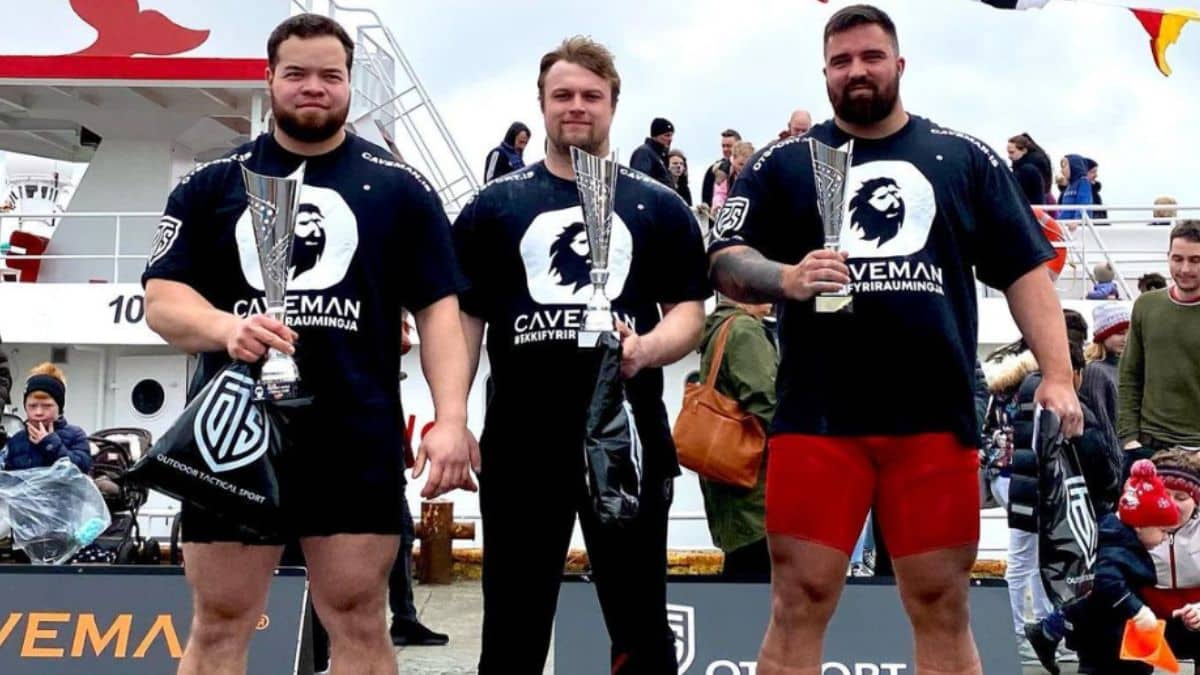
Iceland has gained a reputation for producing exceptional Strongman athletes, with several World’s Strongest Man (WSM) champions hailing from the country. So, it is understandable that the National competitions held in Iceland are of the highest quality possible. To ensure that, the 4x WSM Magnús Ver Magnússon organized the 2023 Strongest Man In Iceland competition. It gathered ten of the greatest Strongmen in the country and Kristján Jón Haraldsson was crowned as the winner.
Winning five out of the eight events, Kristján Jón Haraldsson easily defended his title from last year and marked an important point in his career. Haraldsson recently stepped in to compete at the 2023 World’s Strongest Man competition, which evidently helped him crush his rivals at the 2023 Strongest Man In Iceland competition.
2023 Strongest Man in Iceland Results
Kristján Jón Haraldsson — 72.5 points
Vilius Jokužys — 67.5 points
Pálmi Gudfinnsson — 54 points
Gudmundur Adalsteinsson — 51.5 points
Stefán Karel Torfason — 43 points
Aron Geir Gudmundsson — 37.5 points
Birgir Gudnason — 36.5 points
Alexander Andersen — 30 points
Fannar Katrínarson — 27.5 points
Ólafur Haukur Tómasson — 17 points
Related: 2022 Iceland’s Strongest Man Results — Kristján Jón Haraldsson Wins
Max Dumbbell
As defending champion, Haraldsson had a great start to the 2023 Strongest Man in Iceland competition, winning the first event which was the Max Dumbell. However, he had to share the top spot with Vilius Jokužys, as both men locked out 110 kilograms.
Kristján Jón Haraldsson — 110 kilograms (Tied-First)
Vilius Jokužys — 110 kilograms (Tied-First)
Stefán Karel Torfason— 100 kilograms
Pálmi Gudfinnsson — 90 kilograms
Gudmundur Adalsteinsson — 80 kilograms (Tied-Fifth)
Ólafur Haukur Tómasson — 80 kilograms (Tied-Fifth)
Birgir Gudnason — 70 kilograms (Tied-Seventh)
Alexander Andersen — 70 kilograms (Tied-Seventh)
Fannar Katrínarson — 70 kilograms (Tied-Seventh)
Aron Geir Gudmundsson — 70 kilograms (Tied-Seventh)
Bag Over Bar
The bar was set at 4.30 meters of height for the second event of the 2023 Strongest Man In Iceland. Moreover, four bags ranging from 16 to 32 kilograms were placed in front of the athletes who were also given a 60-second time limit.
Three men completed all six bags, with Torfason being the fastest to do so. He performed the event with blistering speed and finished 1 second ahead of Haraldsson.
Stefán Karel Torfason — 6 in 18.67 s
Kristján Jón Haraldsson — 6 in 19.51 s
Pálmi Gudfinnsson — 6 in 26.44 s
Vilius Jokužys — 5 in 19.81 s
Aron Geir Gudmundsson — 4 in 14.88 s
Gudmundur Adalsteinsson — 4 in 24.85 s
Birgir Gudnason — 3 in 10.69 s
Alexander Andersen — 2 in 9.86 s
Fannar Katrínarson — 2 in 11.05 s
Ólafur Haukur Tómasson — 1 in 4.8 s
Front Hold
Gudmundur Adalsteinsson rose to the top on the third event of the 2023 Strongest Man In Iceland by performing a 25-kilogram Front Hold for 49.24 seconds. No one managed to hold the identical 25-kilogram implement for as long as him, but Torfason and Jokužys did battle fiercely for the second place. However, Torfason managed to hold the weight for 0.10 seconds longer.
Gudmundur Adalsteinsson — 49.24 s
Stefán Karel Torfason — 44.19 s
Vilius Jokužys — 44.09 s
Birgir Gudnason — 40.39 s
Fannar Katrínarson — 38 s
Kristján Jón Haraldsson — 37.31 s
Alexander Andersen — 35.53 s
Aron Geir Gudmundsson — 32.5 s
Pálmi Gudfinnsson — 30.46 s
Ólafur Haukur Tómasson — 10.65 s
Max Deadlift
Kristján Jón Haraldsson got back to winning ways in event four – the Max Deadlift. He was the only man to deadlift 400 kilograms, with Pálmi Gudfinnsson locking out 380 kilograms and clinching second place. Torfason lifted another 20 kilograms less than Gudfinnsson to finish third.
Kristján Jón Haraldsson — 400 kilograms
Pálmi Gudfinnsson — 380 kilograms
Stefán Karel Torfason — 360 kilograms
Vilius Jokužys — 340 kilograms (Tied-Fourth)
Birgir Gudnason — 340 kilograms (Tied-Fourth)
Fannar Katrínarson — 340 kilograms (Tied-Fourth)
Aron Geir Gudmundsson — 320 kilograms
Gudmundur Adalsteinsson — 300 kilograms
Alexander Andersen — 260 kilograms (Tied-Ninth)
Ólafur Haukur Tómasson — 260 kilograms (Tied-Ninth)
Arm-Over-Arm Pull
For the fifth event, the athletes had to perform an arm-over-arm pull for a distance of 60 meters in a time cap of 60 seconds. Only two men managed to do it with Haraldsson coming out on top with a time of 41.95 seconds. Vilius Jokužys, on the other hand, finished the event exactly as the time cap ran out.
Kristján Jón Haraldsson — 41.95 s
Vilius Jokužys — 60 s
Stefán Karel Torfason — 12.4 meters
Aron Geir Gudmundsson — 11.45 meters
Pálmi Gudfinnsson — 11.35 meters
Gudmundur Adalsteinsson — 9.54 meters
Birgir Gudnason — 9.25 meters
Alexander Andersen — 9.1 meters
Fannar Katrínarson — 4.85 meters
Ólafur Haukur Tómasson — 1.6 meters
Mooring Bitt Carry
The 2023 Strongest Man In Iceland competition featured a carry event as the sixth event. However, this time the athletes carried a peculiar 140-kilogram Mooring Bitt for the max distance possible.
Haraldsson claimed his third victory in a row by covering a distance of 40 meters. In addition, Vilius Jokužys once again finished second, carrying the bitt for 2.8 meters less than Haraldsson.
Kristján Jón Haraldsson — 40 meters
Vilius Jokužys — 37.2 meters
Pálmi Gudfinnsson — 32.3 meters
Gudmundur Adalsteinsson — 25 meters
Alexander Andersen — 24.35 meters
Aron Geir Gudmundsson — 19.9 meters
Fannar Katrínarson — 13.2 meters
Birgir Gudnason — 6.5 meters
Ólafur Haukur Tómasson — 4.15 meters
Stefán Karel Torfason — withdrew
Block Press
Momentum helped Haraldsson to win his fourth consecutive event which was manifested in the form of a Block Press. Being the only man to lift all four blocks ranging from 90 to 120 kilograms, Haraldsson claimed maximum points and extended his lead over everyone else.
Kristján Jón Haraldsson — 4 in 67.31 s
Vilius Jokužys — 3 in 24.49 s
Gudmundur Adalsteinsson — 3 in 65.08 s
Pálmi Gudfinnsson — 2 in 31.03 s
Aron Geir Gudmundsson — 1 in 10.35 s
Alexander Andersen — 1 in 12.47 s
Birgir Gudnason — 1 in 13.44 s
Fannar Katrínarson — 1 in 21.62 s
Ólafur Haukur Tómasson — 1 in 29.28 s
Farmer’s Carry & Yoke Medley
Vilius Jokužys won the final event of the 2023 Strongest Man In Iceland, having carried a 120-kilogram farmer’s carry and a 400-kilogram yoke down a 20-meter course in just 27.51 seconds. However, seeing that Haraldsson finished in second with a time of 38.15 seconds, he was pronounced as the winner of the competition overall.
Vilius Jokužys — 27.51 s
Kristján Jón Haraldsson — 38.15 s
Gudmundur Adalsteinsson — 43.46 s
Pálmi Gudfinnsson — 57.10 s
Birgir Gudnason — 36.8 meters
Alexander Andersen — 34.95 meters
Aron Geir Gudmundsson — 23.1 meters
Ólafur Haukur Tómasson — 10.8 meters
Fannar Katrínarson — 2.35 meters
Related: 2023 UK’s Strongest Woman & Man Results — Rebecca Roberts & Paul Smith Take Gold
After showcasing his incredible strength and skill at the 2023 World’s Strongest Man (WSM) and successful defense of his title at the 2023 Strongest Man In Iceland competition, Kristján Jón Haraldsson has certainly made a name for himself in the strongman world. With such impressive performances under his belt, it’s no surprise that he is expected to become a familiar face on the big stage, competing alongside the best in the sport. He proved that he excels in some static events, as well as those which require a high pain tolerance. This is essential to become one of the greatest Strongmen in the world, so Haraldsson has potential for the future.
Published: 8 June, 2023 | 4:57 PM EDT
Lee Priest Shares Diet Philosophy in Contest Prep: ‘Always Dieted 16 Weeks Minimum’
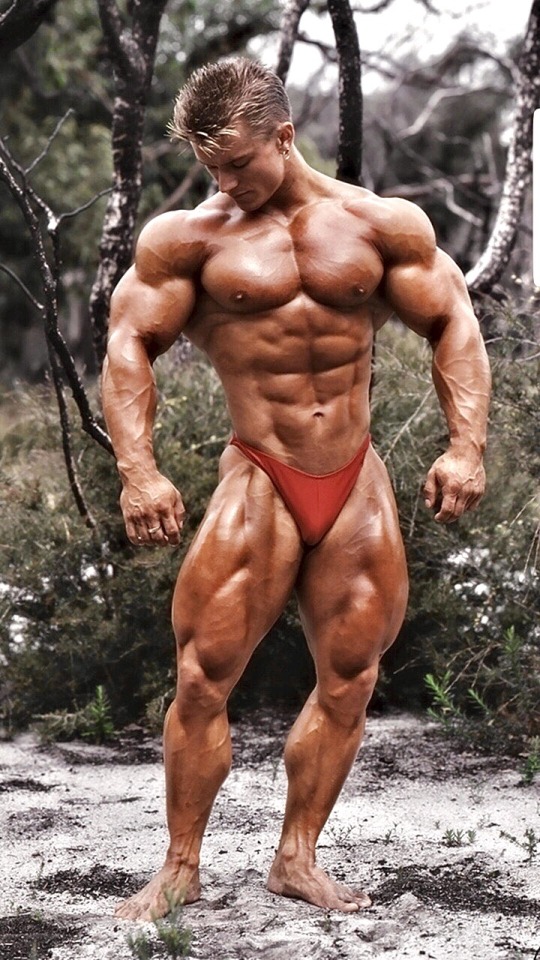
Australian bodybuilding veteran Lee Priest rose to the highest level of competition during his days of competition. He presented insane arms and granite conditioning on par with some of the freakiest mass monsters of the Men’s Open class. In a recent episode of IFBB AMA, Priest shared his diet philosophy for contest preps.
Lee Priest first made a name for himself with his impressive muscle mass, size, and detail in the IFBB Pro League in the 90s. Hailing from Australia, he dominated the national circuit before making his way to the most elite fitness showcases in the world, such as the Arnold Classic and Mr. Olympia contests.
Priest proved to be one of the most disciplined athletes in the sport with six Mr. Olympia appearances against Dorian Yates, Ronnie Coleman, and Chris Cormier. His longevity saw him enjoy an illustrious career that spanned over two decades with his final outing resulting in a win at the 2013 NABBA Mr. Universe.
Since stepping away from competition, Priest has turned into an analyst known for his candid takes on controversial issues. In Nov. 2022, he opened up about gaining 20 pounds of solid muscle by taking Deca (Nandrolone) as a teenager. He credited daily training and proper nutrition for helping him retain muscle mass after coming off his steroid cycles.
Lee Priest / Instagram
Priest gave fans a look into some of his favorite exercises to build jacked forearms earlier this year. To much surprise, he revealed he did not train the muscle group and believes his genetics boosted the growth.
Lee Priest sparked debate about eliminating the Men’s 212 division five months ago. Given the rise in talent from the division, he theorized the elite competitors would be able to hold their own in the Open class and suggested dissolving the category.
As far as training goes, the 50-year-old offered tips on maximizing the preacher curl to get bigger biceps and optimize the pump. Priest laid out the ideal rep ranges along with different techniques and equipment to utilize for maximum gains.
Priest continues to train regularly in his later years. He reflected on the differences in his training and diet plan over the years from when he was competing in his 20s to now. He revealed not much had changed in his regimen except for some workout modifications.
Lee Priest shares diet philosophy in contest prep
In a recent YouTube video, Lee Priest shared his thoughts on the dieting philosophy he used while in prep for a contest.
Priest believes switching to a clean diet after consuming whatever he wanted helped him lean out very quickly. He followed a strict diet for at least 16 weeks and would get in stellar shape about four weeks out from a show.
“The thing was I’d go from eating anything I wanted like sh*t food and come Monday I’d go strict on my diet,” said Priest. “I’d go straight to chicken breast and rice and cardio an hour a day, I got the three hours but the first two weeks of my diet I was that sick because here I am eating fats and sugars and everything.
“Now, I just go super clean. My body would just go into this f**king rebound where I just cut all the bad food out, fats and sugars, two weeks I’d be sick until I started getting into the diet but I always dieted 16 weeks minimum. My first two weeks, people were like oh you lost a bit of weight because I cut out all the preservatives and the sodium. I’ll drop about 15 pounds in two weeks just from water.
“My face would be [shrunken], go in a bit. Almost like I just dropped water weight and then it would slow down. I was always ready about 12-13 weeks and then I did all my photo shoots before the contest so I’d get in shape pretty quick once I turned it on.”
Lee Priest / Instagram
Lee Priest admitted he’d find it more challenging to stick to a diet if he went into prep lighter.
“One year I started my diet I only got to like 250 and mentally hit was harder because if I’m 285, I’m a fat pig I figure f**k Lee, you’ve got to train hard, you’ve got to diet strict, gotta do cardio. When I started with 250 I’m like I’m already 30 pounds ahead I can take it easy. So, I found it actually harder getting ready when I was lighter. When you’re heavy, you got motivation to get in shape.”
He gave his take on eating fruits while in prep for a show.
“I did a lot of [s**t loading]. When I came to America, I didn’t do. But I did it through my whole career. I ate a ton of fruit and now I hear some bodybuilder saying they’re starting to have fruit in the diet I’m thinking I always did that. Because when I went to America people were like, can’t have fruit, it’s got sugar in it. I’m like, I’m training twice a day. I’m doing two to three hours of cardio. I don’t think having a couple of apples is going to do anything to me.”
Lee Priest expressed his willingness to take on bodybuilder Jay Cutler in a guest-posing appearance in light of the upcoming 2023 Masters Olympia. He suggested hosting a Golden Era seminar where he could engage in a friendly battle with the four-time Mr. Olympia.
Earlier this week, Priest called for a superhero showdown with bodybuilding icon Kai Greene to entertain fans, which would surely bring back some fond memories for all parties involved. His latest offering will certainly add more clarity for competitors on how they can improve their diets while in contest prep.
RELATED: Lee Priest Reflects on Maintaining Muscle Mass: ‘Even If I Came Off a Cycle, I Never Really Lost Size’
You can watch the full video below.
Published: 8 June, 2023 | 4:39 PM EDT
Bradley Martyn & Jo Linder Talk Drug Abuse, Insulin Scares, and ‘Craziest Cycles’ Ever Taken
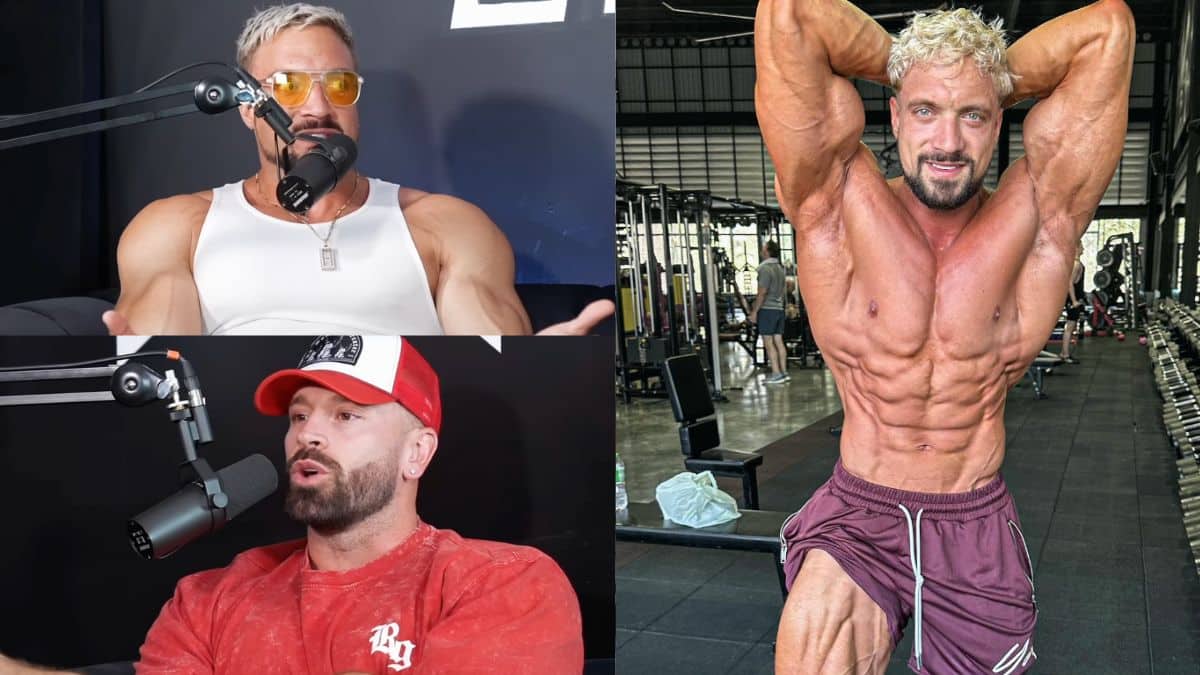
Fitness influencer Jo Linder well known as ‘Joesthetics,’ achieved fame with a shredded physique he sports year-round. In a recent episode of Bradley Martyn‘s Raw Talk, Linder reflected on his arrival to America for the first time, insulin, and his craziest steroid cycles.
In fitness and bodybuilding, performance-enhancing drugs (PEDs) have influenced athletes’ physiques for decades. Despite their taboo nature, their use, abuse, and mismanagement have become rather interesting talking points online.
Bodybuilders often use PEDs to enhance their already muscle-bound physiques. And the same goes for fitness influencers like Jo Linder, however, some members of these communities claim they have built their physiques through natural means, with hard work, nutrition, and discipline.
Popular names like Mike O’Hearn, Dwayne ‘The Rock’ Johnson, and Chirs Hemsworth come to mind. Even though fans have no concrete evidence they use such drugs, many in the community are convinced, including Joe Rogan. He’s taken to multiple Joe Rogan Experience podcasts to urge many of these superstars to come clean.
As for Jo Linder, he takes a more transparent approach regarding PEDs. He is open to talking about his use and even discussed past cycles in the company of respected powerlifting phenom Larry Wheels. This time, he sat down with Martyn and offered him a behind-the-scenes look at building a next-level physique. They also discussed Jo’s arrival in the U.S. and his reaction to the American culture.
Jo Linder and Bradley Martyn Discuss Life in the U.S. + Substance Abuse & Legality
Splitting up his time in Dubai and Thailand, this is Jo Linder’s first trip to Northern America. He was pleasantly surprised by the availability and accessibility of marijuana.
“First time for me in the U.S. I just realized that you know here also weed is legal. So I used that to be able to sleep. It helps me big time. In Thailand, they just recently started to legalize weed, kind of. They’ve been the first Asian country to make it medically prescribed. I actually had a medical prescription license already since a while over there.”
“I never admitted to this ever, I never have said this before that I smoke weed bro, no. Never said it ever anywhere that I would smoke,” Jo Linder said. “Mostly sleep or also when you answer DMs and comments and stuff and you’re just in the zone and I’m so calm bro. Otherwise, I get too high-tempered online right, they say some stupid shit and you just be quiet. It’s easy to react.”
Note: Fitness Volt does not condone and/or recommend the use of recreational or performance-enhancing drugs. This article reports on information relayed by the athlete or subject. FitnessVolt is not a medical resource and the content provided to you is for informational purposes only.
Jo Linder Discusses ‘Craziest Cycle’ & Shares Insulin Health Scare: “Don’t Do It”
Before delving into details about his most intense cycle ever, Jo Linder explained why he’s afraid of diuretics. He said they dry out the body before contests after it’s already in a vulnerable state of dehydration.
“Let’s be honest, the heart is also a muscle and that’s my biggest concern. What if I have such a bad cramp that my heart gets a cramp,” said Linder. “That makes me scared. That’s why I’m also staying away from a bit of bodybuilding competitions too much because I would take all these diuretics.
If I just stopped eating salt and drink a lot, and stop drinking as well, and you pee everything out, and you take a diuretic on top, and then you pee even more so, I cannot exist kind of [when I do that] I cannot walk. That’s what’s been scary. Oh yeah, you have this already and you dehydrate yourself more, maybe your heart will give up at one point,” said Jo Linder.
Linder said he’s experienced with high doses but never went over 600 milligrams of any compound except testosterone. According to Jo, his craziest cycle of all time was 100 milligrams of Primobolan daily, 100 milligrams of Trenbolone daily, and testosterone.
“To be honest, I’ve done all kinds of crazy shit in the past. I’ve tried different dosages, the highest kind of test that I ever ran was 750, 750 and then like, never, I never used a single compound more than 600 milligrams except the 750 milligrams of test.”
“The craziest cycle I’ve probably did this stupid coach back in the day put me on 100 milligrams of prop, and 100 milligrams of tren every day. It was like 700 and 700, that was a sick cycle right there. I was 105 kg at the start of the diet, it went down to 102 just 3kg, then I didn’t even need to do cardio I was just the guy who was getting more saucy more ripped, weight stays the same, and just getting more lean and dry by the day.”
Since Jo adheres to a diet almost year-round, it was very difficult for him to use Insulin effectively in prep. He added that he suffered from a few ‘close calls’ with his health.
“I tried also, people would tell you growth is so good, so good man, obviously I need to try it right? I tried a few times with insulin but as you know, I’m low body fat and I diet almost always, and insulin, if you eat a lot it’s maybe okay, but for me, if I try to do it, let’s say I take 5 IUs pre-workout and I try to do here with a sugar drink, then you do too many sets, then you forget to drink your intra workout, and you’re just dripping. Really man, close calls man, close calls man, don’t do it,” Jo Linder said.
For his last Men’s Physique contest a few months ago, Linder shared that he used 75 milligrams of Tren, 250 milligrams of test, and 100 milligrams of Primobolan.
“I personally, I really experienced it again now in March. I did another show, I tried to get a pro card and I used a bit of tren. I also did not mention this before. Just 75 milligrams of tren, no per week. On top of 250 test, so I did 250 test, I did 75 tren, and 100 primo also. I like primo a lot. Minimum effective dose I always believe is the best. For example, there’s kids just starting to work out and they are taking two CCs of test per week.”
With the sport of bodybuilding growing, conversations about PEDs have become common. In fact, Arnold Schwarzenegger recently unveiled the two-compound cycle he used to sustain himself as a dominant seven-time Mr. Olympia.
In an age where content is king, some worry that steroids and social media make for a dangerous combination. As for Jo Linder, he hopes to encourage young people to realize that the “minimum effective dose is always the best” should they choose to go down the route of enhancements.
RELATED: Kali Muscle Gets Honest About 13 Years of Heavy Gear Use: ‘I Really Didn’t Stop Till the Heart Attack’
Watch the full video from Bradley Martyn’s Raw Talk YouTube channel:
Published: 8 June, 2023 | 2:10 PM EDT

Make Sure THIS Is NOT In Your Protein Powder
Here is another reason to avoid sucralose, especially when it is in protein powder or, worse yet, ready-to-drink protein beverages. A new study was just published online: 29 May 2023, in which the author stated this,
The study, published in the Journal of Toxicology and Environmental Health, found that a metabolite of sucralose, called sucralose-6-acetate, is “genotoxic.” That means it breaks down the genetic material that makes up DNA, explained Susan Schiffman, PhD, senior author of the study and an adjunct professor at North Carolina State University.
When DNA strands break and are then rearranged and repaired, that can increase the risk of cancerous cells forming, previous studies have shown. ( 1)
Buying protein powders without anything added, like artificial flavors and artificial sweeteners, is the best way to ensure you’re getting the purest, cleanest, and highest protein percentage powder. Thus, I’ve been telling my customers this with an emphasis on avoiding sucralose A.K.A. Splenda.
Alex Rogers is a supplement manufacturing expert. He has been formulating, consulting, & manufacturing dietary supplements since 1998. Alex invented protein customization in 1998 & was the first company to allow consumers to create their own protein blends. He helped create the first supplement to contain natural follistatin, invented whey protein with egg lecithin, & recently imported the world’s first 100% hydrolyzed whey.
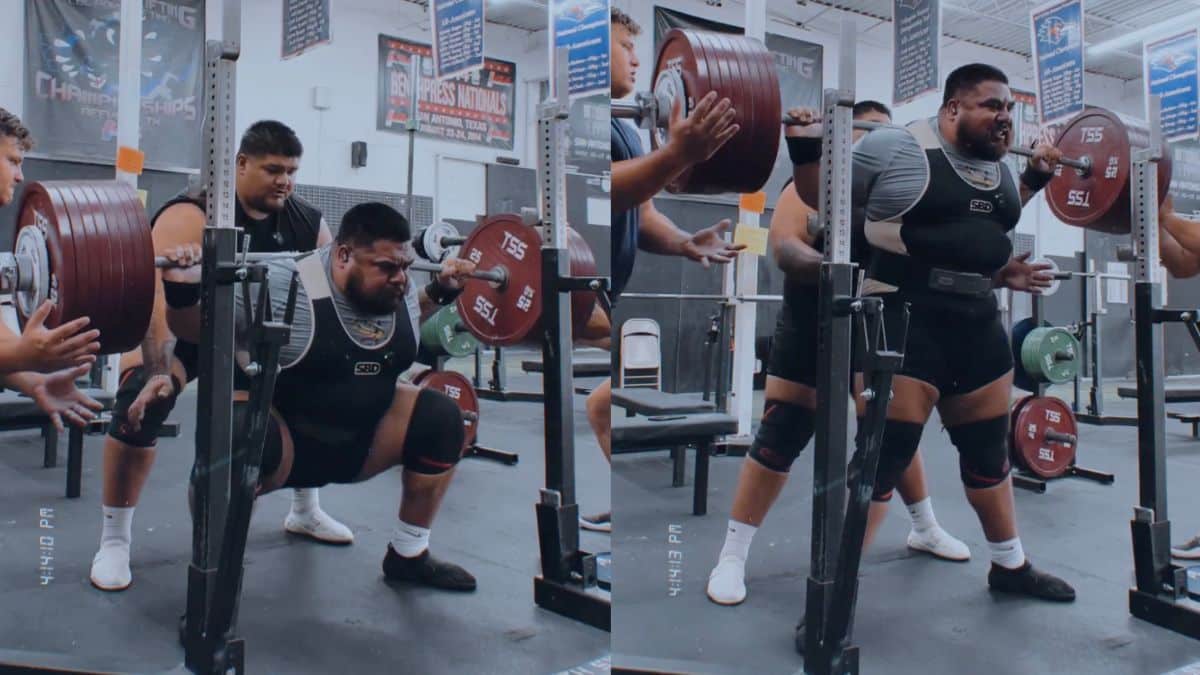
Powerlifter Jesus Olivares Smashes 435-kg (960-lb) Raw Squat Two-Rep PR In Training
The biggest hype in powerlifting is currently revolving around Jesus Olivares, as he is the reigning 2x IPF World Champion and will try to defend his title in just one week from now. So, everyone is unsurprisingly eager to find out how prepared Jesus is for the 2023 IPF World Championships. On his Instagram page, he often shares updates, and the most recent one showed him setting a new record. This PR turned out to be a humongous 435-kilogram (960-pound) two-rep squat.
Jesus Olivares believes that strength is determined by how much weight a person can lift with as little equipment support as possible. So, he completed the 435-kilogram (960-pound) two-rep squat in a raw manner, utilizing only a lifting belt and knee sleeves to aid him in the lift.
Jesus Olivares did not have too much trouble locking out either of the reps with 435 kilograms (960 pounds), especially considering just how heavy the squat was. In addition, Jesus captioned the video with “Still Hungry“, hinting that he still wants to lift even heavier.
Watch the lift here:
Related: Powerlifter Jesus Olivares Sets New Deadlift & Total IPF World Records At 2023 Sheffield Powerlifting Championships
Jesus Olivares recently took part in the 2023 IPF Sheffield Powerlifting Championships where he displayed his greatest shape yet. He set two new IPF World Records in the Deadlift and Total events. However, he is now attempting to break the Squat World Record as well. The current record is held by Ray Williams who locked out 490 kilograms (1,080.3 pounds). On the other hand, Jesus’ heaviest squat in a competition came out to 470 kilograms (1,036.1 pounds). So, having now improved his two-rep PR, it is clear that he is capable of squatting more in his one rep max.
During Jesus’ Olivares’ career so far he has taken part in 20 sanctioned powerlifting competitions and won 11 of them. In addition, he earned the title of the strongest raw powerlifter in the world, all while being natural contrary to many other athletes who use PEDs.
Jesus Olivares’ Competition PRs
*Jesus Olivares set all of his competition PRs at the 2023 IPF Sheffield Powerlifting Championships.
Squat: 470 kilograms (1,036.1 pounds)
Bench Press: 272.5 kilograms (600.7 pounds)
Deadlift: 410 kilograms (903.9 pounds)
Total: 1,152.5 kilograms (2,540.8 pounds)
Related: Powerlifter Jesus Olivares Destroys Massive 465-kg (1,025.1-lb) Raw Squat In Training
Jesus Olivares’ Competition History
Personal Bests
Equip
Squat
Bench
Deadlift
Total
Dots
Raw
1036.2
600.8
1036.2
2540.8
592.59
Single-ply
645
360
645
1665
433.39
Competition Results
Place
Fed
Date
Competition
Division
Total
Dots
1
IPF
2023-03-25
Sheffield Powerlifting Championships
Open
2540.8
592.59
Location
UK
Competition
Sheffield Powerlifting Championships
Division
Open
Age
24
Equipment
Raw
Weight
392.9
Squat
937
1003.1
1036.2
1036.2
Bench
551.2
584.2
600.8
600.8
Deadlift
815.7
879.6
903.9
903.9
GLP
115.12
1
IPF
2022-06-06
World Classic Powerlifting Championships
Open
2254.2
528.4
Location
South Africa
Competition
World Classic Powerlifting Championships
Division
Open
Age
~23.5
Equipment
Raw
Class
264.6
Weight
385.1
Squat
903.9
-948
-970
903.9
Bench
518.1
551.2
573.2
573.2
Deadlift
777.1
-837.8
-837.8
777.1
GLP
102.81
1
AMP
2022-04-01
Classic Open Nationals Presented by SBD
MR-O
2447.1
574.71
Location
USA-TX
Competition
Classic Open Nationals Presented by SBD
Division
MR-O
Age
23
Equipment
Raw
Class
264.6
Weight
382.3
Squat
903.9
959
992.1
992.1
Bench
529.1
551.2
567.7
567.7
Deadlift
782.6
848.8
887.4
887.4
GLP
111.88
1
IPF
2021-09-23
World Classic Powerlifting Championships
Open
2303.8
546.3
Location
Sweden
Competition
World Classic Powerlifting Championships
Division
Open
Age
~22.5
Equipment
Raw
Class
264.6
Weight
368.2
Squat
854.3
909.4
942.5
942.5
Bench
512.6
540.1
556.7
556.7
Deadlift
755.1
804.7
-832.2
804.7
GLP
106.68
1
USAPL
2021-06-14
Raw Nationals
MR-O
2248.7
532.62
Location
USA-FL
Competition
Raw Nationals
Division
MR-O
Age
~22.5
Equipment
Raw
Class
264.6
Weight
369.8
Squat
870.8
920.4
937
937
Bench
518.1
534.6
551.2
551.2
Deadlift
760.6
-815.7
-843.3
760.6
GLP
103.97
1
USAPL
2020-12-12
Collegiate Cup and Texas Open
MR-O
2327
560.02
Location
USA-TX
Competition
Collegiate Cup and Texas Open
Division
MR-O
Age
~21.5
Equipment
Raw
Class
264.6
Weight
347.9
Squat
826.7
870.8
903.9
903.9
Bench
490.5
512.6
541.2
541.2
Deadlift
788.2
843.3
881.8
881.8
GLP
109.94
1
USAPL
2020-12-12
Collegiate Cup and Texas Open
MR-Jr
2327
560.02
Location
USA-TX
Competition
Collegiate Cup and Texas Open
Division
MR-Jr
Age
~21.5
Equipment
Raw
Class
264.6
Weight
347.9
Squat
826.7
870.8
903.9
903.9
Bench
490.5
512.6
541.2
541.2
Deadlift
788.2
843.3
881.8
881.8
GLP
109.94
1
USAPL
2020-06-27
Capital City Classic
MR-Jr
2171.6
522.75
Location
USA-TX
Competition
Capital City Classic
Division
MR-Jr
Age
~21.5
Equipment
Raw
Class
264.6
Weight
347.6
Squat
766.1
804.7
848.8
848.8
Bench
474
501.6
518.1
518.1
Deadlift
766.1
804.7
-837.8
804.7
GLP
102.63
1
USAPL
2020-06-27
Capital City Classic
MR-O
2171.6
522.75
Location
USA-TX
Competition
Capital City Classic
Division
MR-O
Age
~21.5
Equipment
Raw
Class
264.6
Weight
347.6
Squat
766.1
804.7
848.8
848.8
Bench
474
501.6
518.1
518.1
Deadlift
766.1
804.7
-837.8
804.7
GLP
102.63
1
USAPL
2019-12-21
Winter Iron Open
MR-Jr
1989.7
482.18
Location
USA-TX
Competition
Winter Iron Open
Division
MR-Jr
Age
~20.5
Equipment
Raw
Class
264.6
Weight
338.9
Squat
683.4
716.5
749.6
749.6
Bench
440.9
457.5
474
474
Deadlift
722
766.1
-799.2
766.1
GLP
94.92
DQ
THSPA
2015-03-28
State Championships Division 1
Boys
Location
USA-TX
Competition
State Championships Division 1
Division
Boys
Age
16
Equipment
Single-ply
Class
274.9
Weight
258.8
Squat
620
4
THSPA
2015-03-12
Boys Region 1 Division 1
Boys
1665
433.39
Location
USA-TX
Competition
Boys Region 1 Division 1
Division
Boys
Age
16
Equipment
Single-ply
Class
274.9
Weight
265.2
Squat
645
Bench
360
Deadlift
660
GLP
72.92
3
THSPA
2014-03-08
Boys Region 1 Division 1
Boys
1465
383.07
Location
USA-TX
Competition
Boys Region 1 Division 1
Division
Boys
Age
15
Equipment
Single-ply
Class
274.9
Weight
261.6
Squat
585
Bench
310
Deadlift
570
GLP
64.5
DQ
THSPA
2014-02-22
Midland High Invitational
Boys
Location
USA-TX
Competition
Midland High Invitational
Division
Boys
Age
15
Equipment
Single-ply
Class
274.9
Weight
266
Squat
580
Bench
300
1
THSPA
2014-02-15
Mustang Invitational
Boys
1440
373.98
Location
USA-TX
Competition
Mustang Invitational
Division
Boys
Age
15
Equipment
Single-ply
Class
274.9
Weight
267
Squat
585
Bench
290
Deadlift
565
GLP
62.9
3
THSPA
2014-02-08
Seminole Invitational
Boys
1300
338.38
Location
USA-TX
Competition
Seminole Invitational
Division
Boys
Age
15
Equipment
Single-ply
Class
274.9
Weight
265.2
Squat
500
Bench
275
Deadlift
525
GLP
56.94
8
THSPA
2013-03-09
Boys Region 1 Division 1
Boys
1230
326.57
Location
USA-TX
Competition
Boys Region 1 Division 1
Division
Boys
Age
14
Equipment
Single-ply
Class
274.9
Weight
250.4
Squat
485
Bench
270
Deadlift
475
GLP
55.12
6
THSPA
2013-02-23
Midland High Power Invitatational
Boys
1165
308.17
Location
USA-TX
Competition
Midland High Power Invitatational
Division
Boys
Age
14
Equipment
Single-ply
Class
274.9
Weight
253
Squat
460
Bench
255
Deadlift
450
GLP
51.98
7
THSPA
2013-02-09
Seminole Power Invitational
Boys
1050
277.6
Location
USA-TX
Competition
Seminole Power Invitational
Division
Boys
Age
14
Equipment
Single-ply
Class
274.9
Weight
253.4
Squat
415
Bench
250
Deadlift
385
GLP
46.82
DQ
THSPA
2013-02-02
Levelland Powerlifting Meet
Boys
Location
USA-TX
Competition
Levelland Powerlifting Meet
Division
Boys
Age
14
Equipment
Single-ply
Class
274.9
Weight
256.2
Squat
390
Data Source: Open Powerlifting. Last Updated: April 12, 2023
Analyze Lifts
Jesus Olivares already has the joint second heaviest raw squat of all time, as Jezza Uepa has lifted as much as him. However, Jesus wants to be the greatest of all time which is the reason for his recent squat improvement. Within a few days, we will see just how close he can get to the world record. Jesus is pumped up for the 2023 IPF World Championships and hopes to put up the greatest performance in the history of powerlifting.
Published: 8 June, 2023 | 12:40 PM EDT
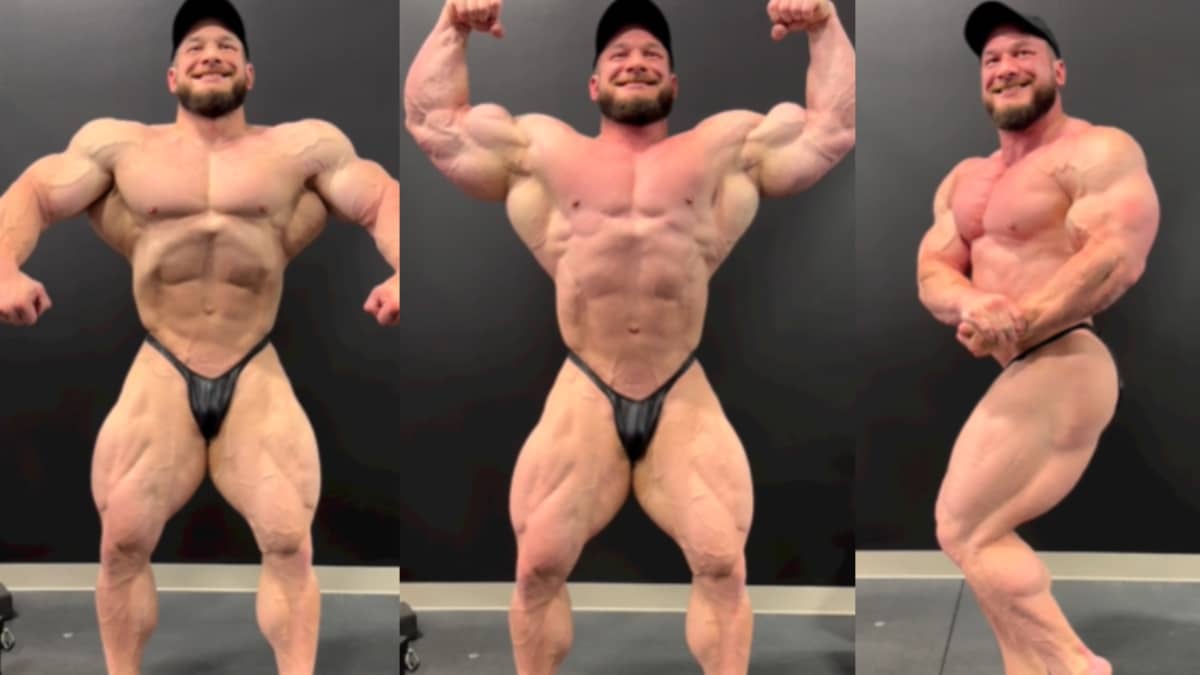
Hunter Labrada Shares Stacked Physique Update 8-10 Weeks from 2023 Tampa & Texas Pro
Hunter Labrada, son of bodybuilding icon Lee Labrada, is ready to set the record straight on the Mr. Olympia stage later this year. However, to accomplish that goal, he must qualify, thus his focus is on the 2023 Tampa Pro in eight weeks. In a recent Instagram video, Labrada shared a detailed posing routine, as well as the diet and training changes he’s employed for future success.
“Feeling focused and ready to push,” Labrada shared.
From the moment he entered the IFBB Pro League, lofty expectations were the norm for Hunter Labrada considering his father Lee’s legacy. Nevertheless, it didn’t take long for Hunter to establish himself in the Open class. His breakout year came in 2021 when he snagged the Chicago Pro title before finishing a career-best fourth at the Olympia competition.
Given his performance, he started 2022 as a leading favorite heading into the next Mr. Olympia show. With time to focus on progress, size, and other improvements, Hunter used the majority of the year for preparations but also made guest posing appearances. On the big O stage, however, he found himself in seventh. He was devastated by the result, though he vowed to return better than ever.
In February, news surfaced that Labrada would enter the upcoming Tampa Pro and Texas Pro. He also said regardless of the first contest’s outcome, he still intended to compete in the Lone Star State. Labrada, who appears more fired up than in past seasons, is ready to once again insert himself in the Olympia title discussions.
Hunter Labrada Promises ‘Overhauled Presentation’ at 2023 Tampa & Texas Pro In Recent Update
In his latest post, Hunter admits he reduced his meals from six a day to five. He says the change has allowed him a better night’s sleep. As for training, Labrada is following a split of two days on, one day off, three days on, and one day off. It appears his efforts are paying off as his arms and legs look bigger.
At 273 pounds fasted, Labrada mentioned ‘his look is changing daily.’ With extra sleep and less food, Labrada feels energized heading into the next stage of contest prep approaching.
Find his post below:
“8 & 10 weeks out from the Tampa Pro and Texas Pro 273lbs fasted–Well, the proverbial hammer got dropped this week! After a week of deload-ed training while in Florida with my family last week, I hit the ground running this weekend/week, and am watching my look change daily!–One of the biggest changes I want to highlight is I went from 6 meals a day to 5! Reason: I get 2 hours more sleep! I found myself just staying up to eat a lot recently, and now that the food was low enough for it not to mess with my digestion, I told @squatlikechow I wanted to give it a try and I’m glad I did! The meals are more satiating, and I’m recovering even better with the extra sleep!–Also started posing with @kj_centerstage / @joey1belt twice a week, and I’m sure y’all can see the difference that’s made already. Looking forward to my presentation being completely overhauled for this season
Nutrition:
Meal 1220g Lean Beef180g Rice50g Green Veg
Meal 2220g Chicken Breast180g Rice50g Green Veg
Meal 3- Post260g Lean White Fish/Cod180g Rice50g Green Veg
*On rest days please repeat MEAL 5 here instead of post*
Meal 4220g Chicken Breast180g Rice50g Green Veg
Meal 5260g Lean White Fish/Cod110g Rich70g Avocado50g Green Veg
Cardio:
40 min level 5 stairmaster fasted20 min level 5 stairmaster PM–Training:
Back and hamsPush aOffLegsBack and bisPush bOffRepeat, Labrada wrote
Labrada has not been idle in-between shows, as he has graced the stage as a guest poser at a number of contests around the United States. He first flew to Washington to wow the crowd at the Emerald Cup and then joined a star-studded lineup of Men’s Open pros at Jim Manion’s 2023 Pittsburgh Pro. At the gathering, he posed alongside Olympia-runner-up Derek Lunsford, 2023 Arnold Classic champ Samson Dauda, Nick Walker, former two-time Mr. O Mamdouh ‘Big Ramy’ Elssbiay, and reigning two-time 212 Olympia Shaun Clarida.
RELATED: Bodybuilder Hunter Labrada Shares Detoxifying ‘Gut Health Drink’ for Optimal Digestion
If his growing strength is an indicator of his progress, Labrada is on track for an explosive season. Time will tell if he can take down other athletes entering these contests like Blessing Awodibu (in Tampa, Florida) and Andrew Jacked (in Texas).
Published: 8 June, 2023 | 11:28 AM EDT
The Best Daily Mobility Exercises for Men
Speaking as a typical man, I can honestly say I’d rather be lifting weights or doing push-ups than stretching. Heck, I’d even prefer to do cardio!
However, not stretching can have an adverse effect on flexibility, mobility, exercise performance, posture, and joint health. You might not notice the consequences yet, but as you get older, the effects of not stretching become more noticeable.
The good news is that, like your biceps and quads, your flexibility and mobility are highly trainable. And it doesn’t take a lot of time or energy to improve them.
In this article, we reveal the best daily mobility exercises for men.
Why You NEED to Do These Exercises Daily
Your body was designed to move. Muscles, joints, ligaments, tendons, cartilage, intervertebral discs – all of these structures get healthier and stronger when you move your body.
However, unless you have a manual labor job, the chances are you don’t move enough to be healthy. Prolonged sitting can do a real number on your musculoskeletal system, leaving you sore, stiff, and immobile.
Regular workouts can help but aren’t enough to offset the effects of an otherwise sedentary lifestyle. For example, even if you hit the gym for five hours a week, that still leaves 163 hours during which you can be inactive.
Prolonged sitting causes your muscles to shorten and stiffen up. This will adversely affect your flexibility and mobility. Your posture can also take a hit.
Like a machine allowed to rust, this will make your joints more prone to wear and tear and could even stop you from performing movements that should be smooth and painless, such as reaching overhead or touching your toes.
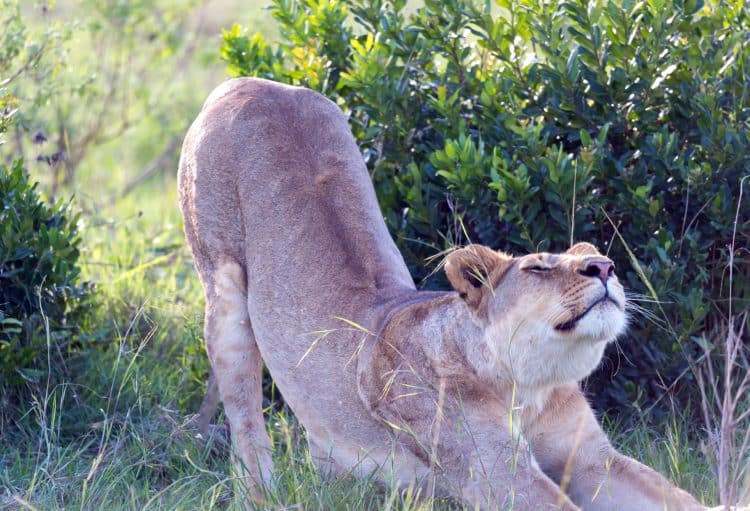
Animals don’t need to be told to stretch and move. It’s something they do instinctively. Watch a cat, dog, lion, or tiger, and invariably, they’ll stretch briefly but regularly throughout the day. That way, they’re always ready for action; you don’t see big cats warming up before a hunt!
Humans would do well to take a page from the animal fitness guidebook and stretch little and often to break up periods of inactivity. This would alleviate many of the detrimental effects of prolonged sitting and sedentarism.
But which stretches should you do? After all, fitness experts often recommend dozens of different and often convoluted exercises, which is one of the things that makes stretching so unattractive.
It doesn’t matter that most men know they need to stretch more; the moment it becomes inconvenient or seems more trouble than it’s worth, they quit doing it.
So, we’ve boiled things down to a short list of six simple movements most men should do daily. These big-bang-for-your-buck exercises focus on the areas most likely to be tight, i.e., the hips, back, and shoulders.
Sure, you could do more if you want, but that may mean you get bogged down and, due to lack of time, don’t stretch and mobilize at all.
Like most animals, who only do a couple of different stretches, it’s better to do less but do it well than try to do more and fail to do it at all. So, we’re aiming to be good and consistent rather than perfect but inconsistent.
By keeping things simple, you can work on your mobility in less than ten minutes a day.
The Best Daily Mobility Exercises for Men
Do the following exercises daily or more often if you have time. You can combine them to make a morning routine, do them before or after your workout, during your lunch break, after dinner, or before going to bed.
Spend longer on the exercises that feel the most difficult. Invariably, these are the ones that you need the most.
Cat/cow
Standing spine twist
Waiter’s bow
Kneeling hip flexor stretch
Yoga push-up
Yoga squat
1. Cat/cow
Target areas: Lower back, upper back, neck, erector spinae, rectus abdominis.
Cat/cow is a pose from yoga, so people have been doing this exercise for centuries. This move effectively mobilizes your entire spine, from your lumbar or lower vertebrae to your cervical vertebrae or neck. It also “flosses” your spinal cord, which can help alleviate issues like sciatica. Your spine will feel fabulous after this exercise, especially if you’ve been stuck in a chair or car for a few hours.
Steps:
Kneel on all fours with your shoulders directly over your hands and your hips over your knees.
Exhale and lift the middle of your back up toward the ceiling. Lower your head and tilt your pelvis under to create a large C-shape with your spine.
Next, inhale and lower your abdomen down toward the floor. Lift your head and your butt to extend your spine.
Smoothly alternate between these two positions for 6-12 reps, timing your movements with your breaths.
2. Standing spine twist
Target areas: Lower back, upper back, obliques, shoulders, hips, knees.
Twisting is a very uncommon movement pattern in modern life. As such, a lot of people are rotationally restricted. So if you find turning your head and shoulders to look behind you difficult, e.g., when reversing your car, this exercise will help. It’s also a great stress reliever and general warm-up movement.
Steps:
Stand with your feet about shoulder-width apart, knees slightly bent. Relax your shoulders, arms, and neck.
Start by rotating your head and shoulders to the left and right. Allow your arms to trail behind, reaching around to touch your hips.
Then, allow your hips and knees to turn with your shoulders. Add a slight lateral weight shift if you wish.
Increase your momentum as your muscles start to loosen and warm up. However, never force the movement or fling your arms. Make “soft and supple” your movement mantra.
Continue for 15-30 reps per side.
3. Waiter’s bow
Target areas: Lower back, hips, hamstrings.
The waiter’s bow is a great way to ease tension from your lower back and stretch your hamstrings, commonly one of the tightest muscles in the body. Tight hammies can cause numerous postural and functional problems and are also prone to injury. Do this exercise anytime you’ve been sitting for a long time, which invariably causes the hamstrings to tighten up even more.
Steps:
Stand with your feet about hip-width apart, knees slightly bent, and arms by your sides.
Push your butt backward, hinge forward from your hips, and extend your arms in front of you so your entire upper body is roughly parallel to the floor. Do not round your lower back.
Lower your arms and return to the starting position.
Repeat 10-15 times.
4. Kneeling hip flexor stretch
Target areas: Hip joints, hip flexors, quadriceps, rectus abdominis.
Prolonged sitting can leave you with very tight hip flexors, which are the muscles located on the fronts of your thighs and pelvis. Tight hip flexors are a leading cause of low back pain and poor posture. Hip flexor problems can also cause your lower abdomen to protrude, making your belly bulge even if you are very lean. This exercise is critical for anyone who spends long periods sitting – so everyone, really!
Steps:
Step forward and bend your legs. Lower your rear knee to the floor. Adjust your feet so your front shin should be vertical.
Gently push your hips forward to stretch the hip flexor on your back leg.
Take care not to hyperextend your spine. Instead, keep your lumbar spine and pelvis neutral. Do not rest your hands on your front leg; let your arms hang relaxed by your sides.
Hold for 30-60 seconds, and then switch sides.
For added credit, reach up into the air with one arm to stretch your obliques and lats; this stretch feels so good!
5. Yoga push-up
Target areas: Lower back, hips, hamstrings, shoulders, upper back, calves.
While push-ups are usually viewed as a strength and conditioning exercise, the yoga push-up is also a top-drawer mobility exercise. Yoga push-ups will stretch and mobilize your ankles, hips, lower back, and shoulders. In fact, if you only have time for one mobility exercise, the yoga push-up is probably your best choice.
Steps:
Adopt the push-up position with your hands shoulder-width apart, arms extended, and body straight. Brace your core and pull your shoulders back and down.
Bend your arms and lower your chest down to within an inch of the floor.
Next, push up and back, lifting your hips up toward the ceiling.
Gently push your head between your arms to extend your shoulders, open your chest, and stretch your lats. Keep your legs as straight as possible, and press your heels down toward the floor. Your body should now resemble an inverted V. Hold this position (but not your breath) for several seconds.
Return to the starting position, bend your arms, and repeat for 4-6 smooth reps.
6. Yoga squat
Target areas: Lower back, hips, inner thighs, calves.
This exercise is a variation of the famous Asian squat but with more emphasis on opening the hips and stretching your inner thighs. While this exercise might feel awkward at first, in time, it will become a relaxing resting posture. Practice it often to mobilize your hips, knees, and lower back. Look for opportunities to drop into a squat throughout your day.
Steps:
Stand with your feet about shoulder-width apart, toes turned slightly outward.
Raise your heels and descend into a deep squat.
Next, lower your heels to the floor and press your elbows against your inner thighs to open your hips and knees.
Sit in this position for 60-90 seconds.
Rest your heels on one-inch blocks if you are unable to keep them flat on the floor. Lower the height of the blocks as your flexibility improves.
Mobility Exercises – FAQs
Do you have a question about these daily mobility exercises for men? No problem, because we’ve got the answers!
1. Do I need to warm up before doing these exercises?
While you could warm up before these exercises with some light cardio, it shouldn’t be necessary. Instead, start each movement slow and easy, and only increase your range of motion as you feel your muscles start to relax and your joints begin to loosen. Use the first few reps as your warm-up.
Also, the exercises are listed in approximate order of difficulty, so each one will prepare your muscles and joints for what comes next.
Finally, if you do the exercises several times a day, especially to break up long periods of sitting, you should find they get more manageable as your day progresses.
2. Some exercises are more difficult than others. Is this normal?
Most people have some muscle groups tighter than others. For example, you may have overly tight hamstrings while the rest of your muscles are relaxed and supple. This is completely normal.
Mobilizing your entire body is an excellent way to identify localized areas of tightness. If you find any such places, just spend a few extra minutes on them. With this extra attention, they’ll soon catch up with the rest of your muscle groups and cease being the tight link in your kinetic chain.
3. When is the best time to do mobility exercises?
There is no single best time to stretch and mobilize. It’ll do you good almost any time of day. That said, there are times when it might be marginally more beneficial or convenient, such as:
Shortly after waking as part of your morning routine.
Before or after exercise.
Before bed.
To break up long periods of sitting.
After long journeys.
During TV ad breaks.
To reduce stress or promote relaxation.
Anytime you need to wake up and energize.
Try to set a mobility schedule to ensure you do these exercises regularly. Doing them at the same time each day is a great way to make mobility training more habitual so you’re less likely to forget to do it.
4. Do I have to stick to the prescribed number of reps for each exercise?
The prescribed number of reps is merely a suggestion. If you feel like you would benefit from doing more, then please do so. Continue doing each exercise until you feel it’s done its job, i.e., stretched your muscles and mobilized your joints.
However, remember these are not conditioning exercises and, as such, should not be fatiguing. Rather, you should feel energized but relaxed after completing them.
5. Do I need to do all the exercises in sequence?
While these mobility exercises are presented in a sequence, you don’t have to perform them that way. If you only have time to do a couple of the exercises, that’s what you should do. Any mobility training is better than none.
Choose the exercises that target known areas of tightness. This is usually the hips and shoulders for most men but can vary from person to person.
6. Can I do these exercises more than once a day?
You can stretch and mobilize as many times a day as you want or need to. In fact, the more often you do these exercises, the better you’ll feel, and the longer-lasting their effects will be.
The entire sequence of exercises should take no more than ten minutes, so you should have no problem doing it 3-5 times per day.
That said, even once per day will be beneficial if you do them consistently, i.e., daily for several months. However, do your best not to skip a day. Daily mobility training is a must.
Closing Thoughts
Modern living means that many people are tight and stiff, unable to perform everyday movements comfortably or efficiently. Prolonged sitting and other sedentary activities are primarily to blame. The less you move, the more difficult moving becomes.
Working out can help, but a few hours of gym time cannot make up for an otherwise sedentary, inactive lifestyle. Your body is the master adapter, and muscles soon shorten with lack of use.
Thankfully, in the same way you can develop your aerobic fitness or build bigger biceps, you can improve mobility and win back lost flexibility. All you need to do is move more.
Use the exercises in this article to restore lost mobility. Do them at least once a day and more often if you can. They might be difficult at first, but that’s precisely why you need to do them! Focus on the exercises that feel most challenging.
Just a few minutes a day is all you need to regain your mobility. You don’t have to be sore and stiff and remember that even old big cats are still supremely supple. Why? because they stretch every day!
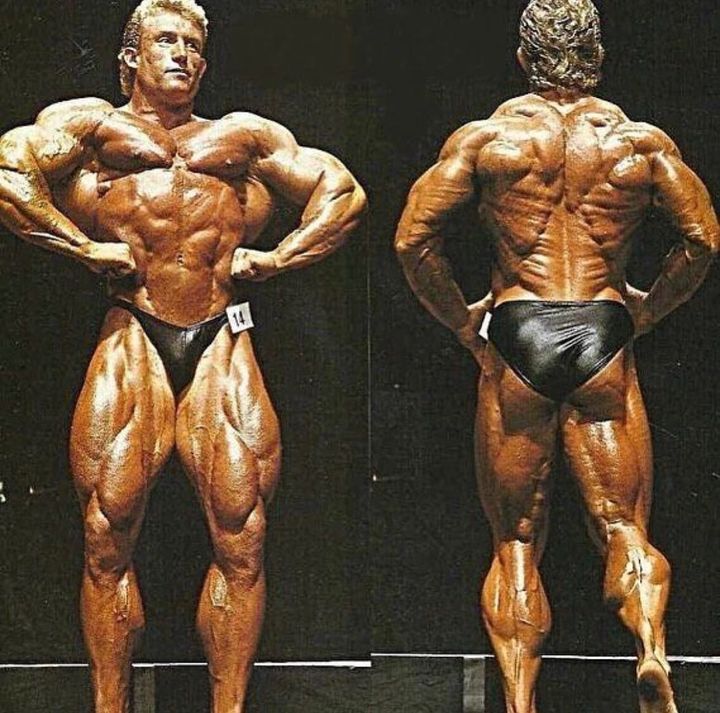
Bodybuilding Legend Dorian Yates Discusses 2-Exercise Ab Routine That Led to 6 Mr. Olympia Titles
Bodybuilding icon Dorian Yates reached the top of the Men’s Open division with hard work and a granite physique. In a recent Instagram post, Yates laid out the two-exercise abs routine that helped him achieve six Mr. Olympia titles.
Dorian Yates was a trailblazer in the Men’s Open division mostly throughout the 1990s. He was next to take the throne after the great Lee Haney, who left the sport as an eight-time titleholder. While dominating his class, Yates had a major influence on the overall look. As time passed, bodybuilders with overbearing size continued to find success years after his departure.
Yates followed an unconventional training style on his way to becoming one of the world’s best bodybuilders. He ignored commonly used practices regarding reps and sets in the weight room. Instead, Yates trained to the brink of failure regularly and pushed his body to extremes whenever he decided to train.
Dorian Yates / Instagram
In retirement, he’s an open source of bodybuilding knowledge for everyone. Whether he’s talking about the mindset it took to reach the top or reliving a hallucinogenic ayahuasca journey, Yates leads a busy and exciting life. This time, he’s offering fans two of his favorite abs exercises he used during the prime years of his career.
Dorian Yates Reveals Mr. Olympia-Winning Ab Routine: “I Usually Trained Abs Once Per Week”
Yates said ab training was typically included after a ‘heavy-duty shoulders and triceps session.’ His two-exercise routine consisted of two sets of bodyweight crunches to failure and two sets of bodyweight reverse crunches to failure.
“I usually trained abs once per week.
They were usually done after my heavy duty shoulders and triceps session. This was because I felt that shoulders and triceps was probably the ‘easiest’ workout of the week (well, easier than the others!) and didn’t take as much out of me, so I added them on to the end here.
My abs routine was simple:2x bodyweight crunches to failure2x bodyweight reverse crunches to failure
The six-time Mr. Olympia shared that he completed these exercises with hard contractions and a big exhalation of air at the peak of each movement. Personally, Yates never found ab training ‘that important’ because he was usually keeping a low body fat percentage during days of active competition.
But these were done with a hard contraction and a big exhalation of air at the peak contraction. We would squeeze our abs so hard that they’d be on the verge of cramping almost!
The physique that inspired me when I was younger, especially abs wise, was Bruce Lee’s, he had great abs. In my youth, I’d always be doing bodyweight exercises like sit-ups and pushups, with a poster of Bruce Lee watching over me!
As far as I remember, I always had a visible set of abs. In my early bodybuilding days, I would train them with weights but I noticed that they would grow fairly quick and would potentially look quite ‘blocky’.So I switched to contraction work with just my body weight.
In my opinion, it wasn’t really that important to train my abs as they were always visible due to my low body fat year round and my genetics did play a part here in helping me stay lean.Everyone has abs… it’s just a case of revealing them by lowering your body fat.” Dorian Yates shared.
In addition to maintaining his own health, Yates loves to offer wellness advice to his followers. He routinely offers guidance and tips on building muscle. One of the last topics he approached was training time. The legend explained that he preferred to keep his body guessing by training at times it wasn’t accustomed to.
Dorian has long been respected for his nuanced training methods and tactics. He’s learned and drawn from a number of legends such as Mike Mentzer and Tom Platz, who is highly regarded for his advanced, intense, and downright gritty leg training workout strategies. Last year, Platz extended his gratitude for Yates and was proud Dorian took his teaching seminar to heart decades ago.
At 61 years old, longevity has become a priority for Yates. Just last week, ‘The Shadow’ shared that he recently underwent a stem cell therapy procedure. After the treatment, Yates says he has more energy and mentioned his nagging shoulder pain is feeling better.
RELATED: Dorian Yates on Building Legs with Hamstring Curls: ‘Use a Full Range of Motion & Slow Negative’
Given his contributions to the sport, the bodybuilding community is fortunate to have a figure as forthcoming as Yates. Even in retirement, he continues to influence generations of bodybuilders after him.
Published: 8 June, 2023 | 1:18 AM EDT
Sit-Up Exercise Guide: How To, Benefits, Muscles Worked, and Variations
The sit-up is one of the most popular exercises. It is taught in school PT classes, done at home, and is a part of the most complex metabolic conditioning workouts. This versatile exercise works your midsection and can help build a shredded six-pack. Sit-ups can also improve your posture, core strength, and balance.
Most people have a love-hate relationship with sit-ups. They love the results but hate doing the exercise. Although sit-ups look easy, they will have you begging for mercy halfway through a set. They are especially difficult for beginners that lack abdominal strength and endurance. Furthermore, many exercisers find sit-ups boring.
That said, thanks to their effectiveness and results, sit-ups are a part of most training regimens, and this doesn’t appear to be changing any time soon.
Notably, sit-ups are often confused with their cousin — crunches. Both these exercises look similar to an untrained eye, and ‘sit-ups’ and ‘crunches’ are often used interchangeably. However, these exercises have significant differences.
The biggest difference between the two exercises is their range of motion. The crunch is roughly a quarter of the sit-up’s range of motion (ROM). While performing the crunch, your lower back is always in contact with the floor; in fact, your upper back, too, barely leaves the floor. However, as the name implies, the sit-up involves sitting upright at the top of the range of motion.
The sizeable difference in the ROM leads to the isolation of your abdominal muscles while performing the crunch. On the other hand, sit-ups stimulate multiple muscle groups, including the abs, hip flexors, hips, and lower back.
In this article, I take you over the fundamentals of the sit-up, the muscles worked during this exercise, its benefits, proper form, the most common mistakes, and the best variations and alternatives.
What is a Sit-Up?
A shredded midriff and a six-pack are considered the epitome of fitness, and the sit-ups help you achieve just this. This exercise involves contracting your abs with every rep, which helps you develop a chiseled midsection. The sit-up is an isolation exercise that trains your abdominal muscles.
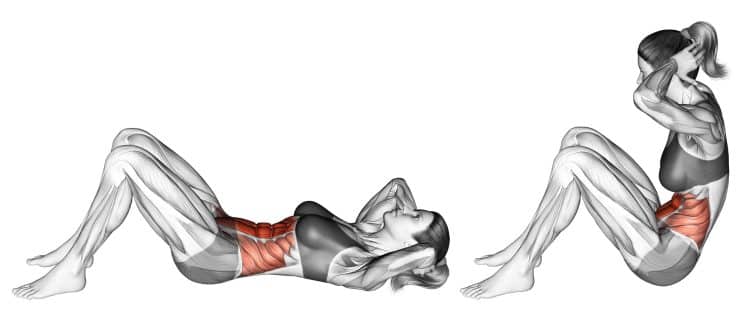
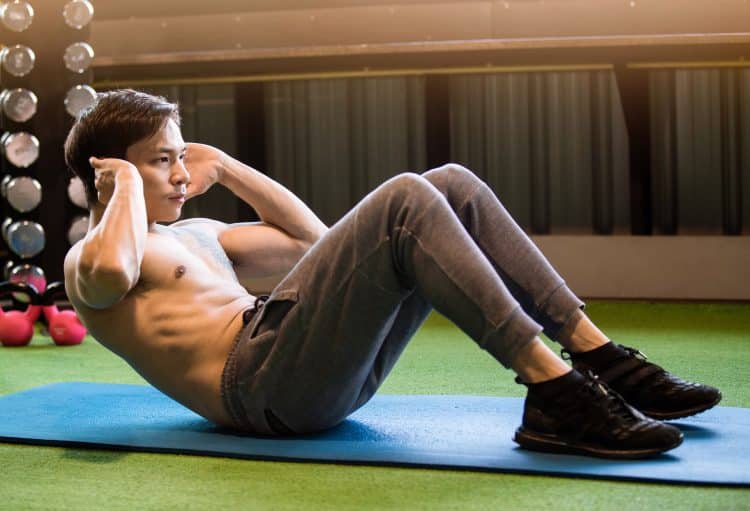
To perform a sit-up, lie supine and place your feet flat on the floor. While holding your hands at the side of your head, lift your torso off the floor by contracting your abs. Your upper body should be almost parallel to the floor at the top of the motion — anything between 12 and 1 ‘o clock is acceptable.
Since performing the sit-up requires no equipment, you can do it anywhere. As you gain more experience, you can make the exercise more challenging by incorporating additional resistance using a weighted vest or holding a dumbbell, weight plate, or kettlebell in front of your chest.
The sit-up primarily works the upper and middle abs. However, you can achieve better lower ab stimulation by performing this exercise on a decline bench. Conversely, beginners can perform this exercise on a stability ball, as it provides a little assistance at the bottom of the movement.
Muscles Worked During a Sit-Up
The sit-up works the following muscles:
Abs
Sit-ups work the rectus and transverse abdominis. The rectus abdominis is the long vertical muscle that runs down the front of your abdomen. It is also known as the six-pack. On the other hand, the transverse abdominis muscle wraps around the abdomen and provides stability and support to the spine and internal organs. The transverse abdominis plays a crucial role in core stability while performing sit-ups and other exercises.
Obliques
Sit-ups work the internal and external obliques. The external obliques are the fish-gill-like muscles at the side of the rectus abdominis and help with trunk rotation and bending movements. The internal obliques lie under the external obliques and also assist with trunk rotation and bending.
Hip Flexors
Hip flexors run along the front of your upper thigh. They are responsible for flexing the hip joint. Hip flexors engage during the sit-up’s concentric (upward) motion to lift the torso toward your thighs.
Hips
Your hips provide stability during the sit-ups. The hip joint flexion also allows you to move from a lying to a seated position. Strong hips will also help prevent lower back strain while performing the exercise.
Lower Back
Your lower back, especially the erector spinae, plays a crucial role by providing stability and maintaining proper spinal alignment while performing sit-ups. It helps you avoid rounding your lower back during the concentric motion.
Benefits of Sit-Ups
Here are the advantages of adding sit-ups to your training regimen:
Improved Core Strength
Performing sit-ups helps you build a stronger core, the benefits of which carry over to compound exercises. Furthermore, it improves your performance in daily activities, which helps you get done more quickly and effectively.
Boost in Athletic Performance
A strong core can help improve your athletic performance. Irrespective of your sport, sit-ups can improve your posture, stability, and form, which can boost your overall performance and results. It will also significantly delay the onset of fatigue.
Increase in Muscle Mass
Sit-ups can help build muscle mass and strength in the abdominal and hip muscles. This exercise can also be a valuable indicator of muscle loss. A 2016 study found that older women who could perform sit-ups were less likely to lose muscle mass with age. [1]
Improved Balance and Stability
Sit-ups help build a strong core, which improves your balance and stability. It can improve your performance in daily activities and other exercises. A stronger core can also help prevent falls in older adults.
Better Posture
Building a strong core helps keep your hips, spine, and shoulders in alignment, which helps promotes a better posture. Folks that have a desk job or spend the majority of their days sitting should make sit-ups a constant in their training regimen.
No Equipment
Sit-ups are a bodyweight exercise that you can do anywhere at your convenience. Plus, you can program this versatile exercise into most training regimens and use additional resistance for better results.
How To Do Sit-Up
This is how to perform the sit-up with the correct form:
Steps:
Lie supine on the floor. Bend your knees and plant your feet on the ground.
Hold your hands next to your ear.
Raise your torso off the floor by contracting your abs. Exhale sharply during the concentric movement.
Your torso should be perpendicular to the floor at the top of the movement.
Contract your abs as hard as possible.
Inhale as you slowly lower your torso to the floor.
Repeat for recommended reps.
Sit-Up Tips:
Your head should remain neutral throughout the range of motion. Bending your head during the concentric movement puts unnecessary strain on your neck.
Avoid interlacing your fingers behind your head as it increases your odds of bending your neck during the upward motion. Crossing your arms in front of your chest is a better alternative if you don’t prefer holding your hands next to your ears.
Exhale and contract your abs during the upward motion.
Keep your back straight throughout the range of motion. Rounding your back can strain your lower back.
Use an elevated surface to anchor your feet. This will help keep your feet planted on the floor and allow you to establish a better mind-muscle connection.
It is common for beginners to experience ab cramps while doing sit-ups. Stop the exercise if you experience cramps and stretch out your abs.
In This Exercise:
Target Muscle Group: Abs
Type: Strength
Mechanics: Isolation
Equipment: Bodyweight
Difficulty: Beginner
Best Rep Range: 8-12
Common Mistakes While Performing Sit-Up
These are some of the most common sit-up mistakes that you must avoid to maximize results and lower the risk of injury:
Using a Limited Range of Motion
Many people leave gains on the table by following an incorrect form and a restricted range of motion. Your back should be on the floor at the bottom, and it should be perpendicular to the floor at the top.
Using Momentum
Exercisers try to make this exercise easier by using momentum. Avoid throwing your arms toward your legs to lift your torso off the floor. Driving through your neck during the concentric motion can cause neck sprains.
Neck Strain
Sit-ups are a demanding exercise. You must keep your head, neck, and torso in a straight line throughout the exercise for optimal ab stimulation. Folks that interlace their fingers behind their necks or throw their heads forward during the concentric motion increase their odds of injury during the exercise.
Rounding Your Back at the Top
Think of your torso as a hardboard while doing sit-ups; it should move in a straight line. Rounding your back at the top of the motion causes unnecessary lower back strain. It will also hamper your form during the eccentric (lowering) motion.
Improper Breathing
Many people make the mistake of holding their breath while performing crunches. Breathing correctly while performing crunches can help amplify your results. Exhale sharply during the concentric motion and inhale during the eccentric motion.
Not Adding Variety To Your Training Regimen
Although crunches are a great exercise to build a shredded midriff, your training program must include exercises that train your torso from different angles for overall development. It will ensure you build a bulletproof midsection. This point is a perfect segue into…
Variations and Alternatives of Sit-Ups
Add the following sit-up variations and alternatives to your training regimen to build a shredded midsection:
Weighted Sit-Up
Weighted sit-ups are for advanced athletes. It involves holding additional resistance, such as a dumbbell, kettlebell, or weight plate, in front of your chest. The exercise form for this variation will remain the same as the conventional sit-up.
Pro Tip: Use an appropriate weight that allows you to keep your head and torso in a straight line throughout the range of motion. Using a weight that is too heavy can cause you to bend your head forward.
Stability Ball Sit-Up
Stability ball sit-ups are an excellent exercise for beginners as the exercise ball acts as a support at the bottom of the movement and delivers a pop that pushes you into the next rep.
Steps:
Sit upright on an exercise ball and plant your feet flat on the floor.
Hold your hands at your ear level and slide forward so your lower and middle back are on the exercise ball. Your shoulders should be hanging off the ball.
Exhale and contract your abs to lift your torso toward the ceiling.
Your torso should be perpendicular to the floor at the top.
Slowly return to the start position.
Rinse and repeat.
Pro Tip: Some trainers go down too fast during the eccentric motion to use the bounce from the ball to complete the next rep. However, this reduces the effectiveness of the exercise and increases your risk of lower back injury.
Reverse Crunch
Sit-ups and crunches work the upper and middle abs. On the other hand, reverse crunches focus on your lower abs. During a sit-up, your lower body remains steady while your upper body moves. The reverse is true for the reverse crunch.
Steps:
Lie with your back on the floor. Your body should be in a straight line at the starting position.
Place your hands under your hips for leverage.
Lift your feet off the floor so your heels are a few inches off the ground.
Pull your quads to your chest while bending your knees.
Your hips should be off the floor at the top.
Slowly return to the start position.
Repeat for recommended reps.
Pro Tip: Make this exercise more challenging by performing this exercise on an elevated platform, such as a flat bench. Let your feet touch the floor at the bottom of the movement for better abdominal stimulation.
Check out our complete reverse crunch guide!
V-Up
The V-up is a great exercise to build core strength, balance, stability, and coordination. This exercise targets your entire midsection, including your upper, middle, and lower abs.
Steps:
Lie flat on your back on the floor.
Extend your arms toward the ceiling so they are perpendicular to the floor. Simultaneously, raise your legs off the floor.
In a single motion, lift your legs toward the ceiling and bring your hands toward your feet.
Your body should resemble a “V” at the static contraction point at the top.
Slowly lower to the starting position.
Repeat for recommended reps.
Pro Tip: Experienced lifters can make this exercise more challenging by wearing ankle weights and holding a pair of dumbbells.
Check out our complete V-up guide!
Crunch
The crunch is the easier version of the sit-up and roughly involves a quarter of the sit-up’s range of motion. This exercise is a better option for people trying to maintain constant tension in their upper abs or undergoing rehabilitation.
Steps:
Lie supine on the floor. Bend your knees and plant your feet flat on the ground.
Hold your hands next to your ears.
Contract your core, and exhale as you lift only your head and shoulder blades off the ground.
Slowly lower to the starting position.
Repeat for reps.
Pro Tip: Like with sit-ups, you can perform crunches while holding onto weights or on a decline for greater abdominal stimulation.
Check out our complete crunch guide!
Bicycle Crunch
The bicycle crunch is one of the few ab exercises that simultaneously work your lower and upper body. This ab exercise is incredibly effective at working your lower and upper abs and obliques.
Steps:
Lie flat on the floor while facing the ceiling.
Hold your hands next to your ears and lift your legs off the floor.
Exhale as you bring your right knee to your chest while driving your left elbow to the knee.
Return to the starting position.
Repeat on the other side.
Alternate between sides for the recommended reps.
Pro Tip: Focus on your breathing to make the most of this exercise. Breathe out during the concentric motion and breathe in during the eccentric motion.
Check out our complete bicycle crunch guide!
Wrapping Up
The sit-up is a versatile beginner-friendly exercise that will help improve your core strength, balance, stability, and posture, boost your athletic performance and muscle mass, and can be done anywhere at your convenience.
Although sit-ups are a great exercise to work your midsection, your ab training routine should include a variety of movements to ensure overall development. Remember, building a six-pack requires patience, dedication, commitment, and a low body fat percentage. Nail each aspect of your training, diet, and recovery regimen, and your abs will rival those of Greek statues. Best of luck!
Related: Crunch and Sit-Up Alternatives
References
Abe T, Yaginuma Y, Fujita E, Thiebaud RS, Kawanishi M, Akamine T. Associations of sit-up ability with sarcopenia classification measures in Japanese older women. Interv Med Appl Sci. 2016 Dec;8(4):152-157. doi: 10.1556/1646.8.2016.4.7. PMID: 28180004; PMCID: PMC5283773.