
 All Posts By Muscle Insider
Board Certified PHD
Michal Krizo Looks Massive and Ripped in Latest Update, Hints at Surprise Contest in 8 Weeks
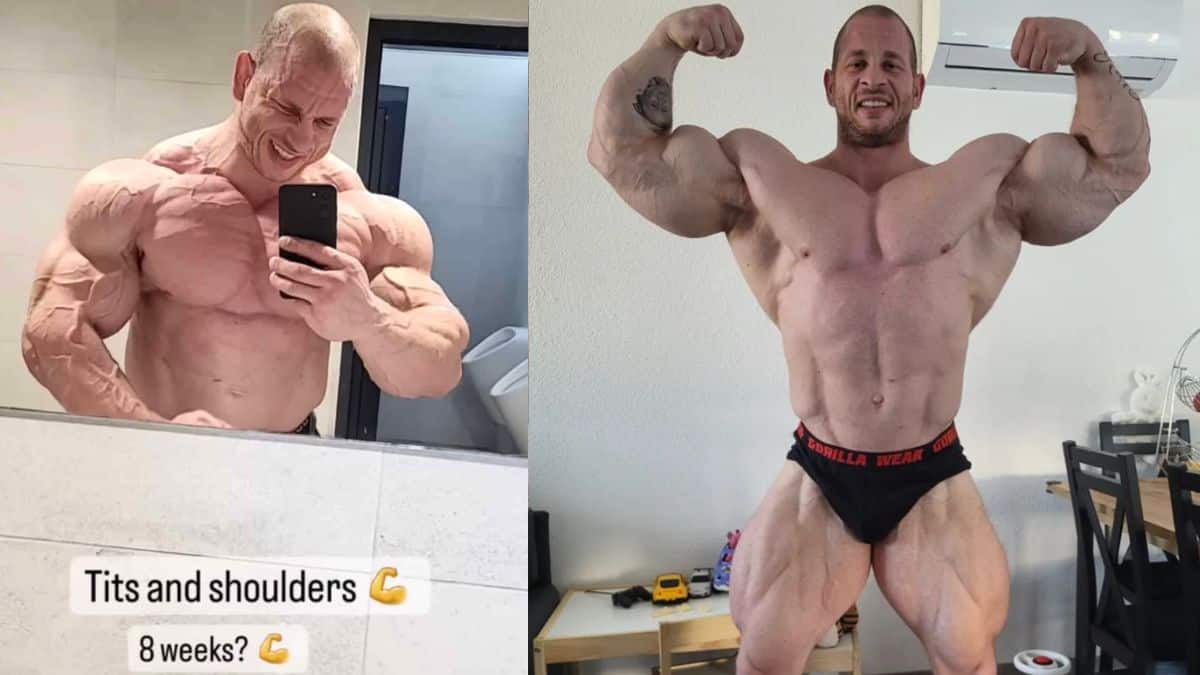
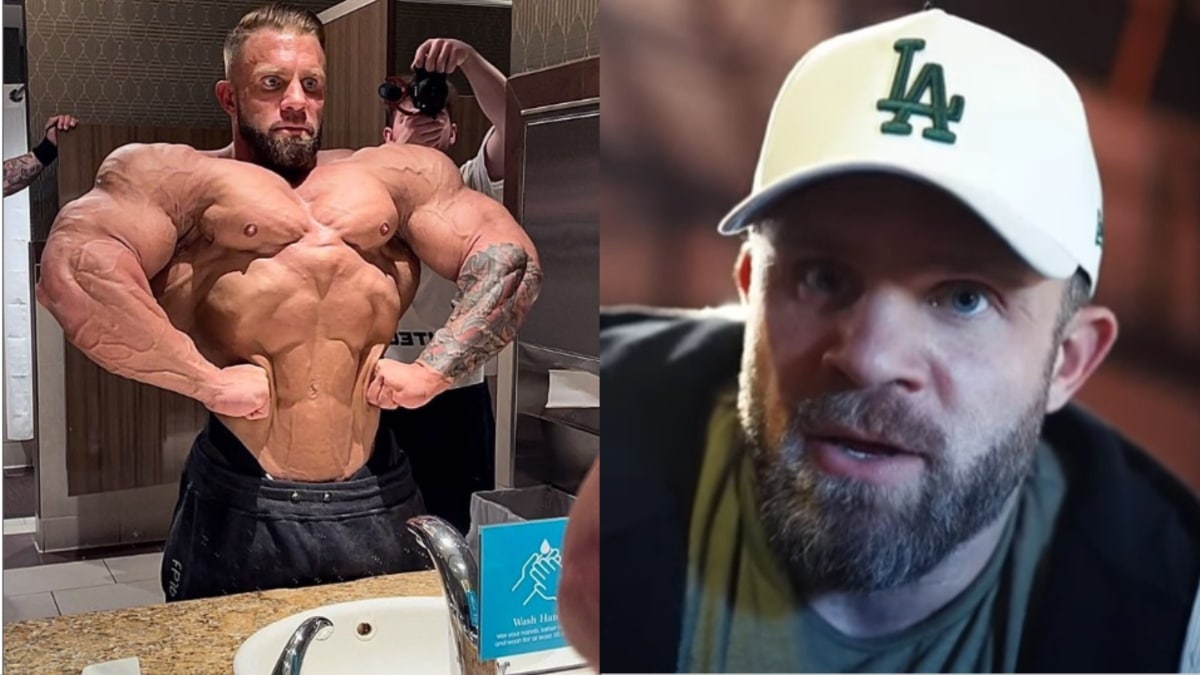
Rising Men’s Open star Michal Krizo appears to be taking to the stage soon. In a recent Instagram stories post, Krizo shocked fans with a ripped physique update and teased a return in eight weeks.
Slovakian mass monster Krizo stole headlines on a consistent basis last year. He switched to the NPC from the IFBB Elite Pro League, then earned his pro card in short order after dominating the 2022 Amateur Olympia Italy. Having claimed victory at the EVLS Prague Pro next, Krizo guaranteed his passage to Mr. Olympia, where he embraced the opportunity with a 12th-place finish in his debut.
Krizo has ambitious plans for the 2023 season and the community has taken notice. Figureheads of the sport such as former Mr. Olympia Samir Bannout have urged Krizo to refine his posing skills. To shore up any stage nerves or weaknesses, Krizo guest posed at 300 pounds during the off-season a few weeks ago.
Aside from posing, the 32-year-old has been following a rigorous training schedule. He offered a glimpse into his bulking leg workout recently, where at the time, admitted his next competition would be the 2023 Arnold Classic UK (AKA: Experience With Sports Festival UK) in September. Fortunately for his fans, it looks like he’s changed his mind and teased his next show in less than two months.
Michal Krizo Teases Next Contest in 8 Weeks, Where Will He Compete?
Given the time frame revealed by Krizo, fans expect his next contest appearance to come at the 2023 Empro Classic Pro Spain on June 18.
Check out his physique update below:
Krizo showed off his fullness and vascularity in a separate IG stories post.
Krizo
Previously, Krizo laid out some of his goals for the current season. Reacting to his 12th-place performance at Olympia, Krizo said he was unhappy with his conditioning levels. He explained that his body felt ‘tired’ in December after peaking multiple times last year.
With time to accept the outcome of 2022 Olympia, Krizo hasn’t been shy about discussing his opposition. During last year’s contest, Krizo argued that the beautiful structure of Brandon Curry was overlooked. In fact, Krizo stated that Curry had the best upper body of the entire show and said he ‘deserved’ to place higher than fourth.
Krizo has also shared rivalries with a number of Open class stars like Nick Walker, Blessing Awodibu, and Iain Valliere. After Olympia, he buried the hatchet with all of them and placed ahead of Awodibu, who defeated Krizo at an amateur bodybuilding contest back in 2017.
RELATED: Bodybuilder Michal Krizo Crushes A Back Workout Eight Days Out of 2022 Olympia
Should he claim a pro show victory before October 9, Michal Krizo will have the chance to break into the first call-out and face the reigning Mr. Olympia Hadi Choopan on bodybuilding’s biggest stage.
Published: 28 April, 2023 | 11:04 AM EDT
Dexter Jackson Demolishes A Back Workout, Addresses A Health Problem
Veteran bodybuilder Dexter Jackson has created a lasting legacy in the sport with some spectacular performances throughout his competitive career. A few years into retirement, Jackson is still pushing himself in the gym to an extent where he has to remind himself it is not as serious anymore!
One of the most prominent names in the 2000s and 2010s bodybuilding era, “The Blade” has five Arnold Classic titles to his name, winning this second-most prestigious bodybuilding competition in 2005, 2006, 2008, 2013, and 2015. He was also a perennial Mr. Olympia contender that pushed dominant champions like Ronnie Coleman and Jay Cutler the way only a handful of other competitors could. In 2008, Jackson even managed to push Cutler off the pedestal and take home the sole Mr. Olympia title of his bodybuilding career.
The 53-year-old is one of the rare athletes that have enjoyed performance longevity and competed well into his late forties before deciding to call it quits. A ninth-place finish at the 2020 Mr. Olympia marked the end of his 22-year-long pro career. Although there was speculation about him competing in the returning Masters Olympia competition, Jackson has made it clear that he has no intentions of wearing the posing trunks again.
Staying in shape and maintaining overall health is the primary goal of his training. However, he is a passionate bodybuilder all the way down to his core, and that nature was on full display in Jackson’s recent back training session. So let’s check out how he trained in this workout.
Dexter Jackson goes through a back workout
Hammer Strength Machine Low Row
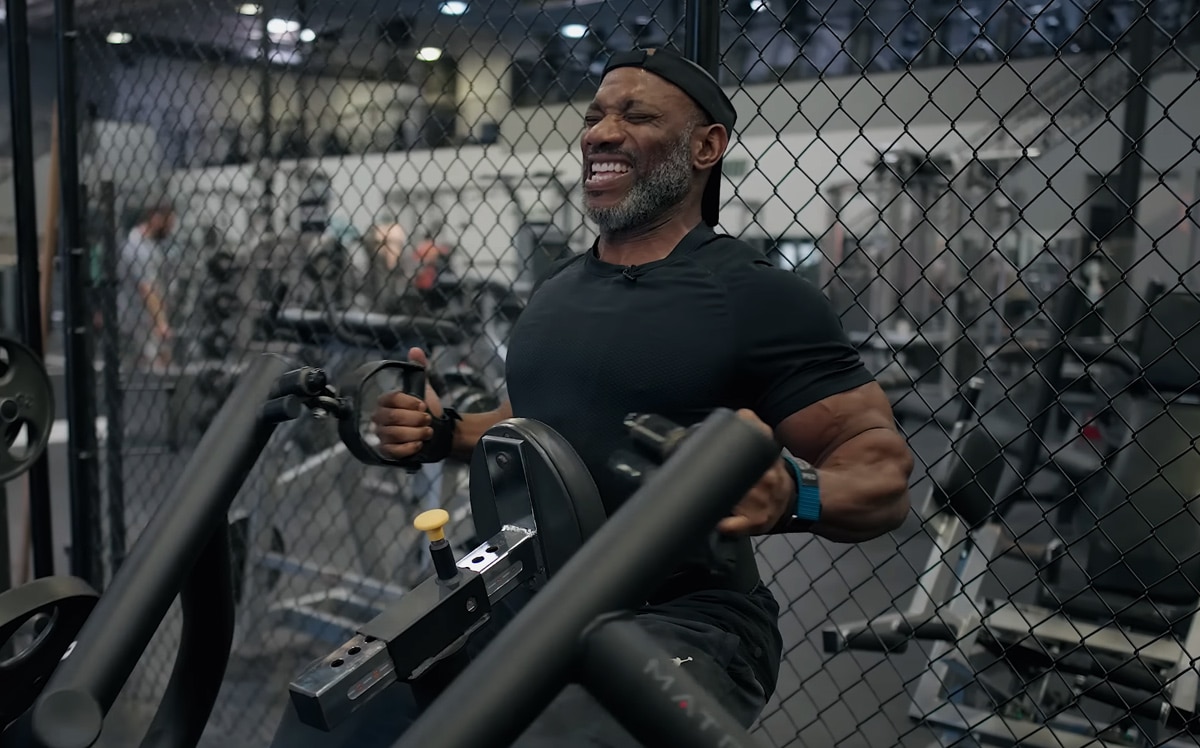
Jackson admitted to not having trained his back seriously in quite some time. He started the training session with low rows on the Hammer Strength plate-loaded low-rows machine to get a good warm-up. After packing a few serious sets of the movement using incrementally heavier weights, Jackson went on to take on the heavier lifts of the session.
Seated Row
The five-time Arnold Classic champion next worked the back muscles on a plate-loaded machine with a swivel handle which enables a more natural movement of the arms during the exercise.
Wide-Grip Lat Pulldown
After putting up with the two horizontal pulling movements, the legendary bodybuilder trained his lats with this compound movement. After performing the first set of the exercise with furious intensity, Jackson made a conscious decision to tone it down a notch as he sometimes has to remind himself that it’s not competition anymore.
“Sometimes, I still find myself training too hard. I have to tell myself to back off a little bit homie – it ain’t that serious no more! But I’ve been doing it for so many years… over 30 years of training like this. So I get why some people can’t let certain things go, you know. I can let it go. That’s why I can tell myself to back off, and I listen to myself. Some people don’t listen to themselves,” Jackson said.
After getting a few sets of lat pulldowns under his belt, Jackson jumped into the next exercise.
Seated Cable Row
Another variation of rows followed next, and the 53-year-old bodybuilder performed the movement on the cable machine with swivel handles. This movement added the last bit of stimulus to the back, as Jackson called it a day in the gym after a few sets of the exercise.
In totality, Dexter Jackson’s back workout consisted of:
Jackson revealed that he has been suffering from arthritis of the back for a while now. However, he will head to Columbia soon to get stem cell therapy to address the problem.
“I’m gonna be 100 percent 20 again…!” Jackson stated.
Jackson has set a positive example for younger bodybuilders in his retirement. A huge and muscular physique is an integral part of a bodybuilder’s identity. Many of them carry the colossal muscle mass into the later years of life despite being aware of its health risks. However, The Blade has let go of the heavy physique and significantly downsized in favor of longevity and quality of life at this stage of his life. Fitness Volt wishes Jacson luck with his upcoming stem cell treatment.
You can watch the full workout video below, courtesy of Dexter Jackson’s YouTube channel:
Published: 28 April, 2023 | 10:22 AM EDT
Dorian Yates Reveals His Contest Prep, Training, Steroid Cycles & TRT Use after Retirement
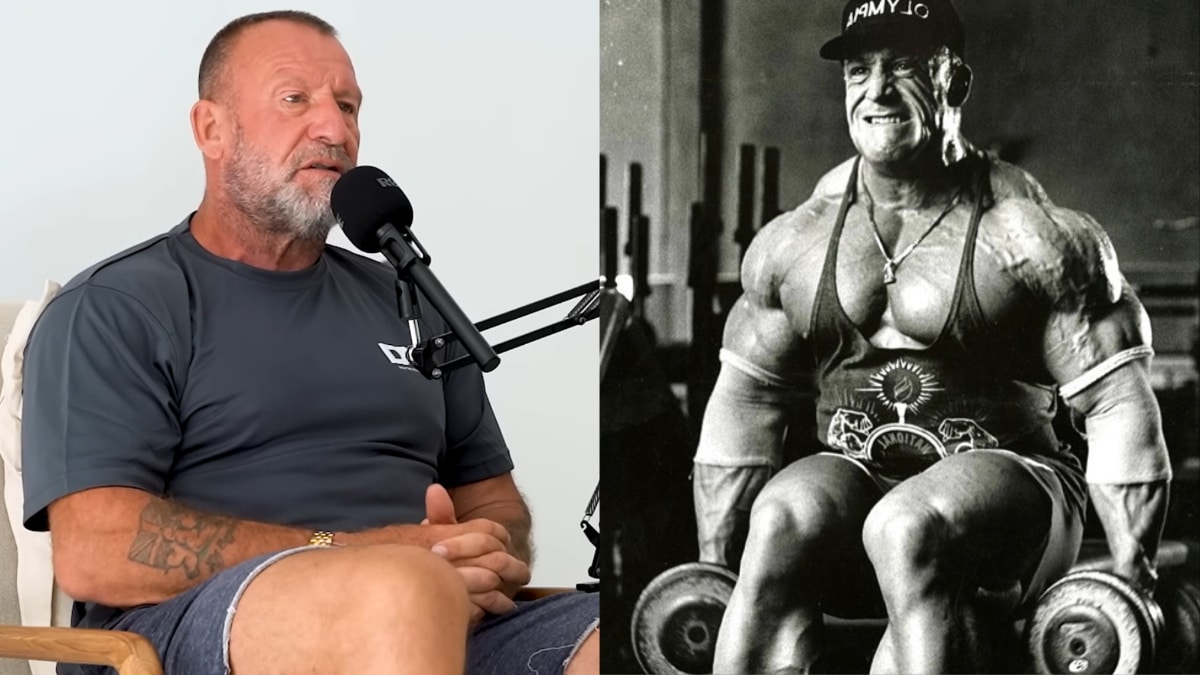
Bodybuilding legend Dorian Yates stands out as a six-time Mr. Olympia champion with a distinct training philosophy. In a recent Rob Lipsett interview, Yates revealed his competition prep, training, and the steroid cycles he used as a competitor. He also opened up about his reasons for getting on TRT after stepping away from professional competition….
Cable HIIT Workout for Burning Fat and Boosting Cardiovascular Health
HIIT workouts have risen in popularity in recent years because they enable you to get a lot of work done in a short period. This versatile training protocol can be programmed to promote muscle growth, lose fat, or boost your cardiovascular health.
However, most HIIT workouts repel exercisers as they involve multiple pieces of equipment in a single workout and try to do too much too soon. Plus, most HIIT workouts ignore cables, one of the most convenient and effective strength training tools.
In this article, we have fixed everything wrong with HIIT workouts. We have put together a cable HIIT workout that will help kickstart your fat-burning process, boost your cardiovascular health, and promote overall fitness.
What are HIIT Workouts?
A high-intensity interval training (HIIT) workout involves short bursts of intense activity followed by periods of rest or low-intensity exercise. These workouts focus on maximizing calorie expenditure, improving cardiovascular health, and increasing muscular endurance.
HIIT workouts include different types of exercises, such as cardiovascular, strength training, bodyweight, plyometric, and balance and stability movements. Plus, they can be done with a variety of equipment like dumbbells, barbells, machines, plyo boxes, etc., or no equipment at all. The possibilities of what can be accomplished in a HIIT workout are endless, limited only by your own imagination.
For the scope of this article, we’ll focus on cable HIIT workouts for burning fat and boosting cardiovascular strength.
The most popular cable exercises are isolation (single-joint) movements. However, to maximize your workout’s fat-burning potential, you must perform compound (multi-joint) exercises. Several exercises in this workout will combine upper-body and lower-body movements to spike your heart rate, helping you burn more calories.
Most HIIT workouts include plyometric exercises, such as box jumps or jumping jacks; however, since we’ll be using a cable machine for this workout, we’ll stay away from high-impact exercises to lower the risk of injury and make this workout more beginner-friendly and accessible.
In this article, we cover the best cable HIIT exercises, the most effective cable HIIT workout, its benefits, and tips to make the most of your training regimen. We have a lot to cover, so sit tight.
Cable HIIT Workout Exercises
Most exercises on this list are uncommon. Chances are, you’ve never heard of them before or seen someone do them. However, these movements will deliver a solid full-body workout and the desired fat-burning and cardiovascular health benefits. So without any further ado, here are the cable exercises that should be a part of your HIIT workouts:
Cable Squat To Biceps Curl
This full-body exercise will shoot up your heart rate. We recommend using a functional trainer instead of a conventional cable machine for this exercise.
Steps:
Adjust the pulleys of a functional trainer to the lowest position and attach D-handle bars to both ends.
Grab the D-handle bars in both hands using a supinated (palms facing up) grip, take a big step back, and assume a hip-width stance.
Keeping your elbows pinned, perform a biceps curl until your arms are at shoulder level.
Lower into a squat while pushing your hips back and down while extending your arms toward the pulley.
The weight should be engaged at the bottom of the movement.
Return to the standing position while curling the weight.
Repeat for recommended reps.
Pro Tip: Perform single-arm biceps curls to boost your workout’s volume and intensity.
Cable Reverse Lunge to Shoulder Press
Bigger quad sweeps and round shoulders can help you achieve the coveted ‘x-frame;’ this exercise kills two birds with one stone.
Steps
Set the cable pulleys of a functional trainer at the lowest position and attach D-handle bars.
Grab the handles with a pronated (palms facing away) grip and bring your hands to your shoulder level while facing away from the cable machine.
Take a big step forward and assume a shoulder-wide stance.
Step back with your left foot and lower yourself until your rear knee touches the floor.
Perform a shoulder press as you return to the standing position.
Repeat on the other side.
Alternate between sides for the recommended reps.
Pro Tip: Press your arms slightly in front of your body while performing the overhead press. Pressing straight overhead can throw you off balance.
Cable Low-To-High Wood Chopper
Most people overlook transverse plane exercises in their workouts. These movements can help build rotational and anti-rotational strength, improve stability, and help prevent lower back pain.
Steps
Position the cable pulley at the highest setting and attach a D-handle bar.
Stand with your right side facing the pulley.
Grab the handle with your right hand using a neutral grip and wrap your left hand around it.
Take a step away from the pulley.
Turn your torso toward the pulley while keeping your hips stable.
Keeping your arms extended, turn to your left side while bringing the D-handle to the outside of your left knee.
Slowly return to the starting position.
Repeat for recommended reps before switching sides.
Pro Tip: Add variety to your training regimen by changing the position of the pulley and working your obliques from different angles.
Cable Forward Lunge To Shoulder Front Raise
Since cable HIIT workouts for fat-burning and cardiovascular health involve exercises that combine two exercises, it can help improve your hand-eye coordination.
Steps
Adjust the cable pulley to the lowest position and attach a D-handle bar.
Grab the bar with a pronated grip in your right hand, face away from the machine, and take a step forward.
As you step forward with your left foot and lower into a lunge, perform a front shoulder raise until your arm is parallel to the floor.
Return to the starting position.
Repeat for desired reps before switching sides.
Pro Tip: Change your grip from pronated to supinated or neutral to train your anterior deltoids from different angles.
Cable Single-Arm Chest Press
HIIT workouts can be overwhelming. Most high-intensity training sessions include an exercise that is programmed in the middle of the workout and acts as a breather by lowering the training intensity, so you can catch your breath and give the remaining circuit all you’ve got. The cable single-arm chest press is that exercise in this training session.
Steps
Set the cable pulley at chest height and attach a D-handle bar.
Grab the bar with a pronated grip in your left hand and face away from the pulley.
Assume a staggered stance for balance.
Extend your arm in front of your torso so it is parallel to the floor. Pause and contract your chest.
Return to the starting position.
Repeat for recommended reps before switching sides.
Pro Tip: Rotate your torso toward the cable pulley at the bottom of the movement for optimal ab and oblique engagement.
Cable Crossover with Lunge
This exercise can take some time to master. You must keep an upright torso throughout the exercise for optimal pectoral engagement.
Steps
Set the cable pulley at waist height and attach D-handle bars.
Grab a D-handle in each hand using a neutral grip.
Take a step forward and assume a hip-width stance. Your hands should be at your chest side at the starting position.
Step forward with your right foot and lower into a lunge while performing a cable crossover.
Return to the starting position.
Repeat with the left foot.
Alternate between sides for recommended reps.
Pro Tip: Your wrists should be stacked at the bottom of the movement for optimal pectoral muscle stimulation.
Cable High Row with Reverse Lunge
Rowing exercises help build a thicker back, which can improve the overall aesthetics of your physique. Plus, combining rows with lunges will leave you gasping for breath in no time.
Steps
Adjust a cable pulley at the highest position and attach a D-handle bar.
Grab the bar with a neutral grip in your right hand, take a step back, and assume a hip-width stance.
The weight should be engaged in this position.
Step back with your left foot and lower into a lunge while pulling your right hand to the side of your chest by driving through your elbow.
Return to the starting position and repeat for recommended reps.
Switch sides.
Pro Tip: Feel free to switch between reverse and forward lunges, depending on which variation helps you achieve a better mind-muscle connection.
Plank Cable Row
Is a high-intensity interval training workout even HIIT if it doesn’t have a core exercise? We don’t think so. The plank row will set your core on fire and help you build a chiseled back.
Steps
Set up an exercise mat in front of a cable pulley machine.
Adjust the cable pulley to the lowest setting and attach a D-handle bar.
Get into a low plank position on the mat facing the pulley.
Take your right forearm off the floor, extend it overhead, and grab the handle with a neutral grip.
While keeping your shoulders square, pull your hand to your shoulder level while driving through your elbow.
Pause and contract your lat at the bottom of the movement.
Slowly return to the starting position.
Repeat for recommended reps before switching sides.
Pro Tip: You could also face away from the cable pulley and turn the plank row into a plank shoulder press, which is an excellent exercise for folks having trouble maintaining balance during the plank row.
Cable Crunch To Biceps Curl
This exercise combines the lying cable crunch with the lying cable curl and will help build muscular strength and endurance in the target muscle groups.
Steps
Set the cable pulley to the lowest setting and attach a straight bar handle.
Lie supine (facing the ceiling) on the floor with your legs toward the cable pulley.
Grab the straight bar with an underhand grip. Your legs should be on either side of the cable.
Your body, from head to toe, should be in a straight line at the starting position. The weight should be engaged at the bottom of the movement.
While keeping your elbows pinned to your sides, curl the bar until it is over your chest.
While driving your hips into the floor, perform a situp.
Extend your arms.
Return your torso to the floor.
Repeat for recommended reps.
Pro Tip: Keep your core and glutes braced throughout the exercise for optimal ab engagement. Switch to an overhand grip for greater forearm recruitment.
Side Plank Cable Shoulder Front Raise
Obliques are one of the most overlooked muscle groups. However, we are not leaving any loose ends in this workout. This exercise will work your midsection and your front delts simultaneously.
Steps
Set the cable pulley at the lowest setting and attach a D-handle bar.
Grab the D-handle with a supinated grip in your left hand.
Plank on your right side in front of the pulley with your feet toward the machine.
While keeping your core and glutes braced, raise your arm in front of your body.
Return to the starting position.
Repeat for recommended reps before switching sides.
Pro Tip: Maintain a slight bend in your elbow throughout the exercise. However, make sure you’re not bending your elbows during the range of motion, as it will remove tension from your deltoids and put it on your biceps.
Cable HIIT Workout for Burning Fat and Boosting Cardiovascular Health
To burn fat during a HIIT workout, ensure you keep your training intensity high. Given below is a workout that includes exercises that will spike your heart rate, resulting in improved cardiovascular health.
Perform two rounds of this workout within 25 minutes. The table details the recommended time for each exercise. You are allowed a 15-second break after completing each exercise and a two-minute break after completing a round. Do not stop for rest while changing sides.
Exercise
Time (in seconds)
Cable Squat To Biceps Curl
30
Cable Reverse Lunge to Shoulder Press
30
Cable Low-To-High Wood Chopper
30 (each side)
Cable Forward Lunge To Shoulder Front Raise
30 (each side)
Cable Single-Arm Chest Press
30 (each side)
Cable Crossover with Lunge
30
Cable High Row with Reverse Lunge
30 (each side)
Plank Cable Row
30 (each side)
Cable Crunch To Biceps Curl
30
Side Plank Cable Shoulder Front Raise
30 (each side)
Benefits of Cable HIIT Workouts
Here are the advantages of adding cable HIIT workouts to your training regimen:
Improves Muscle Mass, Strength, Stability, and Mobility
The biggest USP of cable machines is that they help keep constant tension on your target muscles, which can boost hypertrophy. You must use a challenging weight in each exercise to promote muscle and strength gains. [1]
Furthermore, since the cable HIIT workout for burning fat and boosting cardiovascular health incorporates single-leg, pushing, pulling, bending over, and rotational exercises, it will help improve your stability, balance, and mobility.
Build Hand-Eye Coordination
Exercises like the wood chopper, reverse lunge to shoulder press, and cable crunch to biceps curl involves multiple muscle groups and movement patterns. Performing these exercises can improve your hand-eye coordination and mind-muscle connection. A better hand-eye coordination can also improve your balance.
Helps You Lose Fat
HIIT workouts ramp up your calorie-burning process. Furthermore, HIIT workouts can help keep your metabolic rate high for hours after a training session, resulting in higher calorie expenditure, even when you are physically inactive. [2][3]
Boosts Cardiovascular Health
HIIT workouts can improve your aerobic and anaerobic performance and boost your overall cardiovascular health. The cardiovascular benefits of HIIT training carry over to other forms of exercise and your daily activities. [4]
Quick and Beginner-Friendly
Unlike conventional HIIT workouts that require multiple training equipment, you could do this high-intensity workout with just a cable machine, making this workout more convenient. It also shortens the time it typically takes to switch between exercises.
Furthermore, cable exercises have a small learning curve, which makes it an excellent option for beginners. The selectorized weight mechanism makes changing weights between sets incredibly convenient.
Tips For Optimal Results From Cable HIIT Workout
Here are a few tips to get the best bang for your buck from the cable HIIT workout:
Spend 5-10 minutes warming up before each workout, as it can help prime your muscles, improve your mobility, and lower your risk of injury. Your warm-up routine should have a balance of static and dynamic exercises.
Your cable HIIT workout should not take more than 25 minutes. Shorten the set times if you cannot complete the recommended reps within the 25-minute time limit.
If you keep your training intensity high, you’ll end your HIIT cable workouts with muscle-ripping pumps. Spend 5-10 minutes stretching and cooling down after a workout to kickstart your recovery process.
Focus on contracting your working muscles throughout the range of motion for optimal muscle stimulation.
Following the correct form for each exercise is as important as keeping your training intensity high. Compromising your form can increase your risk of injury.
Wrapping Up
Incorporating a cable HIIT workout into your training regimen is a great way to achieve your weight loss and cardiovascular health goals. Cable HIIT exercises are incredibly versatile; they can be easily modified to fit an exerciser’s training experience and level.
Perform the cable HIIT workout in this article once weekly to improve your strength, stability, and mobility and boost your fat loss progress and aerobic and anaerobic health. Remember, keeping your training intensity high is the key to success with HIIT workouts. Best of luck!
References
Martins C, Kazakova I, Ludviksen M, Mehus I, Wisloff U, Kulseng B, Morgan L, King N. High-Intensity Interval Training and Isocaloric Moderate-Intensity Continuous Training Result in Similar Improvements in Body Composition and Fitness in Obese Individuals. Int J Sport Nutr Exerc Metab. 2016 Jun;26(3):197-204. doi: 10.1123/ijsnem.2015-0078. Epub 2015 Oct 19. PMID: 26479856.
Falcone PH, Tai CY, Carson LR, Joy JM, Mosman MM, McCann TR, Crona KP, Kim MP, Moon JR. Caloric expenditure of aerobic, resistance, or combined high-intensity interval training using a hydraulic resistance system in healthy men. J Strength Cond Res. 2015 Mar;29(3):779-85. doi: 10.1519/JSC.0000000000000661. PMID: 25162652.
Wingfield HL, Smith-Ryan AE, Melvin MN, Roelofs EJ, Trexler ET, Hackney AC, Weaver MA, Ryan ED. The acute effect of exercise modality and nutrition manipulations on post-exercise resting energy expenditure and respiratory exchange ratio in women: a randomized trial. Sports Med Open. 2015 Dec;1(1):11. doi: 10.1186/s40798-015-0010-3. Epub 2015 Jun 5. PMID: 27747847.
Ouerghi N, Fradj MKB, Bezrati I, Khammassi M, Feki M, Kaabachi N, Bouassida A. Effects of high-intensity interval training on body composition, aerobic and anaerobic performance, and plasma lipids in overweight/obese and normal-weight young men. Biol Sport. 2017 Dec;34(4):385-392. doi: 10.5114/biolsport.2017.69827. Epub 2017 Sep 20. PMID: 29472742; PMCID: PMC5819474.
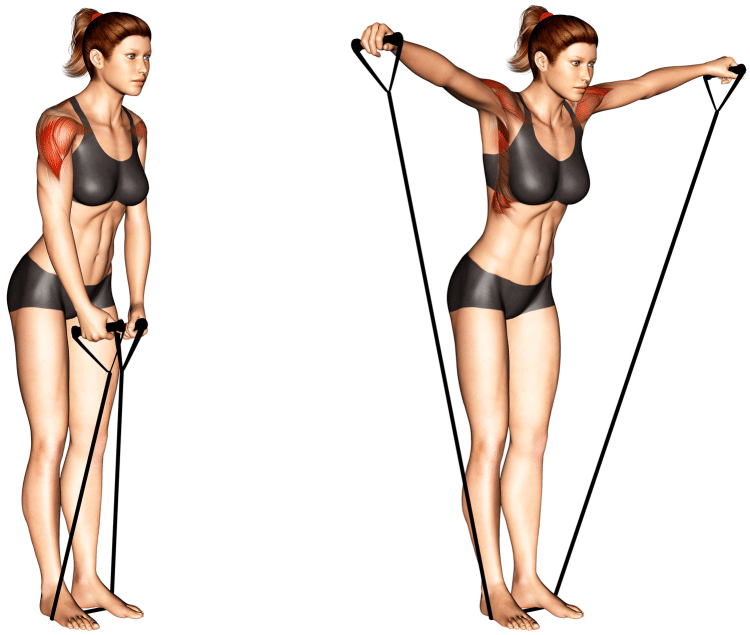
Band Lateral Raise Guide: Muscles Worked, How-To, Benefits, and Variations
If you want to build half-moon-shaped delts at home, or on the go, then you need to get well acquainted with band lateral raises, and resistance bands in general… the ultimate budget and minimalist training tool. But make no mistake, if you know how to use them effectively, you can achieve gains a notch below other training methods like cables, and weights, (we will explain this drawback of bands later on).
If you need an alternative way to stimulate growth in your shoulders and improve your v-taper, then this guide will be a helpful resource for you. Keep reading to learn about lateral delts anatomy, how to accurately perform band raises, benefits you can expect, and the best variations, alternative, and optimal sets and reps.
How To Do Band Lateral Raises
When it comes to exercise technique, the more experienced you are, the more you can modify an exercise to your liking. But for people just starting out, it’s better to get the basics down, to ensure you’re training a muscle properly, using a full range of motion, and keeping yourself pain and injury free.
You can find detailed instructions with a video tutorial below.
Steps
Grab both ends of your resistance band and step on the center of it. Hold the ends of the band (where you grip it) together without stretching it, to make sure the bands are of equal length on both sides. Note: The closer your feet are to each other, the less resistance there will be and vice versa. You may need to do a few practice reps to find your optimal foot placement.
With your hands next to your outer thighs, stand up straight, bend your elbows slightly, breathe in, and brace your core.
Now raise both arms up laterally to your body, then stop when your hands are roughly shoulder level, or slightly higher. Keep your hands higher than your elbows. Breathe out during this phase of the rep. You should feel your outer delts contracting.
Slowly drop your arms to your sides but not all the way (a few inches away from your outer thighs), so that the band doesn’t lose its stretch. Breathe in, brace your core, and repeat.
Here’s a basic tutorial for anyone starting out.
Tips
Beginner exercisers will benefit most from starting with the lightest resistance band first. Focus on feeling the lateral delts work, and optimizing your form to avoid feeling pain in your shoulders.
If you feel pain in your shoulders, rotate your forearms so that your thumbs are pointing up to the ceiling.
If the resistance is too challenging when standing on the band with both feet, take one foot off the band. But still make sure both sides are even.
This Exercise:
Target Muscle Group: Deltoid lateral
Secondary Muscles: Deltoid anterior, serratus anterior, trapezius
Type: Hypertrophy
Mechanics: Isolation
Equipment: Resistance band
Difficulty: Intermediate
Muscles Worked
While primarily an exercise used to add muscle to your outer shoulder muscles, you’ll find that other muscles are involved in band lateral raises too. You can learn about their anatomy, and functional purpose in the following section.
Band Lateral Raise Muscles Worked
Deltoid lateral
When viewed from the front, your lateral or outer deltoid muscles, along with the rear delts are what help to create the half moon shape on the upper arm, right above the triceps. If you want impressive upper arms, developing this head is non negotiable.
Your side delts lift the arms up to either side of your body between 15-100 degrees, which is why lateral raises are most effective for targeting this head.
Deltoid anterior
Many exercisers find that the best way to perform lateral raises is to lift the dumbbells out but also slightly forward too. This engages the front delts, and it’s a good way to nail both heads at the same time. Although, of course, you want to focus more on the side delts.
Serratus anterior
The boxer’s muscle as they call it… your serratus anterior is actually a fan-shaped chest muscle (most of us never knew that) located in the rib area. Serratus anterior protracts the scapula, like when you throw a punch, and it works with the traps to lift objects overhead.
Upper, middle, and lower trapezius
You may hear to “relax the traps” as to not involve them in lateral raises. But it’s almost impossible to not involve them to some extent. After all, they do help to move the scapula and arms up (upper traps), back (mid traps), and down (lower traps).
Benefits of Band Lateral Raises
Band and other lateral raise variations allow you to give special, detailed attention to your outer delts. Here’s why you need them.
Want rounder delts?
Yeah, we thought so…
While pressing movements are also good for building your shoulders, prioritized, progressive lateral raises are going to help you create that wow factor, and 3D look (especially if you focus on your rear delts too). The side deltoids are also what helps to create your best V-taper, and make your waist appear smaller.
Related: How to Build a V-Taper – Training Guide and Nutrition Tips
Don’t have weights? No problem
Dumbbells can be expensive, and if you don’t train at a gym, you need alternatives. While we do have some out of the box bodyweight only band lateral raise variations for you later in this guide, bands are the most practical. They’re also more affordable, and portable. So you never have an excuse as to why you can train delts with limited equipment.
But even if you train at a gym, you may be too exhausted from heavy presses and other movements to include a few sets of focused side lateral raises. You can also do them at home using your bands when you have free time.
Drawbacks of Band Lateral Raises
There are a few potential negatives to consider when including band lateral raises in your workouts. However, none should deter you from doing them because they do have their place.
Bands lack consistent resistance
A problem absent in free weights, cables, and machines, bands do not provide the same challenge throughout the entirety of a repetition. The aformentioned tools are superior if you train at a gym, but having access to them is not always possible. And that’s okay! All tools can be valuable, and you can always use heavier bands. Plus, the more advanced you are, the more you can make bands work in your training program.
Can’t see the numbers
If you train at home, then the numbers don’t really matter as much as they do if you train at a gym, and are serious about tracking your poundages. With bands, you have to consider foot placement, hand placement, band quality, band wear and tear over time, etc. But you can note all of these things and make adjustments to maximize your band usage.
Common Mistakes When Performing Band Lateral Raises
It’s normal that a beginner exerciser trains below their potential. But these guides are designed to help you avoid common mistakes, and get straight to the good stuff.
Using bands that are too heavy
It’s very common that exercisers, especially beginners use bands that are above their strength capabilities. If you’re stepping on the band with one foot and you are straining to raise your arms, you need a lighter band. You won’t make progress this way and you’ll mess up your shoulders.
A lot of times, when people do band lateral raises, they don’t adjust their stance to give them an optimal workout. While we mentioned it before, move your feet closer together, or use one foot to lighten the resistance. If band raises are too easy for you, spread your feet out wider.
7 Variations and Alternatives of Band Lateral Raises
Here are some different, yet similar exercise variations that mimic band lateral raises. They all work, and will give you more rounded delts. However, we love to use a variety of movements to prevent boredom, and stimulate the same muscles with a different technique, which should maximize your muscular potential.
Single arm band lateral raise
Some exercisers prefer single arm lateral raises because it allows them to focus their attention on one delt at a time. While you can just alternate raising your arms while standing on the band with both feet, you can do cross body lateral raises. To do it, you’ll step on the band with either foot, and then use the opposite side arm to perform the exercise. There are several different ways to do it.
Dumbbell lateral raise
Dumbbell lateral raises will always be a classic variation. But a big supposed form flaw is lowering the arms too far down, and taking tension off the delts. Instead, most experts recommend performing lateral raises in a sweet spot.
You can also use weight plates, or anything two object of similar weight that you have lying around.
Steps
Hold your dumbbells together in front of your body with your palms facing each other, and keep your elbows slightly bent.
Then bend your knees and hips, and lean your upper body slightly forward. Tense your core muscles for stability.
Now, raise your arms up and out to the sides until the weight is about head level. Keep your hands higher than your elbows. Slowly lower the weights back down and repeat for the desired number of repetitions.
Cable lateral raise
In many ways, cable lateral raises are better than all of the other variations. It’s the combination of a numbered weight stack, constant muscle tension at every range of motion (if done correctly), various handle/attachment options, and freer range of movement than machines.
Step
Attach a single-grip handle to the lowest point of the cable pulley system.
Stand sideways to the cable pulley and grip the handle with the outside hand.
Either hold onto the cable system and lean away from it or take a step away and remain upright. The cable should have tension before you begin.
Hold the handle in front of or behind your body so that you feel a slight stretch in the delts.
With elbows slightly bent, raise your arm to shoulder level, leading with the elbow.
Slowly lower your arm back down until you feel a stretch in your delts and repeat. Don’t forget to do both sides.
Machine lateral raise
The best option if you don’t want to think too much, just select the weight and go. Lateral raise machines typically have arms with handles that move in a predetermined path, so you don’t have to stabilize the weight. If your gym has one of these machines, we see no reason not to use it.
Bodyweight wall side delt raise
If you don’t have weights, try this variation, as well as the exercise listed below this one. They use just your body weight to train the side delts, but you have to do them correctly, otherwise you can hurt yourself. So, we only recommend them for those with some training experience, and a good understanding of proper form.
Steps
Stand sideways to a wall with your feet together and roughly twelve inches away from the wall.
Then bend the arm closest to the wall at a roughly 90 to 45 degree angle, ball your fist, and lean your body against the wall. Keep your body upright.
Now tense your core muscles, and use your delts to push your body away from the wall. At this point, you can adjust your footing closer to the wall if it’s too hard, or move your feet farther away to make the exercise more challenging.
Complete the set by performing the desired number of reps, then switch sides and repeat. Make sure to alternate to train both sides equally.
You can also do this exercise on a rack or slippery surface like this example.
Side plank lateral raise
A genius idea to train your side delts using your body weight, Jeff Cavaliere of the popular YouTube channel Athlean X introduced this gamechanging variation a few years ago, and it’s a keeper for sure. Rather than lift your arm away from your body, your body is rotating away from your arm. So it essentially does the same thing, just using opposite movement. And your core will also get a great workout.
The drawback is that you need to be decently strong to move a portion of your body weight using your deltoids. There’s no lightening the load or picking the resistance.
Steps
Get in a standard plank position, propped up on your forearms and toes. Your body should form a straight line from head to toe, and you should be looking straight down at the floor.
Now rotate your torso to either side while pushing your forearm into the ground. Your upper body should resemble a side plank.
Return to a standard plank position, but don’t touch the other forearm to the floor. Repeat for the chosen number of reps and switch sides, and do the same thing.
Pro tip: Collapse your body to your left or right side, allowing your body weight to fall onto either shoulder during the negative phase of the exercise, if you want to stretch your delts, as shown in the video example below.
Note: Because of the potential complexity of this variation, we highly recommend watching the following video demonstration, as this exercise can be hard to replicate via written instructions alone.
Shoulder presses
An alternative method of hammering your outer delts is to do overhead presses with your elbows mostly lateral to your body. This guide will show you proper overhead pressing technique for building insane shoulders.
FAQs
Check out the following questions and answers section below, to help you program band lateral raises effectively.
How many sets and reps are best for band lateral raises? Here are the general recommendations for optimal sets and reps based on the desired goal. However, keep in mind, experience, and individual programming will ultimately determine the ideal sets and reps.
Additionally, lateral raises are best performed in a moderate to higher rep range due to the risk of should injury. Therefore, we do not suggest using maximal weight in a 3-5 rep range.
Remember to use a band resistance that challenges you, especially during the last several reps.
Hypertrophy/muscle gains: 2-4 sets x 8-20 reps
Strength focused: 6-8 reps
Muscle conditioning and hypertrophy: 2 sets x 25+ reps
What is the best type of resistance band to use for this exercise? Any long standard resistance band will work whether it’s a looped band or one with handles at the ends. Use what you have, but make sure the resistance is suitable for your experience level.
Wrapping Up
If you want impressive delts that draw eyes, then you need to prioritize shoulder training. That means including isolation work, specifically in the form of lateral raise variations. If you can’t train at a gym, and need a simple, portable way to get the job done, look to resistance band lateral raises.
They’re a great option for dialing in side delt gains, and you can always move up in band strength to continue making progress. Of course, bands do have their drawbacks, but they’re still worth every bit of use.
Navy Physical Readiness Test (PRT) Calculator
Sailors in the US Navy are expected to have a decent level of all-around fitness. Life onboard ship often involves many hours of strenuous physical work. The ships themselves can be vast and multileveled, and sailors must be fit enough to get from one part of the vessel to the other in a timely manner.
Add the pressure of performing duties in a combat situation, and fitness becomes even more important.
Many of the systems onboard a ship are mechanized, but those systems are operated by humans. The sailors must stay at their post and work effectively and diligently for many hours without a break. Fitness, endurance, strength, and resilience are all critical.
The Navy uses the Physical Readiness Test or PRT to determine if sailors are fit for duty.
Navy PRT Calculator
Result:
Your PRT Score: 45
Your Performance Level: 45
Activity
Your result
Level
Forearm planks
283
283
Push ups
283
283
Run time
283
283
If you would like to use this calculator on your website or blog you can simply embedded this
calculator in one click. Use the below ‘Generate Code’ tool to get the embedded code.
Generate Code
What is The Navy PRT Calculator?
The Navy Physical Readiness Test (Navy PRT) is a series of fitness tests that members of the US Navy must pass. It is typically conducted once a year, and sailors are required to reach the minimum standards for their gender and age group. Those who don’t come up to scratch will be remanded to remedial PT and face being discharged if they do not reach the required standard when reassessed.
While any sailor can pass the Navy PFT by hitting the minimum levels, participants are encouraged to beat those standards, especially if they want to be considered as a candidate for promotion.
The Navy PFT comprises three stages:
1. Forearm Plank
The Navy outlined grading criteria for the plank and rowing exercises in the Physical Readiness Test. (U.S. Navy)
In previous versions of the Navy PRT, core strength and abdominal endurance were tested with crunches and sit-ups. These exercises have recently been replaced with forearm planks, which are deemed to be much more functional and relevant to the modern Navy. Planks are also considered safer than crunches and sit-ups.
Core strength is critical for the safe lifting and carrying of heavy equipment and should help lower the risk of lumbar spine injuries, which are common among serving Navy personnel.
For this test, participants must hold a forearm plank for as long as possible. To pass this test, sailors must perform the plank correctly, and poor form is unacceptable.
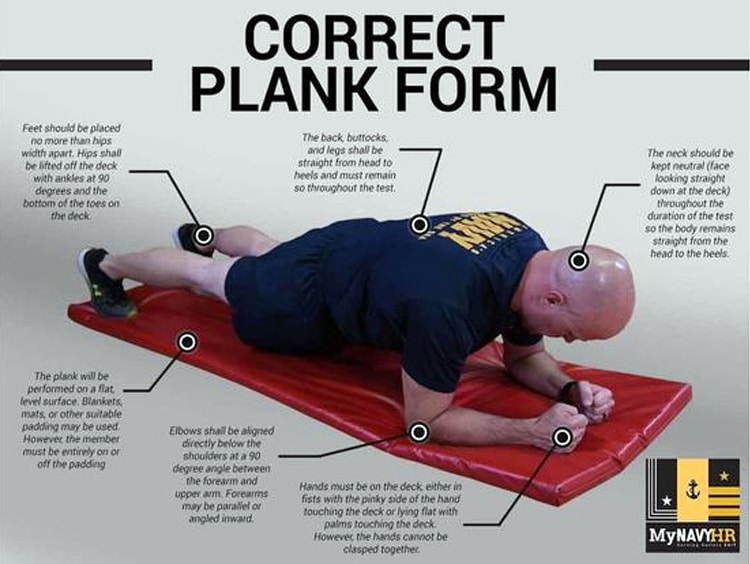
To perform a plank to Navy PT standards:
Lie on the floor and rest on your forearms so that your elbows are below your shoulders and your forearms are parallel. Elbows must be bent to 90 degrees.
Position your feet so they are no more than hip-width apart.
Raise your hips so your body is straight. Look down at the floor so your neck is neutral.
You can perform your plank on a mat, but your arms and feet must be on it, not just your upper body or feet.
Hold this position for as long as possible, but do not hold your breath.
2. Push-ups in Two Minutes
Push-ups develop and test upper body strength and endurance. They mostly work the chest, arms, and shoulders. However, they also involve the core and, to a lesser degree, the legs. For the Navy PRT, participants must complete as many push-ups as possible in two minutes.
Sailors must perform their push-ups using strict form:
Adopt the high plank position with arms, legs, and body straight. Hands should be roughly shoulder-width apart.
Bend your arms and lower your chest to within an inch of the floor. Your body must remain straight and move as a single unit. Arms are generally kept close to the body.
Extend your arms fully and repeat.
You can rest with your arms straight, but the test is over if you lie on the floor.
Perform as many reps as possible in two minutes.
3. Cardio Test
The Navy PRT assesses cardio fitness in one of several ways. Depending on the space and facilities available, sailors are expected to complete one of the following:
5-mile run
500-yard swim
400-meter swim
2-kilometer row
While the run is the preferable and most common cardio test for the PRT, the other assessments may be used if appropriate, e.g., rowing while deployed at sea.
How to Use the Navy PRT Calculator
The Navy Physical Readiness Test (PRT) calculator is very straightforward to use. Just follow these step-by-step instructions to see how your fitness compares to sailors in your age bracket.
Select your gender, choosing between male or female.
Enter your age in years.
Hold a plank for as long as possible, and then enter your result in minutes and seconds.
Perform as many strict push-ups as possible in two minutes and then enter your results.
Choose and perform your cardio test, choosing between running, swimming, and rowing, and then enter your time.
Hit “Calculate.”
Interpreting your Results
The Navy Physical Readiness Test (PRT) calculator compares your performance in the three assessments to the standard tables for your age and gender. Younger participants are expected to perform better than older participants, and the standards for women are lower than those for men.
Each discipline has a maximum score of 100, and the highest total score for the Navy PRT is 300. Pass scores depend on age and gender.
After entering your results, you will receive the following:
Your PRT Score
Your performance level
Your forearm plank result and level
Your push-up result and level
Your cardio result and level
To pass out of basic training, a sailor must achieve an overall category of “good (low),” meaning their average across the three tests must be 60 points or greater.
However, after basic training, sailors only need to reach the “satisfactory (medium)” category or above to pass their annual PRT, so they need an average score of at least 50.
Scores below 50 put you into the probationary category, meaning you must improve your performance in your next test. You may also face disciplinary proceedings or even be discharged from the Navy if you fail to meet the required standard.
Category
Level
Points
Outstanding
High
100
Outstanding
Medium
95
Outstanding
Low
90
Excellent
High
85
Excellent
Medium
80
Excellent
Low
75
Good
High
70
Good
Medium
65
Good
Low
60
Satisfactory
High
55
Satisfactory
Medium
50
Probationary
45
How to Improve Your Navy PRT Score
Do you want to improve your Navy PRT score? These are the strategies you should use!
Forearm Planks
Forearm planks develop and test core strength and endurance. Core is the collective term for the muscles that comprise your midsection, including the rectus abdominis, obliques, and transverse abdominis.
The best way to get better at planks is to do plenty of planking. Start doing planks 2-3 times a week, working on gradually increasing the length of time you spend doing them.
For example:
Week 1 – three sets of 30 seconds
Week 2 – three sets of 40 seconds
Week 3 – three sets of 50 seconds
Week 4 – three sets of 60 seconds
Week 5 – four sets of 60 seconds
Week 6 – four sets of 65 seconds
Week 7 – four sets of 70 seconds, etc.
You can also more challenging types of plank to overload and develop your muscles while adding variety to your workouts. Good options include:
Push-Ups
Arguably the best way to get better at push-ups is to do lots of push-ups. While that might sound confusing or even impossible, it’s not. Push-ups are a skill, and the more proficient you are, the more reps you’ll be able to do in less time. Achieving this requires practice.
Grease the groove, known as GTG for short, involves doing lots of submaximal sets of push-ups spread throughout your day. While none of these sets are too taxing, they help you a) perfect your technique and b) develop the neural pathways that allow you to engage your muscles as effectively as possible.
The result? You could double your push-up max in as little as 30 days!
To do GTG push-ups, simply pump out lots of sets of your current single-set maximum. So, if you can currently do 20 reps in one go, do just 10 reps at a time. Make sure each rep is clean and performed with complete control. Take pride in how perfectly you do your push-ups!
Try accumulating up to ten sets per day, each separated by an hour or so. Do this 5 to 6 days a week for a month, and you’ll CRUSH the Navy PRT push-up standard.
Other ways to increase your push-up numbers include:
All these exercises are more challenging than conventional push-ups, so when you do the regular version, they should feel much easier than usual.
Cardio
Passing the Navy PRT cardio assessment requires an above-average level of aerobic fitness. The best way to develop this fitness is to do plenty of the cardio activity that you will be assessed on.
So, if you are going to run 1.5 miles, you need to do frequent running workouts. But, if you are going to be assessed via swimming or rowing, then those are the activities you should focus on.
Regardless of the cardio modality, you should include the following types of training in your workouts:
Over-distance training – build up to doing at least 50% more than the test distance. So, if you are going to do the 1.5-mile run test, make sure you can run at least 2.25 miles fairly comfortably. Similarly, suppose you are doing the two-kilometer row test. In that case, you should have no problem rowing three kilometers, albeit at a reduced speed.
Speed intervals – this workout involves going faster than your expected test pace. Break the assessment distance down into 3-4 sets and do each one more quickly than your usual speed. Rest for 2-3 minutes and repeat. This will get you used to working at a higher level of intensity and will make the pace on test day feel more manageable.
Time trials – a time trial is a mock race and should help get you used to the demands of your Navy PRT cardio assessment. You should know in advance whether you are being assessed by running, rowing, or swimming. Practice that discipline over the test distance, working on gradually decreasing your time.
Do each of these workouts once per week on non-consecutive days.
Navy PRT Calculator FAQ
1. What is the best way to warm up for the Navy PRT?
Warming up before your Navy PRT will ensure that you can perform at your best while reducing your risk of injury.
To warm up for the Navy PRT:
Go for an easy 5 to 10-minute jog
Do some dynamic mobility and flexibility exercises for your main muscles and joints
Do a couple of sub-maximal sets of push-ups and planks for practice
Do a few short bouts of fast running, rowing, or swimming, e.g., 30 to 60-seconds
You should now feel warm-up and ready to kick butt during your Navy PRT.
2. How often should I do the Navy PRT?
The Navy PRT is typically administered annually, but there is no reason you can’t do it more often if you wish. However, your score won’t improve much if you do the test too often, so limit yourself to performing the PRT once every 1-3 months. Doing the PRT more frequently than this could lead to overtraining, probably making your scores worse instead of better.
3. Can I do the 1.5-mile run on a treadmill?
Sailors based on land usually do the 1.5-mile test on the roads on and around their base. However, when deployed at sea, they may use a treadmill instead. Ideally, you should train using use the modality on which you will be tested. So, if you know your next PRT will happen while you are on ship, you should practice on a treadmill. That way, you’ll be as prepared as possible for the test.
However, if you are only doing the Navy PRT for your own interest, i.e., you are not a serving sailor, there is nothing wrong with using a treadmill if that’s what you prefer it.
4. Are there any other fitness tests that Navy personnel have to pass?
In addition to passing the Navy PRT, sailors must also be below a specific body fat percentage to be considered fit for duty:
Age 18 to 21 – 22% for males, 33% for females
Age 22 to 29 – 23% for males, 34% for females
Age 30 to 39 – 24% for males, 35% for females
Age over 40 – 26% for males, 36% for females
You can read more about the US Navy Body Fat Calculator in this article.
Navy PRT Calculator – Wrapping Up
The Navy Physical Requirement Test (PRT) is the basic fitness assessment of the United States Navy. All sailors are expected to pass it at least once per year, and performance standards are adjusted according to age and gender.
The PRT assesses upper body and core strength and cardiovascular fitness. However, it’s not as comprehensive or demanding as some other military fitness tests. Still, the Navy life tends to be less strenuous than, say, the Army, whose biannual fitness tests are a little more demanding.
Take the PRT to see how your fitness stacks up against the sailors of the US Navy.
Lee Priest Critical of 2023 Masters Olympia Being Age 40 & Over: ‘To Me Masters is 50+’
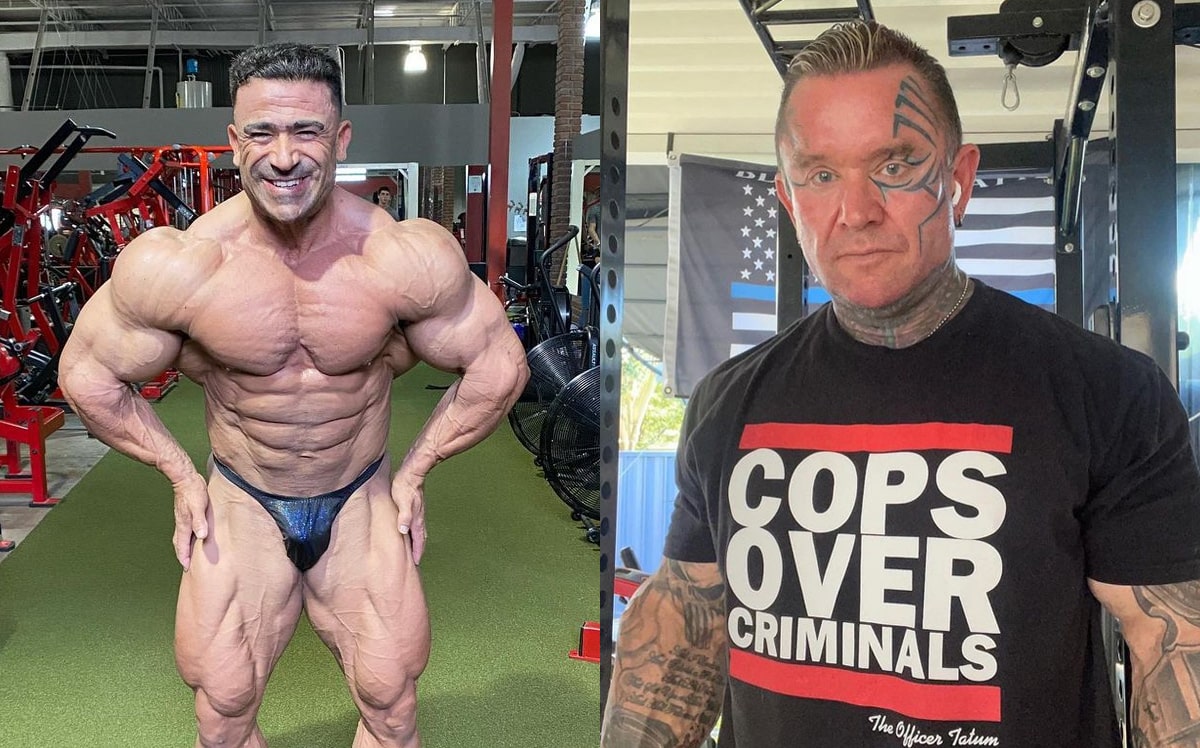
Australian bodybuilder Lee Priest is celebrated for his longevity with over two decades of competitive experience. In a RxMuscle YouTube video, Priest called for changes to the eligibility criteria for the 2023 Masters Olympia by changing the age cap to 50 and over.
The Masters Olympia competition was started by former Olympia president Joe Weider in 1994. He created the event to provide a platform for older bodybuilders past their prime who still love to compete. Dexter ‘The Blade’ Jackson was the last man to win the Masters Olympia title when the show returned in 2012.
Jake Wood confirmed the contest would make a comeback this season after an 11-year break. The weekend of August 25 was announced as the official date for the three-day event scheduled to be hosted in Cluj Napoca, Romania. It is set to feature 10 divisions from the IFBB Pro League.
Some had mixed feelings about the event’s return. Renowned bodybuilding guru Milos Sarcev expressed his concerns about athletes’ risking their health by overusing steroids at an older age in preparation for the competition.
Bodybuilding veteran Lee Priest indicated his desire to compete at the show but ruled out his participation due to chest atrophy earlier this year. He speculated about the potential contenders and favored the chances of Victor Martinez to take the title if Dexter Jackson and four-time Mr. Ollympia Jay Cutler did not compete.
Two months ago, Martinez opened up about his ambitions to compete at the Masters Olympia. However, made it clear he wasn’t interested in the risks unless the prize money stood at $250,000. In the end, the organizers declared the overall prize money for the show at $229,000 days later.
Former 212 Olympia champ Kamal Elgargni was considering making his way to Romania for the event if the prize money was fit for his needs. And sure enough, the Masters Olympia roster was released and Kamal Elgargni will fight for the Open title in August.
Japanese bodybuilder Hidetada Yamagishi will come out of retirement to contend for the title at the age of 50 in the 212 division. Last week, he made headlines for a ripped physique update where he showed off his insane conditioning levels 18 weeks out.
Lee Priest calls for Masters Olympia to be over 50 & talks about top contenders
In a recent YouTube video, Lee Priest shared his thoughts on the upcoming 2023 Masters Olympia with Dave Palumbo. He called on the organizers to raise the age ceiling to 50.
“I’m still upset though it’s 40 and over,” said Priest. “To me, Masters should be 50 above and you haven’t competed for at least 2 or 3 years. Seeing that $229,000, $9,000 goes to the Masters.”
Priest and Palumbo gave their takes on the competitors and highlighted some missing names.
“A lot of these guys I don’t even know who they are,” said Palumbo. “I see Fred Biggie Smalls is on the list, he’s making a comeback. You’ll probably see some guy who we don’t even expect to do well probably win it. Someone who won the Masters Nationals at 40 years old, never competed their whole life, fresh-looking muscle.”
“Victor Martinez could do it and still do very well,” said Priest.
Palumbo responded, “I don’t know why he isn’t competing. He should. It’s actually a pretty weak lineup when you consider it’s only 40 and over. There are guys actively competing who are 40.
“I’d love to see Phil Heath do the show or Kai Greene.”
They believe Elgargni is the frontrunner to win the event.
“Kamal, who’s probably the highest rated guy in the lineup,” said Palumbo.
“I think Kamal is going to be very hard to beat just because he hasn’t been out of the sport. He’s been competing consistently. It’s going to be hard for guys that haven’t competed in a bunch of years to come back and look that great, especially at that age.”
On April 25, Cutler and IFBB head judge Steve Weinberger announced the full lineups for each division of the 2023 Masters Olympia with Elgargni, Maxx Charles, and Phillip Clahar entering as favorites in the Men’s Open division.
RELATED: 52-yo Johnnie Jackson Teases 2023 Masters Olympia Comeback: ‘I’m Leaning Towards Yes’
The show will offer fans an opportunity to see some of their favorite bodybuilders of the past take to the stage once again.
You can watch the full video below.
Published: 28 April, 2023 | 12:02 AM EDT
Lou Ferrigno Guides Joe Manganiello Through Exhausting ‘Hulk’ Chest Workout
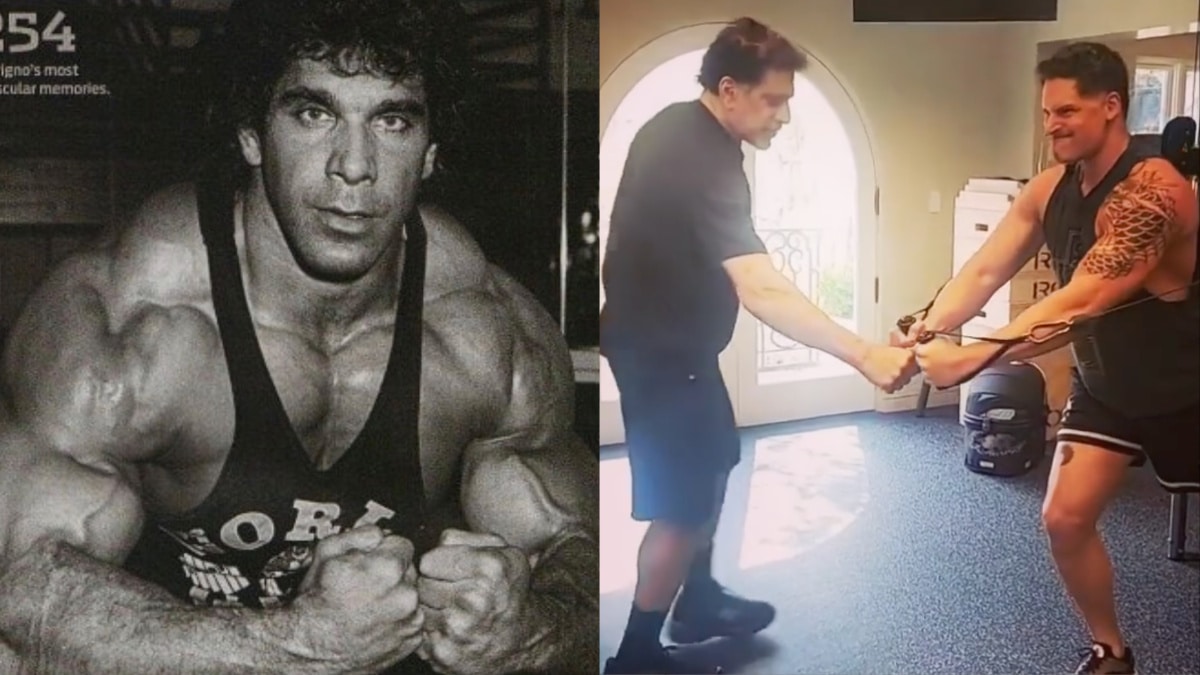
Bodybuilder Lou Ferrigno is renowned for his depiction of the Marvel superhero Hulk in addition to his work as an athlete. In a recent post made on Instagram, Hollywood star Joe Manganiello crushed a chest workout under the guidance of Ferrigno. Lou Ferrigno first gained attention after winning the IFBB Mr. America title as a…
“There Are No Rules in Bodybuilding”: Iain Valliere Gives Hot Take on Steroids & Synthol
Iain Valliere‘s progress is on track for his next appearance at the 2023 Toronto Pro Supershow this June. In a recent Bro Chat podcast with Fouad Abiad, Valliere talked about his current season and the use of steroids and site enhancement oils like Synthol in bodybuilding.
As a Men’s Open pro, Valliere quickly earned the respect of his peers with popping muscle hardness and granite conditioning. Last year, he earned his invitation to the Mr. Olympia contest by defeating popular Open class standout Antoine Vaillant at the Vancouver Pro.
Tipping the scales at over 280 pounds, Iain Valliere brought his best package possible to Las Vegas. However, the 2022 Olympia lineup proved challenging as the Canadian native dropped out of the first callout in 11th place. Meanwhile, Hadi Choopan won gold with Nick Walker and Derek Lunsford earning silver and bronze, respectively.
After his lackluster Olympia bid, Iain Valliere began working with coach Matt Jansen again, who also trains Walker, Charles Griffen, Shaun Clarida, Quinton Eriya, and many other top-tier pros. Setting his sights on a 2023 Mr. Olympia invitation, Valliere sat down to discuss his future. In addition, he debated the role of gear and synthol use in bodybuilding.
Iain Valliere Talks Prep for Toronto Pro Supershow: “I’m in a Good Spot”
Valliere says his preparations are on schedule and believes he’s in a ‘good spot’ leading up to his next show.
“Yeah, [everything is going good in prep]. Physically, no I feel good. No, I’m not ahead [in prep] I’m right in a good spot and I think that’s good for me. I think to be too ahead is like sometimes like the wheels come off with that, I think we have a good base and I think I’m holding a lot of really good size, which I’m really happy with. I’ve had literally almost – in most of my lifts – I’m still progressing in my lifts. I’ve had no drop-off in strength and I haven’t had to reduce volume yet. So, it’s not like I reduce volume to maintain that, it’s still getting progressions in training so yeah, I feel like I’m in a good spot.”
“It’s small things [with new trainer Matt Jansen] I talked about this once, from the diet perspective, my protein intake is definitely a lot higher which it definitely does make you look different. I don’t know what the look difference will be on stage but I definitely look different, I don’t know how to describe it,” said Iain Valliere.
According to Valliere, his schedule hasn’t drastically changed despite rejoining Matt Jansen. He shared that his prep drugs haven’t been altered either but he expects new modifications the closer they get to a contest.
“I just do what’s written,” added Iain Valliere. “Look, he says eat food, and that’s what I do. Either way, yeah, right now, that’s really all the differences you can notice at this point. Small differences in the diet and stuff like that. I’m doing cardio like I was always doing cardio. Our prep drugs are kind of always the same. You get to the level and you might change a dose by a little bit or use a different this or that, but it’s all pretty much the same shit.”
Valliere Talks Using Steroids for Fat Loss & Synthol in Bodybuilding: ‘25% of Guys Use It’
Valliere said most anabolic compounds have fat-burning properties but they can’t substitute training and dieting.
“They [drugs] can aid in fat loss but you really couldn’t just take drugs and get rid of fat like that, you’re still going to have to push the diet and cardio.”
“I’ve never used DMP but you feel terrible on DMP,” added Valliere. “Look obviously anabolics – a good chunk of the anabolics you use have good fat-burning properties but like you said, it’s not enough to outweigh what you eat.”
Iain Valliere disagrees with the use of Synthol and site enhancement oils. However, he specified that it’s a useful tool for adding volume to the biceps and other smaller body parts.
“This is always such a hard question, people ask me this on my Q&A all the time, they ask questions like, ‘What do you think the average amount of drugs is for a pro, or how many pros do you think use SEOs?’ I have no fuc**ng idea, there’s a range you know,” Valliere shared. “I don’t think SEO use is talked about [the same] as gear use or gear dosages. It’s a little more hush-hush, but it’s so hard to say, also how would we know, like you said, how many pros use SEO? Like, I don’t know.”
“It’s good for the arms,” Valliere explained. “I think the thing is like, if you don’t notice, it doesn’t matter. I think we only notice the ones that look bad and then it gives it a bad name. So then people are like, this is what it is and what it looks like. Look, as a whole, I think we should disagree with the use of it but I bet you there’s some amazing bodybuilders [that use it].”
After comparing gear and Synthol use, Valliere highlighted that there are no rules in bodybuilding. Moreover, he suggested all athletes use ‘fake bullshi*’ to enhance their physiques.
“I don’t care but I’m saying as a whole if we just – if it didn’t exist, it would not make the sport worse. I wouldn’t care. So, I care. That would be wrong. I don’t disagree with it because I don’t give a fuc* what everybody else does in bodybuilding. If it’s making you look better, there’s no rules in bodybuilding. It’s not like steroids are okay but SEOs aren’t. It’s all fake bullshit we’re doing to enhance ourselves anyway. But I think if you’re doing it and it’s obvious then I think it should definitely be detracted in a judging capacity.”
“I don’t fuc**ng know [if it’s used a lot],” Valliere said. “I would think guys using a little metformin in their arms is probably like 20-25% of guys, who have maybe used it here or there. Do I think it’s rampant? No.”
Plenty of bodybuilders have been suspected of using site enhancement oils. Last year, reigning Mr. Olympia Hadi Choopan’s ex-managers accused him of shooting the substance into his shoulders. Bodybuilding veteran Samir Bannout ripped Valliere recently for allegedly using Synthol in his calves at the last Mr. Olympia.
RELATED: Bodybuilding Veteran Chris Cormier Warns Others of Synthol Use: ‘I Actually Used It in My Calves, The Damage is Real’
Steroids and site enhancement oil use remain controversial topics in the sport of bodybuilding. The last athlete to approach the subject was Chris Cormier, who underlined that using Synthol/implants in any capacity is a form of cheating.
Check out the full video below:
Published: 27 April, 2023 | 6:06 PM EDT
Rep Range Calculator
Do you want to optimize your workouts and get the best results? We’ve got the perfect tool for you! Our Rep Range Calculator, developed with the help of our certified fitness expert team, will help you find the perfect rep ranges and weights for your specific training goals. This simple yet effective calculator can be…